


The March 3 total lunar eclipse has been and gone, astounding skywatchers around the world with a breathtaking display of orbital mechanics as the lunar disk plunged into Earth’s umbral shadow, transforming it into a crimson-hued blood moon.
A total lunar eclipse occurs as Earth passes between the moon and the sun during a full moon phase. No direct sunlight can reach the lunar surface during totality, as the lunar disk passes through the deepest part of our planet’s shadow, known as its umbra. Instead, the moon is doused in sunlight that has been filtered by Earth’s atmosphere — which is adept at scattering blue light while allowing longer redder wavelengths to pass relatively unhindered — causing it to turn a rusty, blood red color.
Read on to see a selection of mesmerizing images of the March 3 blood moon and don’t forget to check out our total lunar eclipse live blog if you’re looking for a recap of yesterday’s spectacular event.
Spectacular photos of the total lunar eclipse 2026
Our first photo of the eclipsed moon was captured by Phil Walter as it hung in the skies over Auckland, New Zealand, as Earth’s shadow began its tentative creep over the western edge of the lunar disk during the partial phase. Remember: Images of the moon captured from the southern hemisphere appear “upside down” compared to what northern hemisphere viewers are used to seeing, while shots taken near the equator are more likely to show the moon resting on its side.

Ted Aljibe took another striking image of the lunar disk as it glowed orange over the city of Manila in the Philippines. Its striking color here isn’t a result of the eclipse, but rather the lunar disk’s proximity to the horizon in the period directly following moonrise, when its reflected sunlight has to make a prolonged journey through Earth’s atmosphere, which scatters blue light.

That same moon was spotted just a few minutes later from Beijing, China, by photographer Fred Lee. The lunar sea Mare Crisium (the Sea of Crisis) is just visible as a dark circular feature at the top of the sunlit lunar disk, where lava flooded a network of impact craters over a billion years ago, before hardening into a vast basaltic plain.

Lee also snapped a wide-angle shot of the moon as direct sunlight illuminated a thin crescent of its outer disk, mere minutes before the onset of totality, as the Beijing skyline stretched out below, pouring light into the night sky. Sunlight refracted through Earth’s atmosphere can already be seen softly illuminating the shadowed part of the lunar disk, making lunar maria visible to the naked eye.

The moon took on a foreboding crimson hue as it slipped into the deepest part of Earth’s umbral shadow. Tayfun Coskun captured the lunar disk soon after the period of totality began, documenting the deep orange-red hue of its surface. A patch of bluish light can also be spotted on the lower edge of the lunar disk. This fleeting phenomenon, sometimes known as the “turquoise band,” occurs when red light is scattered by the ozone layer in Earth’s upper atmosphere, which allows the blue wavelengths of light through to bend onto the lunar surface, according to Time and Date.

Ezra Acayan snapped a glorious photo of the blood moon as it glowed through a gap in the clouds over the city of Santa Rosa in the Philippines, as faint stars fought for attention close by.

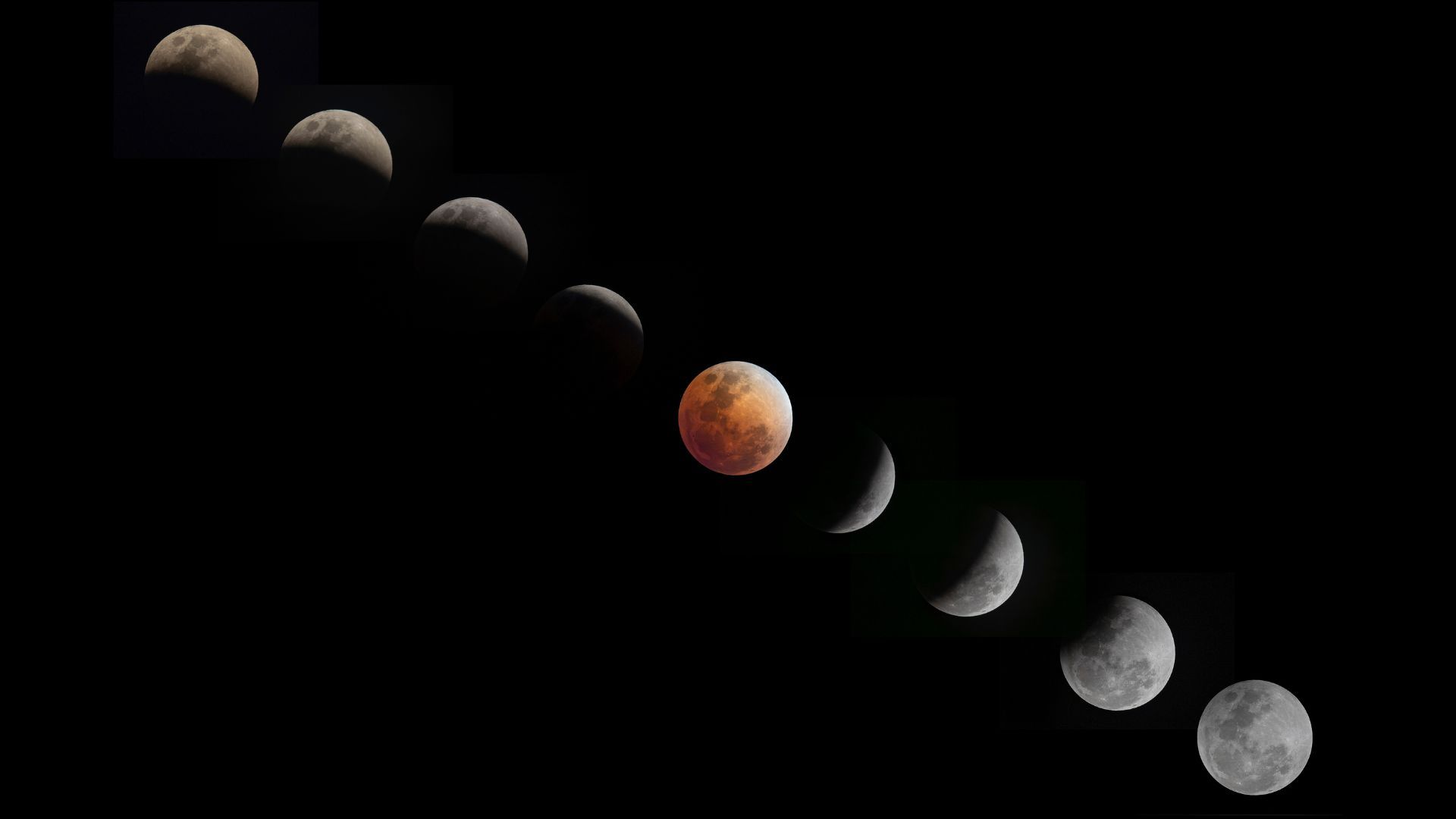
Acayan combined several images into a stunning composite view, revealing the sweeping progress of Earth’s shadow in impressive detail during the partial and total phases of the blood moon eclipse.

Astrophotographer Keith Odendahl took a beautifully detailed image of the fully-eclipsed moon as it glowed in the sky over the city of Price in Utah. Bright streaks known as ejecta rays can be seen streaking away from young impact craters in Odendahl’s photo, whose existence testifies to the incredible force unleashed in their creation.

Trần Hữu Thịnh captured another beautiful composite view of the total and waning partial phases of the blood moon eclipse as they unfolded over Ho Chi Minh City in Vietnam on March 3, soon after sunset for that part of the world.

Tang Chhin, meanwhile, took a photo of the waning partial phase of the eclipse, as Earth’s curved shadow slipped from the lunar disk, revealing the ancient lava plains of Mare Imbrium, Procellarum, Nubium and Humorum. The 51-mile (82-kilometer) expanse of the Tycho impact crater can also be seen, dominating the brighter right side of the lunar portrait.

Finally, Lauren DeCicca captured this gorgeous image of the uneclipsed lunar disk from Chiang Mai, Thailand on March 3.

With the March blood moon in the rearview mirror, you’ll have to wait until New Year’s Eve 2028 for the next total lunar eclipse. Thankfully, there’s still plenty more eclipse action to come this year, including a spectacular total solar eclipse on Aug. 12, which will see the path of totality fall across Greenland, Iceland and Spain as the lunar disk completely blocks out the face of our parent star.
Hoping to catch a glimpse of the Aug. 12 total solar eclipse? Then you’re going to need to pick up a pair of quality eclipse glasses to protect your eyes, such as the model listed above, or if you want a closer look, you could opt for a set of specialized sunoculars.
Editor’s Note: If you would like to share your astrophotography with Space.com’s readers, then please send your photo(s), comments, and your name and location to spacephotos@space.com.