Conny Waters – AncientPages.com – Archaeologists working in the Chicama Valley, located in Peru’s La Libertad region, have recently made significant discoveries that shed new light on the Chimú civilization. The research team uncovered a previously unknown geoglyph and a temple, and systematically documented an extensive network of interconnected agricultural and ceremonial structures. All these features were constructed by the Chimú society, also known as the Kingdom of Chimor.

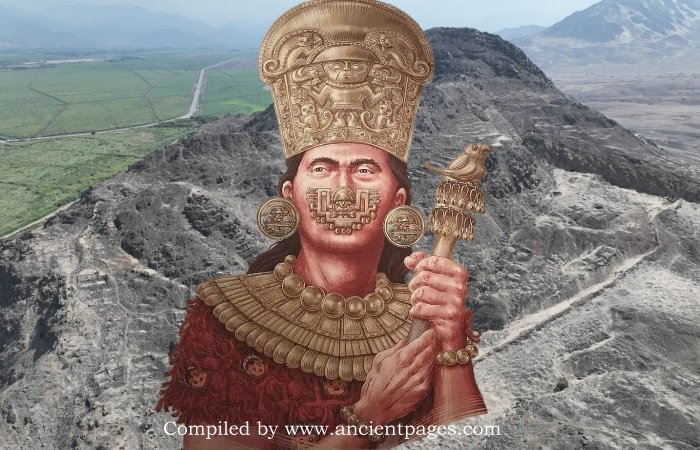
Background: The cerebral complex found in the Chicama Valley. Credit: Chicama Archaeological Program. Front: Modern Representation of King Minchancaman of the Chimú Civilization. Credit: Petroperu S.A. – CC BY 4.0. Image compilation by AncientPages.com
The Large And Thriving Chimú Civilization
The Chimú civilization thrived on Peru’s northern coast between the 12th and 15th centuries CE. With their capital at Chan Chan, they became the largest and most prosperous culture during the Late Intermediate Period and established what is considered the second-largest empire in ancient Andean history. Their success was largely attributed to advanced agricultural techniques, including an elaborate canal-based irrigation system.
According to archaeologist Henry Tantaleán, co-director of the Chicama Archaeological Program, these new findings greatly enhance our understanding of territorial planning, productive capacity, and ritual practices within this pre-Hispanic culture.

Credit: Chicama Archaeological Program.
The recent investigations focused on a previously unexplored area north of Quebrada del Oso near Chicama Pueblo. While this region had been recognized since studies in the 1970s and 1980s by scholars such as James Kus, Richard Keatinge, César Gálvez, and Jaime Deza Rivasplata among others—it had not been documented with today’s level of precision. Modern technologies, such as drones, now enable detailed digital records that provide unprecedented insights into this important archaeological landscape.
“In our ongoing systematic investigation of the valley, we have explored a new sector. We are particularly interested in the agricultural fields, as they are often affected by modern activities such as poultry farming and infrastructure projects,” Henry Tantaleán told the Andina News Agency.
What Can We Learn From The New Chimú Geoglyph?
The co-director of the Chicama Archaeological Program stated that a geoglyph, although previously known, had not been directly associated with the Chimú society until now. According to an archaeologist from San Marcos University, this geoglyph serves as a ritual pathway connecting the fortified settlement of Cerro Lescano with nearby agricultural fields and extends in a straight line toward Cerro Tres Cruces. Researchers highlight this as the first clear instance in which a Chimú settlement is linked to other landscape features via a ritual path or geoglyph.

Credit: Chicama Archaeological Program.
The structure spans at least two kilometers and crosses ancient ravines while maintaining consistent alignment—an approach reminiscent of the famous Nazca Lines in Ica. The geoglyph consists of stone accumulations arranged to form an unbroken line visible across the landscape.
Archaeologist Tantaleán suggests that this geoglyph may have symbolically united two important natural landmarks—Cerro Lescano and Cerro Tres Cruces—which could have served as local apus, or sacred mountains, within Andean cosmology.
“We are looking at one of the most extensive agricultural landscapes known to the Chimú world and systematically recorded,” the archaeologist emphasized.

Credit: Chicama Archaeological Program.
At the nearby Quebrada del Oso site, researchers have identified approximately 60 hectares of cultivated fields. In comparison, the Pampas de Lescano sector features an estimated 100 hectares of agricultural furrows displaying a range of configurations, such as serpentine and comb-shaped patterns. These findings suggest a high level of productive activity in the area. According to Henry Tantaleán, this discovery significantly raises previous estimates regarding the agricultural capacity of the Chimú society in this region.
Temple And Ceremonial Plaza
The complex features a quadrangular stone platform measuring approximately 40 by 50 meters and standing between two and three meters high, oriented to the north—a common trait in Chimú architecture.

Credit: Chicama Archaeological Program.
In front of this platform lies a large rectangular plaza, roughly 100 by 80 meters. Classic Chimú pottery has been discovered on the surface of both the fortified settlement and the ceremonial platform. These findings indicate that the main period of occupation occurred between 1100 and 1470 AD, with possible continued use during the subsequent Inca occupation.
“It is a temple that could have gathered a large number of people. Considering the magnitude of the agricultural fields, it is logical to think that the elites who managed this production organized rituals linked to the agricultural cycles,” the archaeologist explained.
To identify the crops that were cultivated, the team conducted small-scale excavations in agricultural fields and collected soil samples for phytolith and pollen analysis. These samples will be processed in the laboratory to provide detailed information about past crop production.
According to an archaeologist from San Marcos, earlier studies suggest that corn, squash, and beans were likely grown in this area. However, the current analyses will offer scientific confirmation of these findings. Additionally, stone agricultural tools such as hoes—used for plowing—have also been discovered at the site.

Credit: Chicama Archaeological Program.
One of the most important findings from the discovery is the evidence of integrated territorial planning. Tantaleán explains that the geoglyph indicates agricultural production was managed not only through political authority, but also through ritual practices. Tantaleán notes that during the Chimú era, religion, economics, production, and politics were interconnected to mobilize labor. The geoglyph served as more than just a route; it functioned as a ritual path linking agricultural areas with ceremonial spaces.
Preserving Heritage Is Crucial Because It Faces A Variety Of Threats
The archaeologist has highlighted that the site is currently exposed to considerable risks. The development of high-voltage power lines, the construction of service roads, and the expansion of private activities are all affecting both the farmland and the geoglyph.
See also: More Archaeology News
“It’s almost like emergency archaeology. We’re trying to document everything as quickly as possible because no one can guarantee these remains will still be intact next week,” he warned.
The researcher concluded that this discovery broadens our understanding of the Chimú society and offers new evidence regarding the intricate connections between agricultural production, political power, and ritual practices on Peru’s northern coast.
Written by Conny Waters – AncientPages.com Staff Writer