

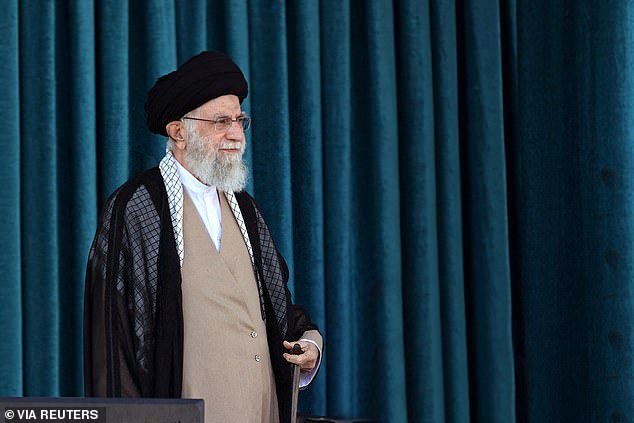
Iran’s Supreme Leader Ali Khamenei left behind a corrupt and repressive legacy, following his assassination on February 28.
Before his death, he was the longest-serving ruler in the Middle East, having taken power in 1989 following the death of his mentor Ruhollah Khomeini.
His 36 years and six months leading Iran resulted in the mass repression of women, the slaughter of civilians and the funding of terror groups including Hamas and Hezbollah.
But among the most wicked things he did was to amass a business empire worth an estimated $95billion by systematically seizing thousands of properties belonging to ordinary Iranians.
Khamenei’s business empire was held under Setad, a little-known organisation set up by Ruhollah Khomeini just before his death.
its full name in Persian is ‘Setad Ejraiye Farmane Hazrate Emam’ – Headquarters for Executing the Order of the Imam.
It was one of the keys to the now-dead Iranian leader’s power and holds stakes in nearly every sector of Iranian industry, including finance, oil, telecommunications, the production of birth-control pills and even ostrich farming.
A Reuters investigation in 2013 found Setad amassed a giant portfolio of real estate by claiming in Iranian courts, sometimes falsely, that the properties are abandoned.
The organisation holds a court-ordered monopoly on taking property in the name of the supreme leader, and regularly sells the seized properties at auction or seeks to extract payments from the original owners.
Under Khamenei, the organisation expanded its corporate holdings, buying stakes in dozens of Iranian companies, both private and public, with the stated goal of creating an Iranian conglomerate to boost the country’s economic growth.

Iran’s Supreme Leader Ayatollah Ali Khamenei (pictured) was killed on Saturday

Images appeared to show a huge fire ripping through a government building in Karaj, near Tehran on January 9
Setad’s total worth is difficult to pinpoint because of the secrecy of its accounts. Reuters estimated it at around $95billion, made up of about $52 billion in real estate and $43 billion in corporate holdings.
While there is no evidence that Khamenei used Setad to enrich himself, it did empower him. Through Setad, Khamenei had at his disposal financial resources whose value rivals the holdings of the shah, the Western-backed monarch who was overthrown in 1979.
As Iran’s top cleric, Khamenei had final say on all governmental matters. His purview included his nation’s controversial nuclear programme, a major reason for American and Israeli strikes on Iran that ultimately led to his assassination.
On top of the wealth accrued under Setad, Khamenei’s son Mojtaba has amassed a vast portfolio that includes mega-mansions in London, an exclusive villa in Dubai and several luxury European hotels.
A year-long investigation into the 56-year-old’s foreign investments has revealed the full eyewatering extent of his sprawling wealth – which touches Persian Gulf shipping, Swiss bank accounts and luxury property – as well as the complex network that has allowed him to evade western sanctions imposed on him in 2019.
According to the US Treasury Department, sanctions were imposed because he represented the Supreme Leader in ‘an official capacity despite never being elected or appointed to a government position’.
Mojtaba was found to have worked closely with the commander of the Islamic Revolutionary Guards Corps’ Quds Force, as well as be connected to the Basij, a religious militia affiliated with the Guards ‘to advance his father’s destabilising regional ambitions and oppressive domestic objectives’.
Over the last 20 years, Mojtaba has built close ties with the Guards, giving him added leverage across Iran’s political and security organisations.
According to research by Bloomberg, Mojtaba’s name never appears on the multiple assets he owns – which are acquired through a spider network of shell companies, middle men and bank accounts held in the UK, Switzerland, Lichtenstein and the United Arab Emirates (UAE), through deals that stretch back to 2011.

From mega-mansions in London and an exclusive villa in Dubai to several luxury European hotels, Mojtaba Khamenei (pictured, centre), the son of the Iranian Ayatollah has been quietly building a global property portfolio worth billions
The shell companies and intermediaries have been established across a wide geographical spread covering the UAE, Isle of Man, Saint Kitts and Nevis, and Europe.
In the UK alone, Mojtaba – considered to be one of the most powerful men in the Middle East and tipped by supporters to succeed his father – is said to own a string of more than a dozen mansions worth in excess of £100million, according to insiders.
His portfolio includes a house in The Bishops Avenue, dubbed London’s ‘Billionaires’ Row’, which was purchased for £33.7m in 2014.
In October, the businessman was placed under UK sanctions for ‘hostile activity’ that included allegedly financing Iran’s Islamic Revolutionary Guards.
The move could prompt Mojtaba and his associates to sell off the network’s European assets ahead of similar sanctions imposed by the EU, an expert in money laundering investigations told Bloomberg .
As for the funding of this substantial portfolio, Mojtaba is believed to have siphoned off profit from Iranian oil sales, before funnelling it through his opaque network to evade international sanctions aimed at curbing Tehran’s military and political operations.
The wealth accrued under the Khamenei name stands in stark contrast to the long-deteriorating economy of Iran, and the effect this had on its 93million people
On top of this, harsh measures the Ayatollah signed off on saw the massive repression of women, gay people and religious minorities.
On the world stage, Khamenei chose to invest heavily in the so-called Axis of Resistance, made up of Hamas in Gaza, Hezbollah in Lebanon, the Houthi movement in Yemen and a series of Islamic militant militias in Syria and Iraq.