Russia is flooding Europe with migrants sent through tunnels from Belarus into Poland as part of a hybrid war.
Thousands of migrants have been sent across Poland’s eastern frontier, as Putin ally Alexander Lukashenko is playing a strong role in attempting to destabilise the West.
Speaking to The Telegraph, Lt Col Katarzyna Zdanowicz from the Polish border force said that in 2025, officers uncovered four tunnels under the border with Belarus.
He added: ‘Physical and electronic security measures at the border, such as thermal imaging cameras and detection systems, allow us to immediately respond to any attempted violations of the state border, even underground ones.’
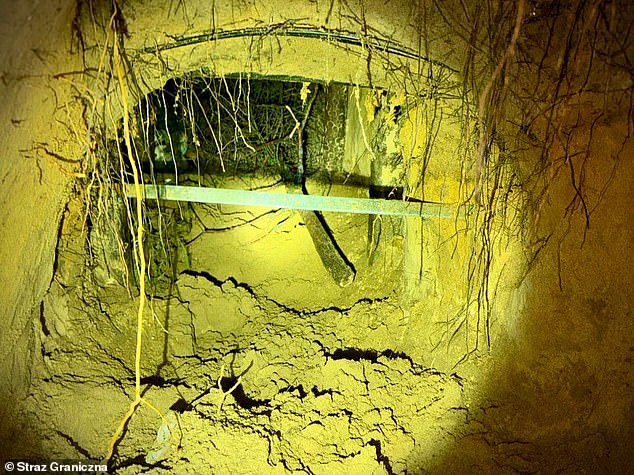
One of the biggest tunnels was found in mid-December near the village of Narewka in the eastern part of the country.
Polish authorities said the tunnel was 1.5 metres high, and the entrance was hidden in a Belarusian forest.
It reportedly measured about 50 metres on the Belarusian side and 10 metres in Poland.
A total of 180 migrants mainly from Pakistan and Afghanistan used the tunnel to cross the border, and the majority were arrested upon emergence.

Video footage released by the border guard showed a dark, narrow tunnel with enough space to crawl

A total of 180 migrants mainly from Pakistan and Afghanistan used the tunnel to cross the border, and the majority were arrested upon emergence
Video footage released by the border guard showed a dark, narrow tunnel with enough space to crawl. It is fixed with concrete struts to prevent it from collapsing.
The Belarusian dictator used specialists from the Middle East to design the tunnels, with Polish officials claiming these people had a ‘high level of expertise’.
Although it is difficult to prove which groups participated, it is thought that Islamic State, Hamas, Hezbollah and Kurdish fighters could be involved.
Military expert Dr Lynette Nusbacher said it was ‘plausible’ that Iranian-backed groups could be involved.
She explained that after the 2006 Lebanon war, cement workers were queuing up in southern Lebanon, adding: ‘We were seeing loads and loads of Iranian tunnel construction.’
She said: ‘We also have ample evidence of Hamas doing the same thing in Gaza. So if you want that deep tunnelling expertise, then the answer to your question is going to be with Middle Easterners.’

The Belarusian dictator used specialists from the Middle East to design the tunnels, with Polish officials claiming these people had a ‘high level of expertise’.

Even before the start of the war in 2022, Belarus was sending migrants over the Polish border
Former Israeli intelligence colonel Sarit Zehavi added: ‘Does Hezbollah or any Iranian proxies have this capability? Yes. Are they the only ones? No. Probably others also have the knowledge, from Kurdish militias in Syria to Isis.’
Poland said it can deal with the tunnels by tracking down entry points and blowing them up, however they are concerned that more entrances will pop up.
Meanwhile Czesław Mroczek, the deputy interior minister, said that the appearance of the tunnels actually means border force is good at its job.
Speaking in a recent interview on Polish radio, he said: ‘Digging these tunnels means that our effectiveness in stopping migration is so high that it was decided to bring in specialists from the Middle East to dig them.’
The discovery of the tunnels come as Russia and its allies have continuously tried to punish the West over its military support in Ukraine.
Even before the start of the war in 2022, Belarus was sending migrants over the Polish border, leading the country to build a massive 200km fence with 300 cameras.

Russian President Vladimir Putin shakes hands with his ally Belarusian President Alexander Lukashenko

Russia’s Oreshnik missile system is seen during a training in an undisclosed location in Belarus in December
Since the start of the invasion of Ukraine, Russia has also sabotaged factories and railways supplying aid to Ukraine as well as launched attacks on European airports.
Belarus has also been sending balloons with contraband such as bootleg cigarettes into nearby NATO countries to cause air traffic chaos.
They were initially being sent only to Lithuania, however Poland has said the balloons are now arriving to their country too.
Belarusian opposition leader Sviatlana Tsikhanouskaya recently said that Lukashenko’s regime was deepening Russia’s military footprint in Belarus and preparing for further escalation in the war in Ukraine.
Her comments came after Vladimir Putin deployed his so called ‘unstoppable’ Oreshnik missile system to Belarus.
‘We see how on Belarusian territory, Mr Lukashenko’s regime intensifies the presence of Russia. They are about to deploy nuclear weapons [to Belarus], Russian missiles,’ said Tsikhanouskaya.
‘So it looks like they’re preparing for escalation,’ she told The Telegraph.
Her warning comes after Russia’s defence ministry in December released footage it said showed a nuclear capable Oreshnik missile system being put on combat duty at an airbase in eastern Belarus.
Lukashenko, a staunch ally of Putin, said 10 Oreshnik systems would be stationed in the country.
The Oreshnik is an intermediate range, nuclear capable hypersonic ballistic missile system.
Experts say it can reach the UK within eight minutes. Although it can carry nuclear warheads, it has so far only been deployed with conventional payloads.
A deployment like this would drastically reduce the time it would take for Russia to strike into EU territory.
Analysts in the west interpreted the release of the footage as a show of power intended to intimidate Ukraine and its neighbours while signalling to a domestic audience that Russia was prepared to escalate further.

A part of Russian nuclear-capable hypersonic Oreshnik missile system at the site of the Russian missile strike in Lviv

A Russia’s Poseidon nuclear-powered underwater drone is seen being test-launched somewhere in Russia
Tsikhanouskaya said Ukrainian president Volodymyr Zelensky, whom she met recently, was aware of the risks posed by the build up in Belarus.
‘This escalation might affect not only Ukraine but also European countries. So we have to put more attention on what is happening in Belarus,’ she said.
She also warned that Belarus was playing a wider role in supporting Moscow’s war effort, estimating there were ‘about 300 Belarusian enterprises’ aiding Russia’s military production.
She said that Belarus’s fate was closely tied to that of Ukraine and that failure by the democratic world to help Kyiv win the war would embolden the Russian president.
‘If the democratic world will not help Ukrainians enough for them to win this war, it will embolden Putin and he will not stop where he is,’ she said, listing Moldova, Armenia and Georgia.
‘All the borders will become negotiable,’ she said. ‘And that’s why, if Ukraine will not win this war, we can forget about changes in Belarus for decades, because it will settle the status quo in our country.’