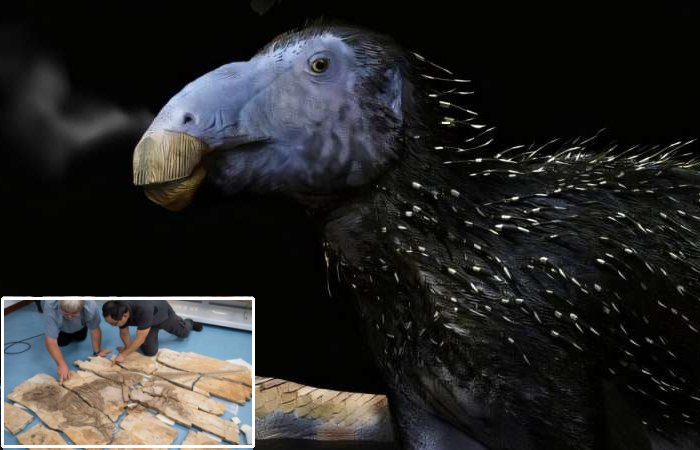
Eddie Gonzales Jr. – AncientPages.com – Documented for 200 years, the Iguanodontia group is expanding with the discovery of a brand-new species, the first known to bear spikes with properties never before observed in dinosaurs.
Scientists from the CNRS¹ and their international partners have uncovered in China the
fossilised skin of an exceptionally well-preserved juvenile iguanodon.

The authors of the study examining the fossil of Haolong dongi at the Anhui Geological Museum in Hefei, China. Image credit: Thierry Hubin
Using X-ray scans and high-resolution histological sections, the researchers observed skin cells preserved for 125 million years, revealing the structure of hollow, cutaneous spikes covering a large part of the animal’s body.
The scientists named this new species Haolong dongi in honor of Dong Zhiming, a pioneer of Chinese palaeontology.
This spiny dinosaur was herbivorous and lived under the predation pressure of small
carnivorous dinosaurs. Comparable in their deterrent function to those of porcupines, its
appendages represent a unique evolutionary innovation. They may also have played a role in
thermoregulation or sensory perception.

Artistic reconstruction of a juvenile Haolong dongi from the Early Cretaceous of China (125
million years ago). Image credit: Fabio Manucci
Until now, no evidence had testified to the existence of such spines in dinosaurs. As the
Haolong dongi specimen is juvenile, it remains to be determined whether these spines were
also present in adults. This unprecedented discovery will be published in Nature Ecology &
Evolution on February 6, 2026.
Source
Paper
Written by Eddie Gonzales Jr. –AncientPages.com – MessageToEagle.com Staff Writer