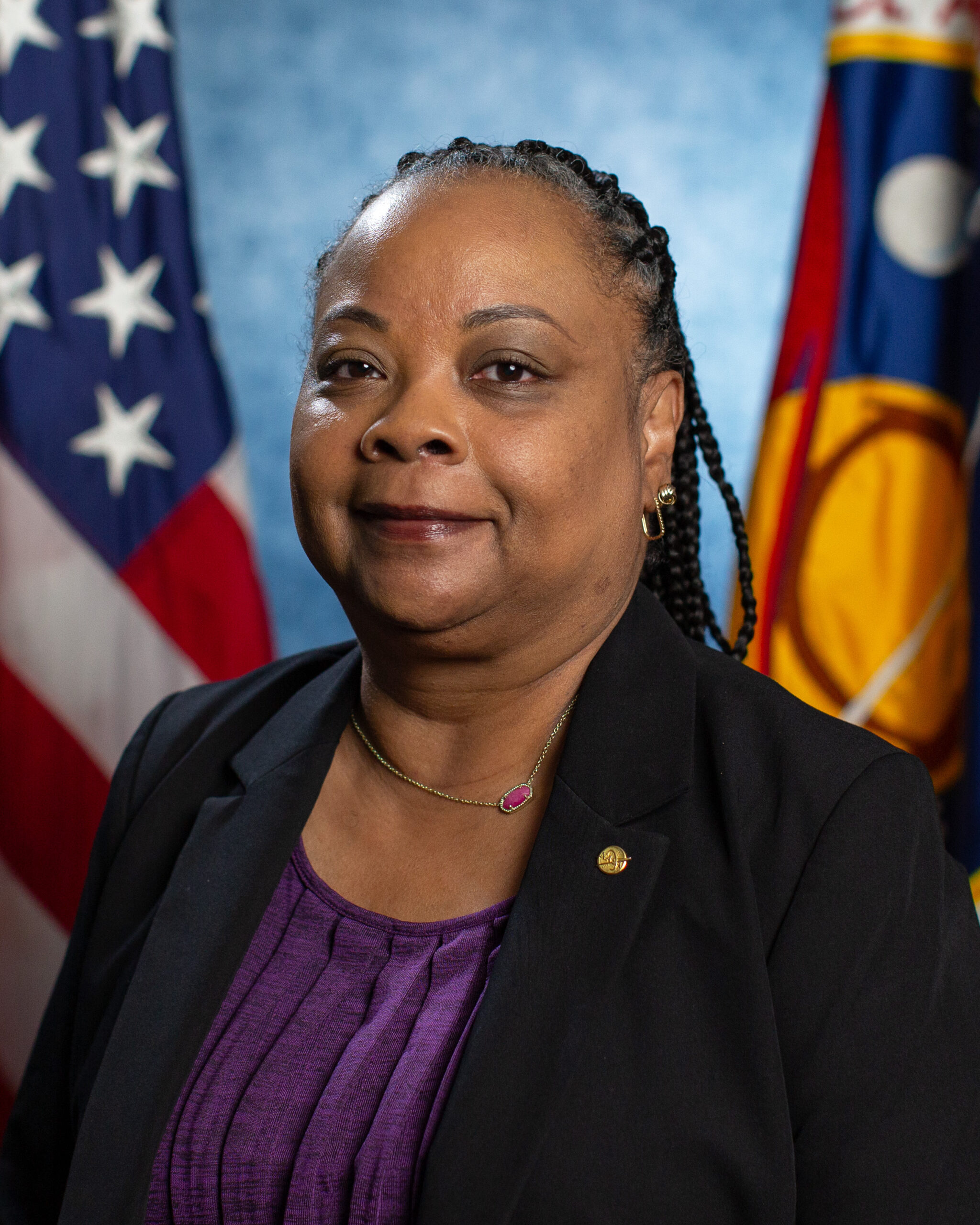
Safety and quality management are integral to every program at NASA’s Johnson Space Center in Houston, and across the entire agency. That gives team members like Regina Senegal, acting chief of the Safety and Mission Assurance Directorate’s (SMA) Quality and Flight Equipment Division, a unique opportunity to collaborate with diverse organizations and personnel.
“I’m responsible for managing safety and quality teams for about 13 customers,” Senegal said, noting that these customers include the Orion and Gateway Programs, the Human Landing System, and the Extravehicular Activity and Human Surface Mobility Program. Senegal’s teams work at several levels to implement agency, program, and center SMA requirements, in addition to assisting with monitoring Johnson’s Quality Management System to identify concerns for SMA leadership.
Some teams operate at the program level, helping to write program requirements, establishing assurance programs, and identifying and characterizing risk. Other teams work on a developmental level and focus on ensuring that a piece of hardware, software, and other components meet requirements and are safe. One team is dedicated to extravehicular activity, or EVA, operations, making sure that both crew members and equipment are prepared for safe and successful spacewalks. Senegal’s division is also responsible for calibration, safety, and quality for government-furnished equipment at Johnson, procurement quality, and the Receiving, Inspection and Test Facility.
“This division is probably the most diverse at Johnson because we do a multitude of things and have a multitude of disciplines,” Senegal said. “That’s why I enjoy it.”
Senegal was introduced to quality management as a manufacturing engineer for General Motors, where she worked for seven years before becoming a NASA contractor. She said it was always her goal to work at NASA, but there were no opportunities available at Johnson when she graduated from Prairie View A&M University with a degree in electrical and electronics engineering. “I just kept applying to anything that had to do with NASA, and then SAIC hired me,” she said. SAIC, or Science Applications International Corp., is a subcontractor of NASA.
Senegal has worked at Johnson for 28 years, becoming a civil servant in 2004. In that time, she has been involved in the development and implementation of space and life science experiments, the Human Research Facility, and crew exercise hardware, among other projects. She said her most memorable experience was working to transition crew health equipment from the Space Shuttle Program to the International Space Station. Senegal explained that while the hardware worked well on shuttle missions, it had to be redesigned to support longer missions and larger crews on station. She was not responsible for the redesign, but she had to ensure the equipment worked and was safe. “I really enjoyed that because it was a challenge, and you had all of these great ideas coming together from engineers, doctors, and the crew,” she said. “We became a strong, close team. Everyone was there trying to achieve the same goal.”
Her career in SMA has touched nearly every program at Johnson and some agency-level initiatives. Along the way, she has progressed from group lead to branch chief, deputy division chief, and now division chief—a role she calls her most challenging yet.
“As deputy, you manage parts of the business. As chief, you own it all—mission outcomes, safety posture, budget, culture, and external optics,” Senegal explains. Decisions once offered as advice now carry her endorsement and reputation. The shift means setting direction, allocating resources, and making tough calls, even when every request feels mission-critical. She also shapes how the division recruits, rotates, and grows talent, while tackling challenges like refreshing skill sets and building succession depth in critical disciplines.
In today’s evolving risk environment, Senegal must balance mission risk with project, program, and agency priorities, while keeping programs on schedule. “The chief’s message has to be clear, repeatable, and behavior-shaping,” she says. Building rhythms like staff syncs and risk reviews keeps the team aligned amid competing agendas.
Looking ahead, Senegal sees the team focusing on supporting NASA’s acquisition strategy and improving the speed and quality of organizational decision-making. “We need to define when issues go to the chief, deputy, or branch chiefs—and protect strategic time by saying ‘no’ when ‘yes’ isn’t the right answer.” Her leadership philosophy centers on connection: “Know your team’s strengths and care about them—even small gestures matter,” she says. “When people know you care, it makes coming to work easier.”
Senegal emphasized the importance of sharing SMA lessons learned with early career team members and future agency employees. “They need to know the safety and quality policies, but they also need to understand why we have them in place,” she said. “If you teach them the history behind it, they’re less likely to repeat it, and it helps them understand how and when to accept risk.”
Senegal also encourages the next generation to ask people for their opinions. “Be honest if you don’t know something and say you want to learn more. Never be afraid to speak up.”