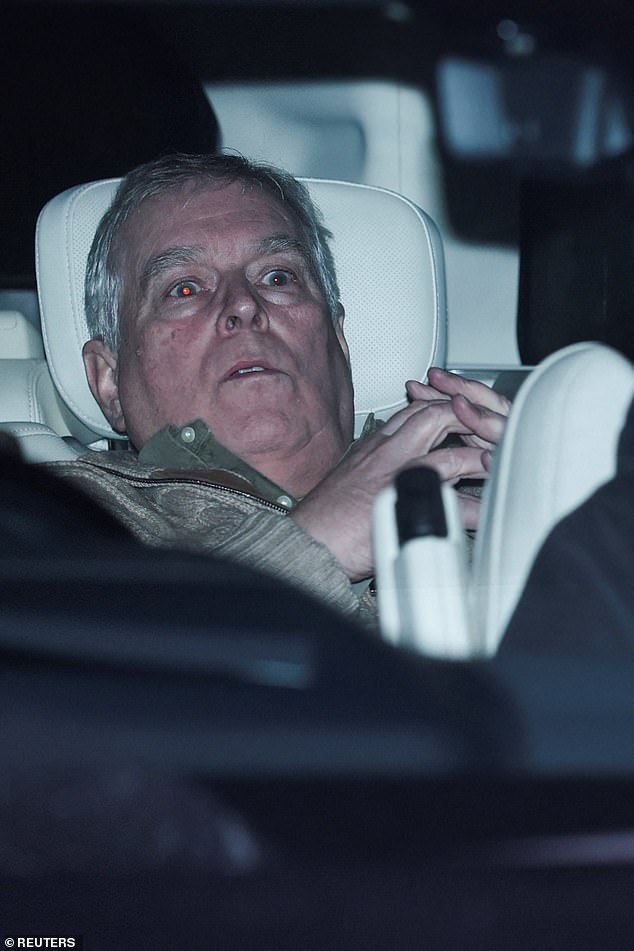
The Government is drawing up plans to remove Andrew Mountbatten-Windsor from the line of succession after he was arrested on suspicion of misconduct in a public office.
To the horror of much of the public, the shamed ex-royal remains eighth in line to the throne, despite the litany of allegations made against him over the years.
He is also still a Counsellor of State, who could be asked to stand in for the King should Charles be incapacitated through illness or away on state duties abroad.
But his arrest this week has upped the pressure on Buckingham Palace and Parliament to strip the last vestiges of respectability from the former Duke of York once and for all.
Now the Mail understands the Government will listen to and act on public concerns once the judicial process has run its course.
The change would require an Act of Parliament and consultation between Britain and other Commonwealth realms.
Today, a new YouGov poll, taken after Andrew’s arrest, revealed that around four out of five Britons want action to be taken.
Just over one in 20 (six per cent) said he should remain in line to the throne.
There have also been calls for Andrew to voluntarily give up his place in the line of succession.

The Government is understood to be considering legislation to remove Andrew Mountbatten-Windsor from the line of succession after he was arrested

A group of police officers in plain clothes arrive at Wood Farm on Thursday morning, where searches began

A YouGov poll revealed that four out of five Britons (82%) believe Andrew should be removed from the line of succession. Just one in 20 (6%) said he should remain
Andrew Bowie, a senior Tory MP, said: ‘I think it would be the decent thing.
‘Of course, if he’s found guilty of this, I think Parliament would be well within its rights to act to remove him from the line of succession.
‘But, let’s remember, he’s not been found guilty of anything – he has yet to be charged with anything.’
Mr Bowie told GB News: ‘So we have to let the police investigation run its course, and I think we should all act accordingly subsequent to that.’
Liberal Democrat leader Sir Ed Davey also weighed in to the debate, saying the case of Mr Mountbatten-Windsor is something Parliament will have to consider ‘when the time is right’ to make sure he cannot become king.
He said: ‘The most important thing right now is that the police be allowed to get on with their job, acting without fear or favour.
‘But clearly this is an issue that Parliament is going to have to consider when the time is right, naturally the monarchy will want to make sure he can never become king.’
In October, Downing Street said it had no plans to introduce legislation that would change the line of succession.
But in reality it would take a catastrophic event for the shamed ex-duke to come within a hair’s breadth of the throne.
And palace officials have already taken steps to ensure he would ever be asked to stand in for his brother.
In the event the monarch cannot undertake his official duties as sovereign on a temporary basis, two or more counsellors are appointed to act in their place drawn from the sovereign’s spouse and the next four people in the line of succession.

Andrew was arrested on his birthday on suspicion of misconduct in a public office
Currently that is Queen Camilla, Prince William, Prince Harry, Prince Andrew and Princess Beatrice.
But, in 2022, the Regency Acts of 1937 and 1943 were amended on the palace’s request to enable the King’s other siblings, Prince Edward and Princess Anne, currently 15th and 18th in line to the throne, to act as counsellors as well.
The change was made to ensure that neither Andrew nor his nephew, Prince Harry, currently fifth in line to the throne, would ever be required to serve as counsellors after they stepped down as working royals and were publicly stripped of their HRH titles.
To remove Andrew from the line of succession is a complex process that requires not just legislation in the UK but all of the other 14 countries around the world – known as the Realms – where the king is head of state, including Australia, New Zealand, Canada, Australia and Papua New Guinea.
This has happened once in recent history, for the Succession to the Crown Act 2013, when the law was updated to ensure that female royals could not be leapfrogged by younger, male relatives.
It took two years of protracted negotiations to ensure that all the different countries where Queen Elizabeth was sovereign came into line.
Yesterday Andrew became the first senior royal in modern history to be arrested after he was held in custody for around 11 hours on his 66th birthday.
Searches were carried out at Andrew’s Norfolk home and he was later released under investigation by Thames Valley Police.
Andrew lost his royal titles and left his Royal Lodge residence in Windsor in October following fresh scrutiny of his links to Epstein. Royal Lodge continues to be searched.
Yet he remains eighth in line to the throne, just behind the children of Prince Harry, with an act of Parliament needed to formally remove Andrew.
Andrew has denied any wrongdoing over his Epstein links, but has not directly responded to the latest allegations.
Constitutional experts have said it would be a complex process to pass legislation to formally remove Andrew from the line of succession.
Robert Hazell, a professor of government and the constitution at University College London, said such a move would ‘require the involvement of the other 14 countries around the world which share the British monarch as their head of state: countries like Australia, Jamaica, Papua New Guinea’.
‘The last time this happened was for the Succession to the Crown Act 2013, which made the law of royal succession gender neutral,’ he added on The Constitution Unit Blog.
‘It took two years of protracted negotiations for all the different countries to amend their own laws or constitutions.
‘With Mountbatten-Windsor being only eighth in line, it seems highly unlikely that the UK Government or the other governments will want to expend time removing him from the line of succession.’
Previous YouGov research found just three per cent of Britons had a positive view of Andrew, who has been progressively stripped of his honours and titles to strong public support.
Asked in October and November last year, 80 per cent of Britons backed the removal of his status as Duke of York, 79 per cent supported stripping him of his title as Prince, and 76 per cent approved of removing his military rank of Vice Admiral.
The public were more reticent to see Andrew stripped of his South Atlantic Medal, which he received for serving as a helicopter co-pilot during the Falklands.
More than a third (36 per cent) of Britons wished to see this campaign medal stripped from the former Prince, but slightly more were opposed (43 per cent).