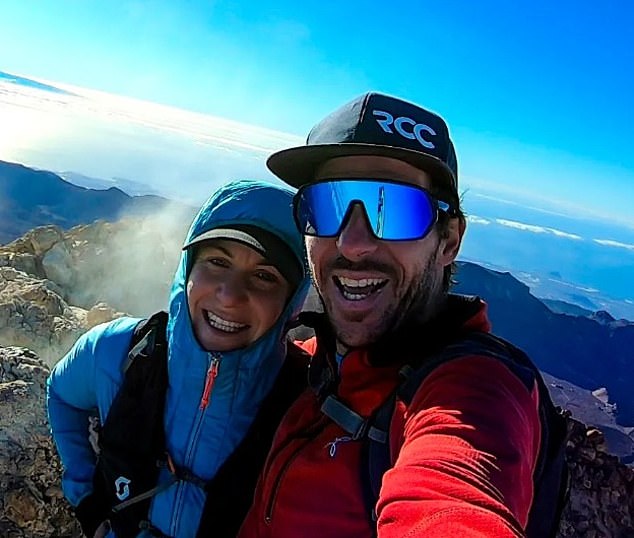
A climber who allegedly abandoned his girlfriend to die at the top of a freezing mountain ditched a previous partner at the same spot, a court heard today.
Thomas Plamberger, 39, is standing trial accused of negligent homicide after girlfriend, Kerstin Gurtner, 33, died just 150ft below the summit of the 12,460ft Grossglockner in January last year as temperatures plunged to minus 20C.
He is accused of leaving Gurtner ‘exhausted, hypothermic and disoriented’ while he went to get help.
During his trial, which opened today in Innsbruck, Plamberger claimed his girlfriend shouted at him to ‘Go!’ after he spent an hour and a half with her in freezing conditions.
But Judge Norbert Hofer found the circumstances of how Gurtner’s body was found inconsistent with Plamberger’s explanations.
It also emerged that the seasoned climber allegedly left an ex-girlfriend on the mountain range following a ‘heated argument with her on the Grossglockner in winter’.
Prosecutors allege he left his ex-girlfriend alone on the mountain in pitch darkness after she complained about the difficulty of the climb.
The position Plamberger left Gurtner in on the mountain has also been disputed.

Kerstin Gurtner, 33, pictured with her climbing partner and boyfriend, Thomas Plamberger, 39, who faces a manslaughter trial after allegedly leaving her to die

Gurtner died just 150ft below the summit of the 12,460ft Grossglockner in January 2024 as temperatures plunged to a bone-numbing minus 20C
The judge showed a photograph of Gurtner hanging freely from the rock face – indicating that she had fallen, he said.
Plamberger said he had left her at a different location approximately ten metres away.
He claimed he secured her to the rock face with a rope to prevent her from falling.
But the court heard she was found dangling from the rope and had been hanging on the rock face for two hours before she died.
Plamberger, who is accused of making a series of mistakes on the trip, which culminated in Gurtner’s death, said he was in an ‘absolutely stressful and exceptional situation’ and wanted to lie down next to Gurtner, who ‘saved his life’ by demanding he ‘go!’
The Innsbruck prosecutor’s office said he left Gurtner’s at 2am and a rescue operation began 90 minutes later when he called emergency services.
Rescue teams were unable to reach Gurtner until the following day due to hurricane-force winds, and she was found just below a cross that marks the summit.
The head of the mountain rescuer team who found her body told the judge‘ it was certainly not a pretty sight for us’, adding ‘it looks as if she had climbed down’
Given the extremely harsh conditions, the defendant should have turned back earlier, prosecutors claim.

Webcam images showed emergency lights of the two alpinists during their ascent glowing at 6pm on January 18

An image captured at around 2.30am showed Plamberger allegedly pushing on alone to the other side of Grossglockner amid claims he left his partner in freezing conditions
Even when he had left his partner to get help., he apparently did not bring her to a wind-protected place and did not use bivouac sack or aluminium rescue blanket.
The mountain rescue station’s group instructor said Plamberger’s ‘account of the situation didn’t quite add up’.
He said the 39-year-old ‘couldn’t explain why he hadn’t used the bivouac sack’ and he could have used on if she was left in the spot he claims.
Plamberger told the judge he was ‘not a mountain guide but an amateur mountaineer’ and that although he had served in the Austrian army, his experience was ‘self-taught’.
He explained how he had climbed the Grossglockner ’14-15 times’ and that he had also watched videos on the internet to gain knowledge and experience of Alpine conditions.
Plamberger – dressed in a suit and a necked white shirt – insisted they had always planned their climbs and hikes together and that Gurtner was ‘physically fit’.
He described how he and Gurtner had been seeing each other for a year and had planned to move in together.
He said they would often go hiking and climbing in the mountains, but also confirmed he had no ‘specific rescue skills’.
Plamberger is accused of making a series of mistakes on the trip, which culminated in Gurtner’s death, including being poorly equipped and failing to call for help despite realising the situation was critical.

At 7.10am webcam footage captured a helicopter soaring over the mountain, but the rescue mission had to be aborted due to strong winds

Just under three hours later, six rescuers were seen during their ascent, but Gurtner was tragically dead upon their arrival
The indictment against him reads that he left her ‘exhausted, hypothermic and disoriented’ – although Gurtner’s mother has backed Plamberger.
Speaking ahead of the trial, she said: ‘It makes me angry that Kerstin is being portrayed as a naive little thing who let herself be dragged up the mountain.
‘And I think it’s unfair how Kerstin’s boyfriend is being treated. There’s a witch hunt against him in the media and online.’
In opening remarks, his lawyer said there had been a ‘misunderstanding’ between his client and the pilot of a rescue helicopter the night of the tragedy, which had led to her death.
Webcam images show the glow of the couple’s two headtorches as they slowly edge towards the summit at around 6pm – almost 12 hours after setting off – then, hours later, only one light is seen as it moved down.
Rescue teams were unable to reach Gurtner until the following day due to hurricane-force winds, and she was found just below a cross that marks the summit.
Gurtner’s social media profile is illustrated with dozens of images of her and Plamberger climbing and hiking, and she described herself as a ‘winter child’ and ‘mountain person’.
As part of their probe, investigators examined their mobile phones, sports watches, laptops and photographs the couple had taken as they made their way to the summit, before concluding he made several errors.
They highlighted how the couple were poorly equipped – Gurtner was wearing snowboard soft boots instead of proper hiking footwear – and officials say he ‘turned away’ despite a helicopter flying low over the area.

Plamberger (pictured) has denied the allegations and said it was a ‘tragic, fateful accident’
Through his lawyer, Kurt Jelinek, Plamberger has denied the allegations and insisted he turned away to get help, and it was simply a ‘tragic, fateful accident’.
In a statement announcing the charge, Innsbruck prosecutor’s office said: ‘At approximately 2am on January 19, the defendant left his girlfriend unprotected, exhausted, hypothermic, and disoriented about 50 meters below the summit cross of the Grossglockner.
‘The woman froze to death. Since the defendant, unlike his girlfriend, was already very experienced with alpine high-altitude tours and had planned the tour, he was to be considered the responsible guide of the tour.’
They added that he did not take into account that his girlfriend was highly inexperienced and had never undertaken an alpine high-altitude tour of this length.
He was also accused of scheduling the start of the climb around two hours later than prudent, while not carrying any sufficient emergency equipment.
Even when he had left his partner to get help, he apparently did not bring her to a wind-protected place and did not use a bivouac sack or aluminium rescue blankets, they said.
Given the harsh weather conditions with wind speeds of up to 46 mph and temperatures of minus eight degrees, which felt like minus 20 degrees when combined, the defendant should have turned back earlier, according to the public prosecutor.
They will also claim at the trial that Plamberger and Gurtner were stranded from around 8.50pm, and he allegedly did not give any distress signals when a police helicopter flew over at 10.50pm.
After several attempts by the Alpine Police, he finally spoke to an officer at around 12.35am.
Officials say he had put his phone on silent and could not be contacted by Alpine Police, but eventually, at 3.30am, he decided to notify the rescue services after having left Gurtner alone.