

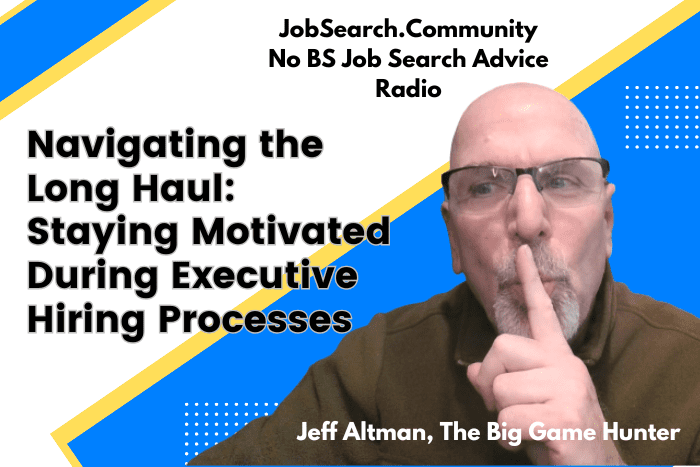
By Jeff Altman, The Big Game Hunter
The “quick hire” has become a relic of the past, particularly for senior leaders. What used to be a four-to-six-week sprint has evolved into a grueling marathon that can stretch from three to six months–or longer. For executives and specialized professionals, these extended timelines are more than just a logistical nuisance; they are a significant test of mental fortitude and professional resilience.
When you are navigating high-stakes transitions, whether due to corporate restructuring, redundancy, or a proactive leap toward a new challenge, the silence between interview rounds can feel deafening. However, staying motivated isn’t about blind optimism; it’s about understanding the new mechanics of recruitment and treating your job search with the same strategic rigor you apply to your professional life.
Understanding the Modern Hiring Landscape
The first step in maintaining your composure is recognizing that delays are rarely a reflection of your individual value. Today’s protracted timelines are driven by systemic shifts in how organizations de-risk their hiring decisions. Several key factors contribute to this slowing pace:
-
Multi-Stage Consensus: Panel interviews and “cultural fit” screenings ensure buy-in from multiple stakeholders, which can add weeks to the calendar as schedules are aligned.
-
Deep-Rooted Risk Aversion: At the executive level, a “bad hire” is incredibly expensive. Organizations now require extra layers of budget approval and headcount scrutiny before a final contract is issued.
-
The “Hidden” Hurdles: Internal shifts, such as a sudden change in departmental strategy or an unannounced hiring freeze, often pause a role without immediate notice to the candidate.
-
Technological Layers: While AI streamlines initial screening, it can create a “black hole” effect where candidates feel disconnected from human decision-makers, leading to anxiety during the wait.
By viewing these delays as structural rather than personal, you can shift from a reactive emotional state to a proactive, strategic one.
Safeguarding Your Executive Wellbeing
A drawn-out search is mentally taxing. High-achieving professionals are used to “closing the deal” and seeing immediate results. When that feedback loop is broken, it can erode the very confidence you need to project during an interview. To sustain your executive presence, you must protect your mental bandwidth through disciplined habits.
Establish a “Search Schedule” and treat your job search like a consulting assignment. Dedicate specific hours to applications and networking, then physically and mentally “clock out.” Constant refreshing of your inbox only leads to burnout and a sense of powerlessness.
Furthermore, prioritize your physical recovery. Resilience is physiological; regular exercise, adequate sleep, and “unplugged” time are not luxuries. They are the fuel that allows you to remain sharp during a grueling fifth-round interview. Finally, build a support ecosystem. The executive journey can be lonely, so engage with a mentor, an executive coach, or a trusted peer group to keep your perspective grounded.
Activating the Hidden Job Market
While you wait for a formal process to move forward, do not remain stagnant. The “Hidden Job Market,” where an estimated 70% of executive placements occur, is your best hedge against a slow formal process.
Strategic networking serves a dual purpose: it uncovers unadvertised roles and provides the social validation that keeps motivation high. Focus on quality over quantity. One deep conversation with a former colleague or a strategic connection in your target industry is worth more than fifty cold LinkedIn invites. Use this time to optimize your digital footprint, ensuring your profile tells the story of your impact rather than just your duties.
Reframing Rejection and Building Resilience
In a long process, the sting of a “no” after four rounds of interviews can be devastating. However, at the senior level, rejection is often a matter of alignment, not ability. Perhaps the board shifted its three-year strategy, or an internal candidate unexpectedly became available.
To stay motivated, treat every interaction as a data point. Use the gaps in communication to refine your approach. Ask yourself what you learned about the industry’s current pain points and which of your leadership stories resonated most with the panel. Even without an offer, reaching the final stages is a confirmation that your skills are highly competitive in the current market.
Practical Momentum: Small Wins, Big Impact
Motivation thrives on progress. When the “Big Win” of a job offer is months away, you must manufacture “small wins” to keep your momentum steady. Set weekly, achievable goals that you can control entirely:
-
Networking Milestones: Aim to secure two “coffee chats” or informational interviews per week.
-
Continuous Learning: Spend three hours a week on a new certification or researching emerging industry trends, such as AI integration in your specific sector.
-
High-Quality Output: Focus on tailoring three exceptional applications rather than sending out dozens of generic ones.
By focusing on these controllable inputs, you decouple your self-worth from the uncontrollable outputs of a company’s internal HR department.
The Final Word
The modern executive hiring process is a test of endurance as much as it is a test of skill. By managing your expectations, diversifying your efforts through networking, and rigorously protecting your well-being, you transform a period of uncertainty into a period of professional preparation.
The right offer is rarely the fastest one to arrive. It is the one that aligns with your long-term trajectory and your resilience during the wait is exactly what will make you a formidable leader once you step into the role.
Ⓒ The Big Game Hunter, Inc., Asheville, NC 2026
Tailoring Doesn’t Always Refer to Your Wardrobe

ABOUT JEFF ALTMAN, THE BIG GAME HUNTER
People hire Jeff Altman, The Big Game Hunter to provide No BS Career Advice globally because he makes many things in peoples’ careers easier. Those things can involve job search, hiring more effectively, managing and leading better, career transition, as well as advice about resolving workplace issues.
Seven Steps To Branding Yourself As An Expert
You will find great info to help with your job search at my new site, JobSearch.Community Besides the video courses, books and guides, I answer questions from members daily about their job search. Leave job search questions and I will respond daily. Become an Insider+ member and you get everything you’d get as an Insider PLUS you can get me on Zoom calls to get questions answered. Become an Insider Premium member and we do individual and group coaching.
Also, subscribe to JobSearchTV.com on YouTube and No BS Job Search Advice Radio, the #1 podcast for job search with more than 3100 episodes over 15+ years.in Apple Podcast, Spotify, Google Play, Amazon Music and almost anywhere you listen or watch podcasts.
From Paycheck to Purpose
Schedule a discovery call at my website, www.TheBigGameHunter.us to discuss one-on-one or group coaching with me
LinkedIn: https://www.linkedin.com/in/TheBigGameHunter
Resume & LinkedIn Profile critiques www.TheBigGameHunter.us/critiques
What You Must Do Before Your Next Job Interview
We grant permission for this post and others to be used on your website as long as a backlink is included to www.TheBigGameHunter.us and notice is provided that it is provided by Jeff Altman, The Big Game Hunter as an author or creator. Not acknowledging his work or providing a backlink to www.TheBigGameHunter.us makes you subject to a $1000 penalty which you proactively agree to pay.