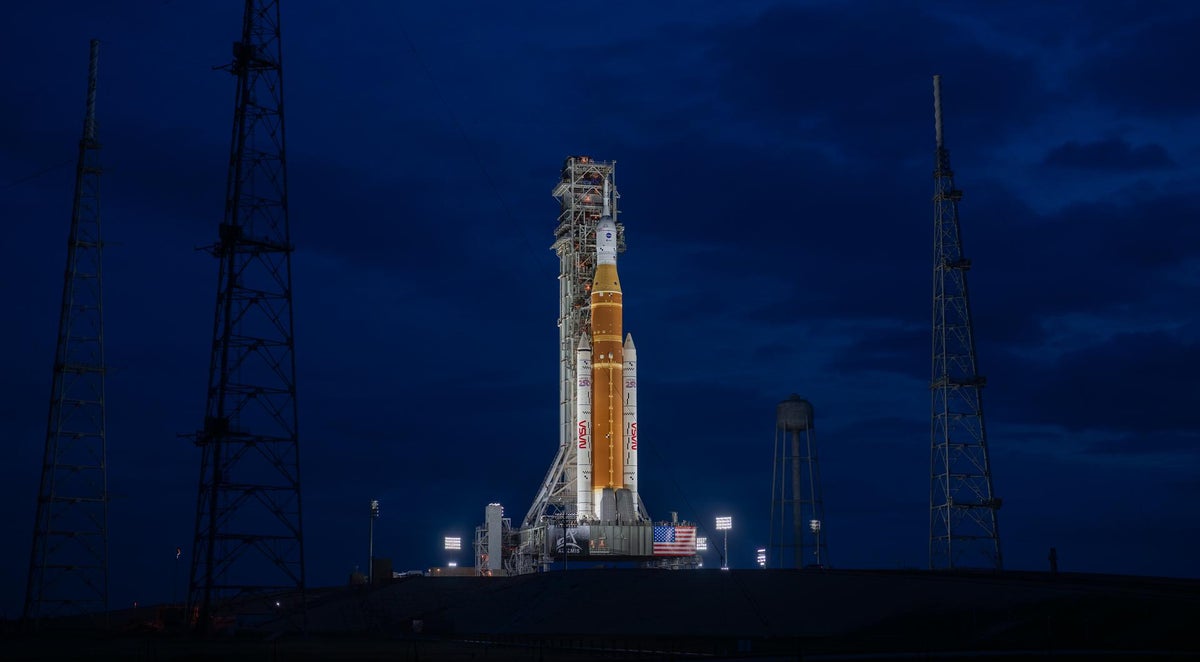
NASA has set a date for the do-over of a key readiness test for its Artemis II mission to the moon. During this “wet dress rehearsal,” the agency will attempt to pump liquid fuel into the Space Launch System (SLS) rocket and simulate a countdown to liftoff on February 19 at 8:30 P.M. EST.
The test is critical for Artermis II to move forward for launch; the first attempt, performed on February 2, exposed problems with both the SLS and the Orion capsule, which is designed to house Artemis II’s four-person crew on a journey around the moon and back. Liquid hydrogen fuel leaked from the rocket, and one of the capsule’s valves malfunctioned. Notably, similar fuel leaks plagued the mission’s predecessor, Artemis I, delaying its launch for months.
In announcing the new wet dress rehearsal date, NASA said that engineers have replaced a filter in ground support equipment that they think reduced the flow of liquid hydrogen into the rocket and that this has potentially resolved the leaking issue.
On supporting science journalism
If you’re enjoying this article, consider supporting our award-winning journalism by subscribing. By purchasing a subscription you are helping to ensure the future of impactful stories about the discoveries and ideas shaping our world today.
Unlike Artemis I, which was uncrewed, Artemis II will loft four people—NASA’s Reid Wiseman, Christina Koch, and Victor Glover and Canadian Space Agency astronaut Jeremy Hansen—into a record-breaking flyby around the moon.* For 10 days, the crew members will observe the moon’s little-studied farside and will perform other experiments onboard before they splash down in the Pacific Ocean off San Diego.
*Editor’s Note (2/17/26): This sentence was edited after posting to correct the description of Artemis II’s planned lunar flyby.
It’s Time to Stand Up for Science
If you enjoyed this article, I’d like to ask for your support. Scientific American has served as an advocate for science and industry for 180 years, and right now may be the most critical moment in that two-century history.
I’ve been a Scientific American subscriber since I was 12 years old, and it helped shape the way I look at the world. SciAm always educates and delights me, and inspires a sense of awe for our vast, beautiful universe. I hope it does that for you, too.
If you subscribe to Scientific American, you help ensure that our coverage is centered on meaningful research and discovery; that we have the resources to report on the decisions that threaten labs across the U.S.; and that we support both budding and working scientists at a time when the value of science itself too often goes unrecognized.
In return, you get essential news, captivating podcasts, brilliant infographics, can’t-miss newsletters, must-watch videos, challenging games, and the science world’s best writing and reporting. You can even gift someone a subscription.
There has never been a more important time for us to stand up and show why science matters. I hope you’ll support us in that mission.