The Reserve Bank has warned inflation may not return to target until late 2028, in unwelcome news for Aussies with a mortgage after newly-released meeting minutes on Tuesday hinted at yet another rate rise.
The alarm comes after the RBA board, led by governor Michele Bullock, unanimously lifted the cash rate by 0.25 percentage points to 3.85 per cent on February 3 – a move that pushed repayments higher for struggling households.
According to the minutes, the outlook remains highly uncertain. The bank expects inflation to stay above its target range until June 2027 and not fall back within the 2–3 per cent band until the end of 2028.
By the middle of this year the consumer price index was expected to hit a two-year high of 4.2 per cent with the minutes noting inflation was broad, had increased sharply, and remained high by historical standards.
‘Measures of inflation expectations at the two-year horizon had increased, most noticeably in Australia,’ the minutes stated.
‘Members discussed the likely persistence of the rise in inflation.’
CPI is crucial because it is the RBA’s key gauge of inflation.
When it stays high, it pushes up the cost of essentials, erodes purchasing power, and forces the bank to keep interest rates higher for longer, meaning prolonged pain for households and mortgage holders.

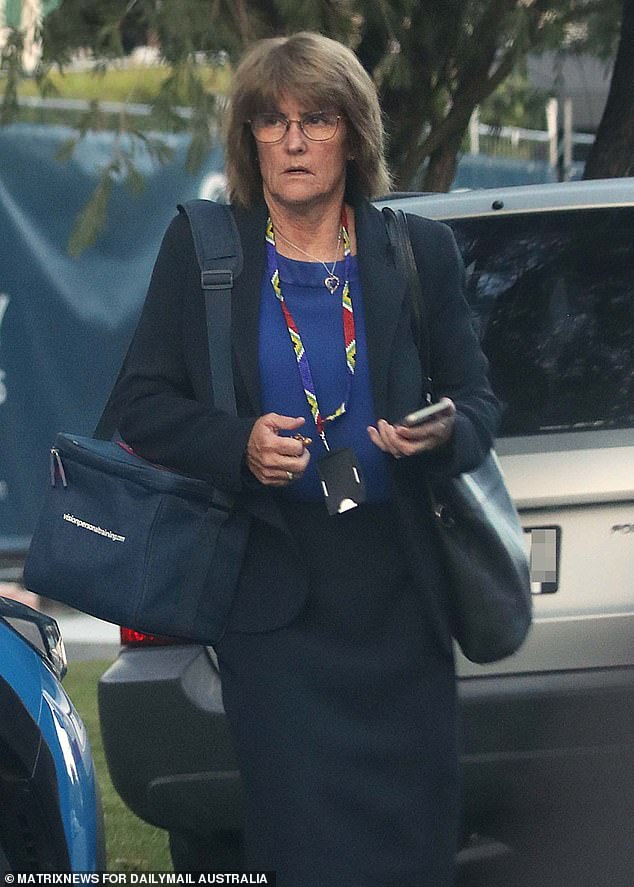
The RBA board, led by governor Michele Bullock (pictured), unanimously lifted the cash rate – a move that pushed repayments higher for many struggling households

After the February rate hike those with a $1million loan would be paying $150 more a month on their mortgages (pictured, a house inspection in Sydney)
The Commonwealth Bank, NAB and Westpac all expect another rate rise in May, with the RBA noting financial markets are pricing in further tightening with some expecting a second increase later in the year.
‘Market pricing had implied a 70 per cent probability of a cash rate increase at the current meeting, with a further increase fully priced by the end of 2026,’ it said.
‘Most market economists tracked by the staff had also expected an increase in the cash rate in February, and a number had expected a second increase later in the year.’
The RBA now judges the economy to be operating above capacity, pointing to stronger household spending, higher business investment and surprisingly resilient labour market conditions.
However, it made no mention of the effects of high government spending.
‘Aggregate demand now clearly exceeded aggregate supply and the labour market remained a little tight,’ the minutes said.
The Board warned that if it left rates on hold, inflation would risk settling at a level inconsistent with the RBA’s 2–3 per cent target.
‘Excess demand was unlikely to be corrected if the cash rate remained at 3.6 per cent,’ the minutes read.

The RBA said it remained open‑minded about the path ahead but emphasised that policy decisions will depend on the flow of economic data (pictured, the RBA headquarters in Sydney)
AMP chief economist Shane Oliver said the RBA might dodge further rate hikes this year, with the latest NAB survey showing businesses are lifting prices at levels broadly in line with the inflation target.
But he warned the RBA will raise rates again if inflation data does not improve.
‘The RBA having raised rates is continuing to warn of more hikes to come if higher inflation is entrenched; and global uncertainty around US policies and geopolitics remains high which will impact our market if it flares up,’ he said.
‘Household spending rose a solid 0.9 per cent in real terms in the December quarter pointing to strong growth in consumer spending on the back of events and discounting activity but fell 0.4 per cent in December after the boosts faded.
‘A sharp fall back in consumer confidence suggests that the slowdown in spending could continue into the current quarter.
‘Cost and prices pressures fell in January, with final product prices remaining around levels consistent with the inflation target. This adds to confidence that the spike in inflation seen in the last half of last year could prove to be an aberration.’
Inflation picked up in the second half of 2025, driven by volatile items such as electricity, travel and groceries.
The board noted ‘risks on both sides’ could push inflation above or below the central case, depending on how demand, supply capacity, wage growth and global conditions evolve.

Inflation picked up in the second half of 2025 driven by volatile items such as electricity, travel and groceries
The rate rise will add fresh pressure to households already dealing with elevated repayments.
Required mortgage payments as a share of household income are now ‘above the historical average’, according to the minutes, even as households funnel extra funds into offset and redraw accounts.
According to Canstar calculations, an owner-occupier with a $600,000 mortgage and 25 years remaining would see their minimum monthly repayments rise by $90, assuming banks pass it on to their variable customers.
Those with a $1 million loan would be paying $150 more per month on their mortgages.
While the RBA acknowledged cost‑of‑living pressures, it also noted that real household disposable income had grown faster than previously thought and that households remained in ‘better financial health’ than assumed earlier in 2025.
The RBA’s hike sets Australia apart from many advanced economies where markets continue to expect policy easing later in 2026.
In the United States and United Kingdom, expectations for rate cuts were pushed back, but cuts were still expected in 2026.
In contrast, markets expect ‘modest future increases’ in the euro area and Canada, continued tightening by the Bank of Japan, and at least one increase by New Zealand’s central bank.
Overall, the minutes noted market expectations were for noticeably higher interest rates in Australia than in many peer economies, reflecting stronger local inflation pressures.
The Board said it remained open‑minded about the path ahead but emphasised that policy decisions will depend on the flow of economic data.
While the RBA stressed the high degree of uncertainty, members agreed their strategy of restoring inflation to target while preserving as many gains in employment as possible, remains appropriate.
‘The board will remain focused on its mandate to deliver price stability and full employment and will do what it considers necessary to achieve that outcome,’ the minutes said.