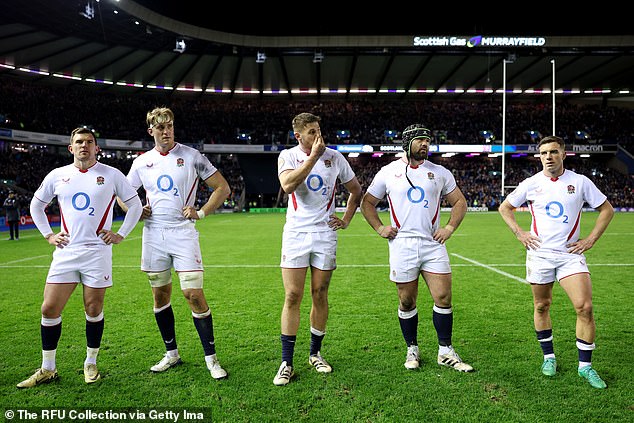
There was a depressing sense of deja-vu for England’s squad as they boarded their charter flight back to London on Sunday morning. The departure lounge at Edinburgh airport does not bring back many happy memories for Steve Borthwick’s senior players.
For all of England’s improvements over the last 12 months, their long wait for a trophy looks like it will continue. Their odds to win the Six Nations title slipped to 8/1 after the defeat at Murrayfield, leaving them relying on a miraculous collapse by Antoine Dupont’s France.
There will undoubtedly be a reaction from England. They will still boast a record of 13 wins from 14 if they beat Ireland on Saturday, yet silverware is the biggest currency in elite sport. England last won the Six Nations in 2020 and they are set to miss out on the trophy again this year – one that could have rubber-stamped their credentials as World Cup challengers.
Instead, doubts will creep in given the nature of Scotland’s victory. The aerial contest became a superstrength for England during the autumn but at Murrayfield they won just four from 14 contestable kicks. England were ahead of the tactical curve with their ability to pounce on the ‘scraps’ last year but other teams have now caught up.
Ben White out-kicked Alex Mitchell on Saturday night. Kyle Steyn and Jamie Dobie got the better of Tom Roebuck and the dismissed Henry Arundell. ‘I know if I put my kick on the money, Kyle and Jamie are going to go for it and fly into it 100 per cent,’ said White.
‘Kyle isn’t worried about getting hurt or anything like that. He’s going up there to win it and that’s why he’s brilliant. They’re aggressive and confrontational in the air. They’re dominant and that’s something they’ve done all season for Glasgow. I think it’s an area of our game that’s very strong and we showed why those boys are class at what they do.’

England were left shocked in Edinburgh as they were beaten 31-20 by Scotland on Saturday

The defeat exposed some weaknesses that we didn’t know existed within this team
Tommy Freeman is one of the best in the world at chasing kicks in the wide channels. Freeman has instead been used as a battering ram in the midfield and this result will test how wedded Borthwick really is to the project to convert his winger to a centre.
At England’s pre-Six Nations training camp in Girona, Freeman claimed England’s goal is to showcase their ability to problem solve on the pitch. That falls on the likes of Maro Itoje, George Ford and Ellis Genge, whose individual errors all contributed to England’s downfall.
The scrum was the only area where England had outright dominance, yet their ability to make it pay showed a lack of conviction. When the Springboks found themselves with outright set-piece superiority against Ireland in the autumn, they called for scrum after scrum, using it as a weapon to draw penalty tries and yellow cards.
England had Scotland on the ropes at the set-piece. The hosts were given two yellow card warnings and Zander Fagerson was all at sea, yet England did not show the same conviction to double down on their dominance and twist the knife.
Rather than scrum again, England stuck to their plan A. They kicked to the corner and opted for line-out drives that were ultimately turned over. They scored just two tries from 12 entries to the 22, turned over in contact and lacking the attacking convictions they have shown over recent months.
Arundell’s red card reduced England to 14 men for 30 minutes and Finn Russell made them pay. Roebuck switched to the openside wing and England were caught narrow, with the Scots slipping through tackles and making constant gains out wide.
‘In a world where we’re surrounded by people who oscillate to real polarities, my job is to be very consistent with the players,’ said Borthwick. ‘What the team has done very well for a long period of time is been able to play consistently for 80 minutes.
‘Even in the situations where teams have got ahead of us, we’ve been able to reel them in. We let them get too far ahead of us. It’s credit to Scotland and also the consequence of playing with 14 men.

Steve Borthwick’s side didn’t show enough conviction and they were unable to problem solve

Scotland celebrated a superb Calcutta Cup win to breathe life into their Six Nations campaign
‘The players are bitterly disappointed. We haven’t tasted defeat in quite a long time. Now we have and we’ll work on this week to be a better team next week.
‘What I’ll do is I’ll see how the players are, check on them, get together. One-on-one reviews, unit reviews and a team review. The players will meet with their respective coaches. We’ll review thoroughly and make sure everyone’s fully ready to go against Ireland.’
The review may force through some changes for England’s return to the comfortable surroundings of Twickenham, where the likes of George Furbank, Ollie Lawrence, Max Ojomoh and Seb Atkinson are all pushing for their first involvement of the competition.
While the Scots drank Tennent’s out of the Calcutta Cup, joined by Princess Anne in their dressing room, England were left thinking what might have been.
They have not become a bad team overnight but their shortcomings in Scotland have left some nagging questions that we thought had already been answered.