1.
The reason we have big Super Bowl halftime shows is because of the TV show In Living Color. In the early days of the Super Bowl, the halftime entertainment was pretty modest. It was mostly marching bands and themed performances that didn’t grab much mainstream attention. In fact, it was treated as more of an intermission for bathroom breaks, etc. During Super Bowl XXVI in 1992, the Fox sketch show In Living Color did something bold: it aired a special episode live against the game’s halftime show and drew about 20–25 million viewers away from the broadcast.
That was a shock for the NFL, because it showed that people were willing to switch channels if there was something more exciting on. In response, the league decided to totally rethink its halftime strategy and booked Michael Jackson for the next year’s show, bringing in a huge pop star rather than another band or themed act. That performance is widely seen as the moment the halftime show became a major music spectacle, and it set the stage for every big-name act that followed.
2.
If it weren’t for World War II, The Great Gatsby would be a forgotten book. When the novel was first published in 1925, it was not a big success. Reviews were mixed, and the novel sold poorly compared to F. Scott Fitzgerald’s earlier work. By the time Fitzgerald died in 1940, the book was mostly forgotten and even out of print.
During World War II, however, the US military sent free paperback copies of books to soldiers overseas through a program called the Armed Services Editions, and The Great Gatsby was one of the titles included. Hundreds of thousands of service members read it during the war, which introduced the novel to a wide new audience. After the war, many of those readers went to college on the GI Bill, where the book was taught in classes, helping turn it into the classic American novel we know today.
3.
WD-40 was originally created to protect the outer skin of the Atlas missile from rust and corrosion. It was first created in 1953 by a small San Diego company called Rocket Chemical Company. The team was working under contract with Convair, an aerospace manufacturer, to solve a specific problem for the Atlas missile program. The outer skin of the Atlas missile was made of very thin stainless steel and needed protection from rust and corrosion, especially in humid conditions.
After 39 failed attempts, the chemists finally developed a successful water-displacing formula on their 40th try, which is where the name “WD-40” comes from, short for “Water Displacement, 40th formula.” The product worked so well at preventing corrosion on the missile’s surface that employees began taking some home for household uses. Seeing its wider potential, the company eventually packaged it for consumers a few years later.
4.
Desperate Housewives was so popular that it forced the Golden Globes to change the night of the week the award show aired. When the show premiered on ABC in October 2004, it quickly became one of the biggest shows on television. At the time (like today), the Golden Globe Awards aired on Sunday nights in January, which put the ceremony in direct competition with the show’s hugely popular time slot.
In fact, in 2005, during Desperate Housewives‘ first season, the Globes saw a ratings dip during the hour it aired against it. NBC, which broadcast the Golden Globes, did not want that to happen again. As a result, beginning in 2006, the network moved the Golden Globes to Monday night to avoid the conflict. It would return to airing on Sunday nights two years later, in 2008.
5.
Legendary Looney Tunes animator and director Bob Clampett helped create the very first Mickey Mouse dolls. In 1930, a 16-year-old Bob was asked by his aunt, Charlotte Clark, a seamstress, to help her come up with drawings to make a pattern for a Mickey Mouse doll. Unable to find reference pictures of Mickey, Bob went to a local movie theater in Glendale, California, where he drew sketches while watching Mickey Mouse shorts.
Using his sketches, he and Charlotte then created the classic 1930s Mickey Mouse doll. However, Bob’s father told them they needed Walt and Roy Disney’s approval because of copyright issues. They set up a meeting with Walt and Roy, who were impressed with the dolls’ level of craftsmanship. Walt and Roy struck up a deal with Charlotte to handmake the dolls for them — which they originally only gifted to business associates, family, and friends — even setting her up in a small studio.
6.
Housewives were asked to save bacon grease during World War II in order to help make bombs. At the time, the US government urged civilians to support the war effort in practical, everyday ways from home.
One of those efforts focused on saving used cooking fats, especially bacon grease, instead of throwing them away. The government explained that these fats could be processed to produce glycerin, a key ingredient used in making explosives like dynamite. Posters, radio announcements, newspaper ads, and even an animated short starring Minnie Mouse specifically encouraged housewives to collect leftover grease in cans and turn it in at local butcher shops (that would pay them for it).
7.
You’ve probably heard that Victorians invented the vibrator to treat women for “hysteria,” right? Yeah… that’s not really true. Vibrators were a hand-cranked massage device that doctors used to treat a number of issues, including hysteria, but they were likely only used on the back and neck, and they were used on both men and women.
Also, despite what we often assume, Victorians weren’t totally clueless about female sexuality, so they weren’t secretly handing out orgasms under the guise of medicine. This is mostly a modern myth, as the whole vibrator story really took off thanks to the 1999 book, The Technology of Orgasm: “Hysteria,” the Vibrator, and Women’s Sexual Satisfaction, and later the 2011 movie, Hysteria, that ran with the idea!
8.
The term “fast fashion” was first coined in 1989 by the New York Times when the writer of an article about the opening of the first Zara store in New York was describing what Zara’s business model was like.
At the time, Zara’s business model was unusual. Instead of following the traditional fashion calendar, the brand was able to design, produce, and ship new styles to stores in just a few weeks or quickly resupply styles that sold well. That speed was almost unheard of in the late ’80s, when most retailers planned collections months in advance. Using the phrase “fast fashion” was meant to capture that rapid turnaround.
9.
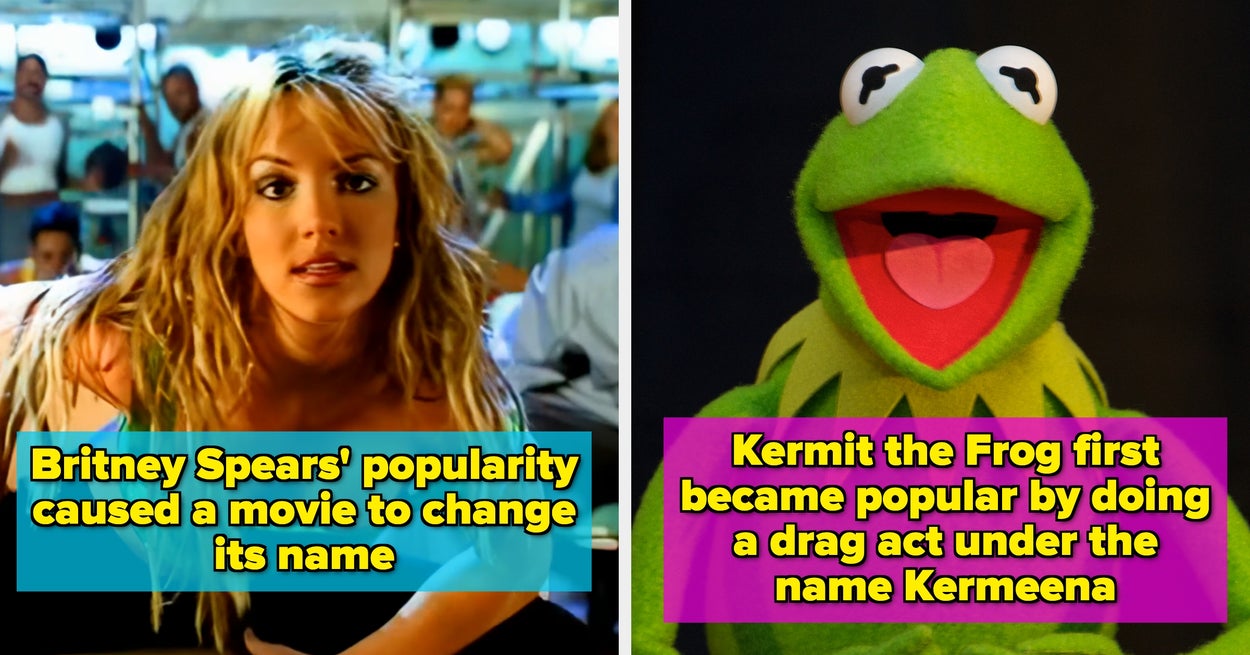
Britney Spears’ popularity caused a movie to change its name. When the teen movie Drive Me Crazy was being made in 1999, it originally had a very different title: Next to You (that name came from the book it was based on). In 1999, Britney Spears had become a huge pop star, so the movie studio decided to put a remix of her song “(You Drive Me) Crazy” on the soundtrack.
The studio also decided to change the movie’s title from Next to You to Drive Me Crazy to match her song and capitalize on her fame. Melissa Joan Hart later said she initially didn’t want the change because she thought Britney was just a flash in the pan, but she was proven wrong about how big Britney would become. The movie even tied into Britney’s music video, with the film’s stars Hart and Adrian Grenier appearing in it to help promote both the song and the movie.
10.
Kim’s Convenience started out as a play before it was adapted into a TV show. The play was written by Canadian actor and playwright Ins Choi. He first developed and performed it in 2011, drawing on his own experiences growing up in a Korean Canadian family and helping out at his parents’ convenience store in Toronto.
The play was well received in Canadian theater circles and built a strong following, which caught the attention of television producers. In 2016, it was adapted into a CBC television series, which was later picked up by Netflix in 2018, helping make it a hit in the US and around the world.
11.
Kermit the Frog first became popular by doing a drag act under the name Kermeena. He was created by Jim Henson in the mid-’50s and first appeared on a local Washington, D.C. TV show called Sam and Friends. In those early years, the Muppets were used in short comedy sketches aimed at adults, not children.
The first breakout skit featured Kermit lip-syncing to “I’ve Got You Under My Skin” by Rosemary Clooney while wearing a wig and exaggerated eyelashes, playing up the performance in a campy drag style. The popularity of the sketch helped get Henson national attention through variety show appearances. In 1968, Kermit would even do a comedic performance of “I’ve Grown Accustomed To Your Face” on The Ed Sullivan Show in drag.
12.
And lastly, Kobe Bryant is the only person to have won both an Olympic gold medal and an Oscar. He earned two Olympic gold medals as a member of Team USA’s men’s basketball teams in 2008 and 2012, further cementing his legacy as one of the sport’s most accomplished players.
After retiring from basketball in 2016, Bryant turned his focus to storytelling and creative projects. In 2018, he won the Academy Award for Best Animated Short Film for Dear Basketball, which was based on a letter he wrote about his love for the game when he announced his retirement. By winning both an Oscar and an Olympic gold medal, Bryant achieved one of the rarest and most difficult combinations of honors.