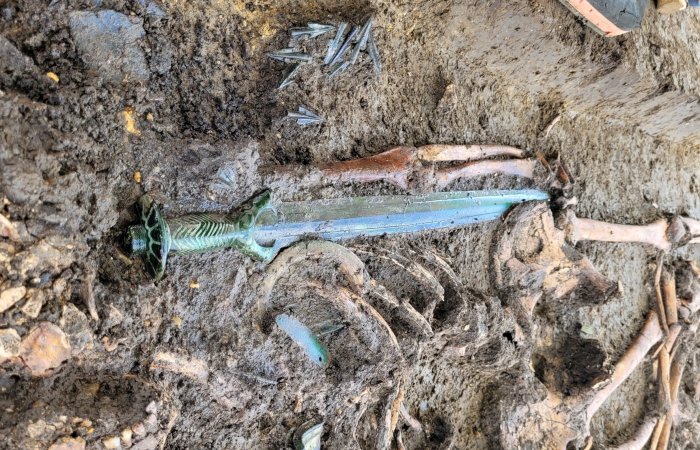
Conny Waters – AncientPages.com – Experts have conducted a detailed analysis of a bronze sword dating back over 3,400 years, notable for its exceptional preservation. The sword features intricate decorations on both the pommel and pommel plate, with the blade itself remaining nearly sharp despite its age.

The sword at the site where it was found. Credit: Archäologie-Büro Dr. Woidich/Sergiu Tifui
This octagonal sword was discovered in 2023 during archaeological excavations at a grave site in Nördlingen, located in the Donau-Ries district of Swabia, Bavaria, Germany. Following its discovery, the Bavarian State Office for the Preservation of Monuments (BLfD) transferred this significant Middle Bronze Age artifact to Berlin for advanced non-destructive testing.
Utilizing cutting-edge techniques such as 3D computed tomography and X-ray diffraction at Helmholtz-Zentrum Berlin (HZB), along with X-ray fluorescence spectroscopy using a beamline at BESSY II operated by the Federal Institute for Materials Research and Testing (BAM), researchers were able to examine how the hilt and blade are connected. They also gained valuable insights into how the rare decorative elements on the pommel were produced. These findings contribute important knowledge about Bronze Age craftsmanship in southern Germany.
How Was The Handle Attached To The Blade?
“We had several specific questions that we wanted to investigate using three different methods at HZB and with the help of BAM,” explains Dr. Johann-Friedrich Tolksdorf.
Conservator Beate Herbold elaborates: “It was very complex to produce such swords. We wanted to find out how the hilt was attached to the blade back then and how the recognizable patterns were incorporated.”

Beate Herbold and Johann Friedrich Tolksdorf, both BLfD, are positioning the sword for measurement at the BAMline on BESSY II. Credit: Archäologie-Büro Dr. Woidich/Sergiu Tifui
They explored these questions in the HZB computed tomography laboratory, where Dr. Nikolay Kardjilov and his team created a three-dimensional X-ray image of the sword.
“The CT scan shows that the blade was clamped and riveted into the hilt with a tang, which is an extension of the blade. The resolution of the CT scan is so high that we can even examine the material and the tool marks of the decorative work,” says Tolksdorf in a press release.
Material Used For Decoration
The pommel and pommel plate feature deep grooves in a geometric pattern filled with a different, unidentified material. The team investigated further at the BAMline of BESSY II, where Dr. Martin Radtke from BAM used X-ray fluorescence spectroscopy to examine the sword.
According to Radtke, the surfaces of the pommel are exposed to intense synchrotron radiation, which excites the atoms in the material and causes them to emit X-rays unique to each element. By measuring these X-rays, researchers can detect even minute traces of different elements. Initial analyses reveal that the inlay work on both the pommel and pommel plate was created using copper wires joined together.

The sword pommel. Credit: Kevin Fuchs/HZB
Beate Herbold notes that this finding was unexpected, as tin—which is softer and easier to work with than copper—was anticipated based on visual inspection. This discovery highlights the advanced level of craftsmanship achieved at that time.
Additionally, traces of tin and some lead—likely originating from a bronze alloy—were detected in certain areas. Tolksdorf explains that similar copper wire inlay work has been observed in other archaeological finds involving bronze objects. To enhance contrast between the reddish copper and golden bronze, it is possible that artisans chemically blackened (patinated) the copper, potentially using substances such as urine for this process.
Dr. Manuela Klaus’s X-ray lab investigated manual processing steps using residual stress analysis, which detects pressure and tension in crystalline surfaces. “This reveals manufacturing methods, as heating, quenching, casting, hammering, and forging cause typical changes in crystalline structures,” says Klaus.
The thorough analysis of the measurement data will take some time, after which the experts plan to publish their findings. “We hope to determine whether this sword, for example, was made in a specific workshop. So far, it is only likely that it was produced in southern Germany, one of the two main areas of distribution for octagonal swords in Bronze Age Germany,” says Tolksdorf.
See also: More Archaeology News
“The collaboration with the Helmholtz Centre Berlin and the Federal Institute for Materials Research and Testing has been very fruitful. State-of-the-art measuring methods allow us to reconstruct how metal was worked almost three and a half millennia ago, with astonishing precision and highly developed skills.
Although the discovery of the Nördlingen bronze sword has already attracted much attention, its scientific analysis makes it even more significant for us. Only then does a fascinating find become a valuable source of knowledge,” says Prof. Mathias Pfeil, Director General of the BLfD.
Written by Conny Waters – AncientPages.com Staff Writer