


As you probably already know if you read Pocket-lint, it’s critical to match devices like soundbars and game consoles with the right HDMI ports on your TV. In the case of speakers, the wrong port could limit your format options, assuming audio works at all. With consoles, or PCs for that matter, you could potentially run into visual glitches, or find yourself unable to use Dolby Vision or HDR10+. No one wants to sabotage their expensive purchases on day one.
You’d think, then, that chasing the latest version of HDMI would only be logical when you’re shopping for TVs, cables, and peripherals. But this is one of those rare times when futureproofing is not only difficult, but largely pointless, and may not have a point for a few years yet. If you’re hunting for a new TV, you might not find anything fully exploiting HDMI 2.1.
What is HDMI 2.2, and why is it a big deal?
Building a new framework

The defining characteristic of any HDMI port or cable is its bandwidth. It wasn’t until HDMI 1.4, for example, that there was enough to handle 4K resolution, and even then the format was limited to a 30Hz refresh rate. HDMI 2.1 is important not just for supporting 8K, but for allowing 4K refresh rates up to 144Hz, and enabling the lossless versions of Dolby Atmos and DTS:X by way of eARC. You can still connect the likes of a Sonos Arc Ultra or PlayStation 5 Pro to your TV using HDMI 2.0, but you won’t get nearly as much out of it.
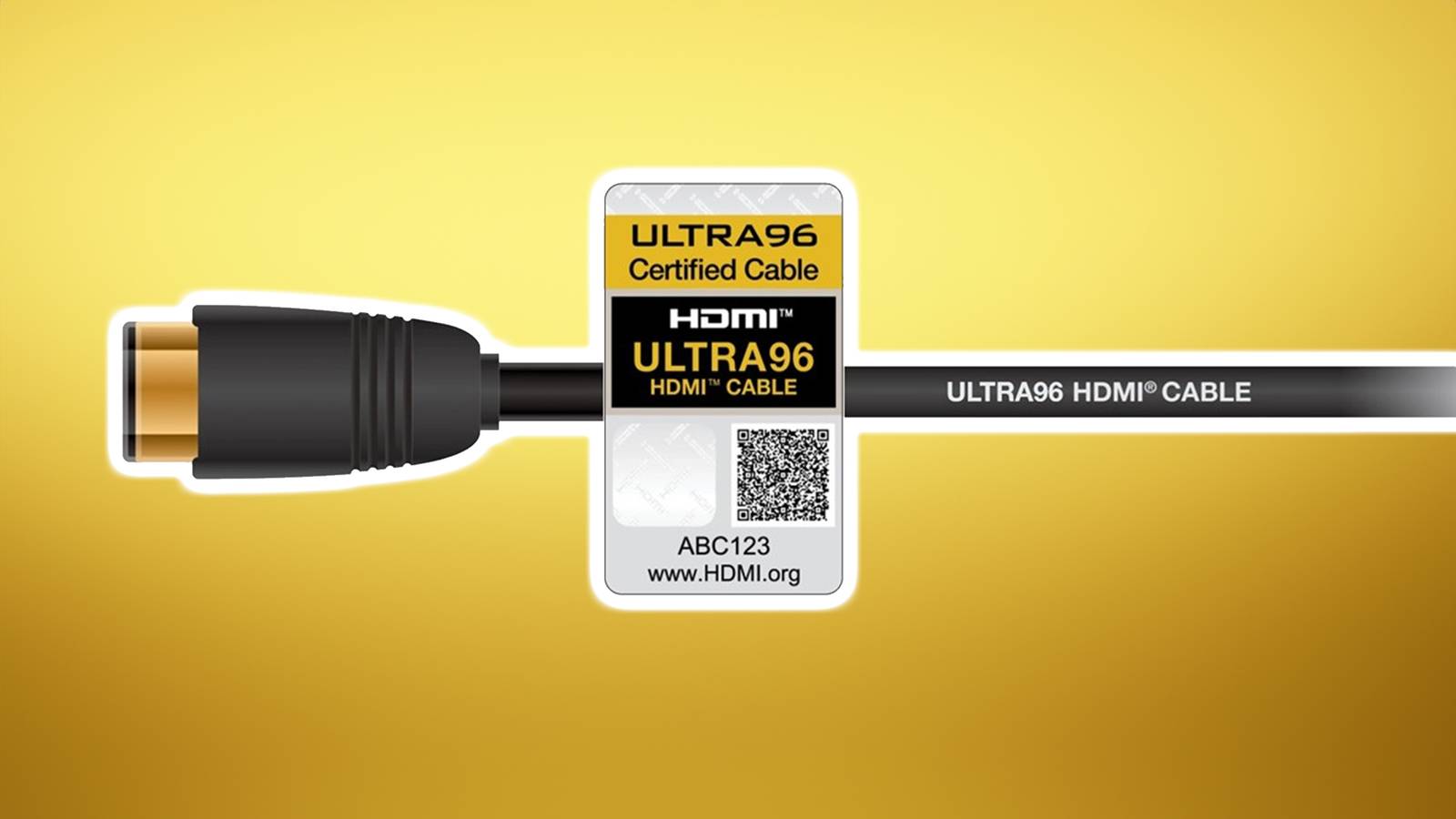
HDMI 2.2 represents a huge jump forward. Whereas 2.1 tops out at 48Gbps (gigabits per second), 2.2 starts at 64Gbps, rising to 80 or 96Gbps. You might see “Ultra96” branding on some cables, regardless of whether they actually support 96Gbps. The easiest way to shop is by searching for “HDMI 2.2” or “16K,” for the record.
The HDMI 2.2 pipeline is wide enough that it can handle a colossal 16K at 60Hz, and 4K at 480Hz.
That last label is a tipoff. The 2.2 pipeline is wide enough that using compression, it can handle a colossal 16K at 60Hz, and 4K at 480Hz. Higher refresh rates allow for smoother video, as well as higher framerates for PC and console apps without producing visual artifacts.
There’s more. Another addition to the standard is the Latency Indication Protocol, or LIP, which improves lip sync on home theater systems with “multi-hop” configurations, i.e. ones that include receivers or soundbars. 2.2 cables also wrap in every technology baked into every iteration of 2.1, such as eARC, variable refresh rates, and Source-Based Tone Mapping (SBTM), the last allowing input devices to perform some of their own HDR mapping instead of foisting everything on your TV.
The HDMI 2.2 spec became official in June 2025. So why would anyone say that it’s going to be irrelevant in 2026, and probably even 2027?
Too fast, too soon
Overshooting the horizon

When I’m driving, a sight that always sticks in my brain for a moment is someone with a high-performance SUV, such as a Porsche, or some BMWs and Land Rovers. I’d love to drive one too, if I won it in a contest — but otherwise, they feel like a huge waste of money to me. A Porsche Cayenne will never, ever be as fast as a 911 or 718 Cayman of the same model year, and it’s more likely to be used for commuting and grocery runs than joyrides.
HDMI 2.2 represents a similar kind of overkill. There aren’t any 10K TVs in stores, never mind ones with 12 or 16K resolution. More importantly, there isn’t the faintest hint of one shipping in the next several years. Major brands like LG, TCL, and Sony have actually retreated from the 8K market. There’s no consumer demand, owing to the fact that the only quasi-reliable source of 8K content is YouTube. That, in turn, is because 8K consumes massive amounts of internet bandwidth, and even a lot of Hollywood productions aren’t shot at that resolution.
There isn’t the faintest hint of a 10K, 12K, or 16K TV shipping in the next several years.
The spec’s refresh rates have dubious value as well. While 120Hz can be useful for both consoles and PCs, some games fight to hit 60 frames per second, and there are diminishing smoothness returns for any content past the 120Hz mark. I defy anyone to look at a video or a game on a 240Hz monitor and argue that it’s dramatically better than 144Hz.
As I write this in February 2026, I’m not seeing any TVs with HDMI 2.2 on the market. Let that sink in — you could buy Samsung’s 114-inch MicroLED TV, potentially priced as much as a small house, and still end up with HDMI 2.1. But why would you clamor for more when its color, contrast, and brightness are going to remain mind-blowing at 4K120? There’s no reason at all to go over 4K on a more conventionally-sized TV, since the human eye often fails to spot the difference with upscaled 1080p.
So what’s the holdup with HDMI 2.2?
Cost and a natural delay

You might think that despite the absence of practical value, some companies would be eager to add HDMI 2.2 to their devices for bragging rights. That tactic is extremely common across multiple product categories. Apple regularly promotes the iPhone 17 Pro for its filmmaking capabilities, for instance, knowing full well that most owners won’t shoot 4K ProRes footage of their kid’s birthday party. It’s probably why those Cayenne drivers exist. 0-60 times might be a ridiculous reason to get an SUV, but it feels good knowing you can smoke your neighbor’s Ford Explorer.
One potential explanation for the delay is cost. Newer and faster components cost more money — and while that might be just a few extra dollars or cents in this case, that adds up quickly when you’re shipping millions of TVs annually. It’s why some cheaper units still include HDMI 2.0 ports, pretending that 2.1 hasn’t been on the radar since 2017.
On a normal schedule, it still takes months to design, test, and manufacture new TV models. So realistically, the earliest we might see HDMI 2.2 on TVs is closer to fall 2026.
My own vote, however, is for an inherent delay in bringing new standards to market. It took about two years for HDMI 2.1 to actually arrive in consumer products. That was unusual, but on a normal schedule, it still takes months to design, test, and manufacture new TV models. So realistically, the earliest we might see 2.2 on TVs is closer to fall 2026, conveniently in time to exploit the holiday shopping season, and be ready for 2027 Super Bowl promotions.
As I’ve hinted repeatedly though, you probably won’t get anything meaningful out of 2.2 for years beyond that. You could plausibly buy a TV today and feel little to no pressure to upgrade in 2036, at least not because of HDMI compatibility. I’m ready to stand corrected — new technologies do sometimes come out of leftfield. Maybe whole-wall 10K displays will be all the rage in 2036.