WE ARE three rounds into the National Hurling League and already clear patterns are emerging to go with a whole host of talking points.
And the team dominating debates are Cork, whose new senior hurling manager Ben O’Connor has made such a public splash that he was being namechecked at the Aviva Stadium during a League of Ireland soccer match.
Now, there’s a crossover.

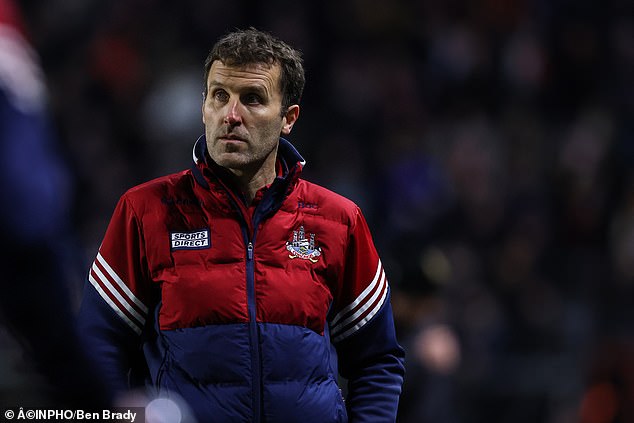
Talk of the town: Cork hurling manager Ben O’Connor has made a big impact
When Bohemians manager Alan Reynolds was asked about a rash challenge early doors after a 0-0 draw in front of an attendance of over 20,000, he replied tongue in cheek: ‘If that’s a red card we might as well go home! I sound like the Cork hurling manager do I, giving out?’
Which just shows the extent to which O’Connor’s outspoken views post-match have gone viral. And Cork’s three-time All-Ireland winner – no more than his playing days – refused to back down after his statement in the wake of the win over Galway that hurling was being sanitised.
That it was ‘gone like soccer’ and that between: ‘Black cards, red cards, yellow cards, technical areas, we’re following that game. That’s the fellas above trying to cleanse hurling…’ he insisted.
‘They don’t want any dust-up, they don’t want any bit of blood spilt, they don’t want a hurley broken, they want to make it a nice game for “my little Johnny” at home.
‘Genuine hurling people don’t want that. They want a good, hard physical game.’

Toughing up: O’Connor favours hard, physical hurling from his Cork side
And O’Connor fully doubled down after Cork’s third win on the bounce – this time against Tipperary on Saturday night.
That’s despite an unseemly melee – roughly five minutes of players pushing and jostling which ended up with Jason Forde and Shane Barrett red-carded for ‘contributing to a melee’.
As Joe Canning pointed out on Sunday evening, ‘Why didn’t he send off the 30 players then?’
Because most of those on the field fell into that category.
There is a simple fix. Jim Gavin’s Football Review Committee helped change the same offence in Gaelic football to a black card, rather than a red card offence. Which emboldens referees to actually punish any guilty parties with a 10-minute sin bin. The game has been tidied up as a direct result.
It’s hard to understand how there isn’t a motion to the GAA’s Annual Congress later this month bringing uniformity.

Rethink: Cork showed a tactical change against Tipp from the Pat Ryan era
Meanwhile, as radio commentator Oisin Langan suggested: ‘Ben O’Connor has filled the Damien Duff void’.
Certainly, no one has done more to generate debate around the hurling league. The key now for Cork is to back it up with action and, after two agonising All-Ireland defeats, bring an end to the Liam MacCarthy drought that now goes back more than 20 years.
Meanwhile, it was another round of league action and another flurry of black cards. Last summer, it was like the 10-minute sin bin and automatic penalty didn’t exist.
In 2024, the image of Limerick’s Kyle Hayes grabbing Cork’s Shane Kingston with both arms and grounding him to deny a clear goalscoring opportunity in the Munster group game felt like vindication for the introduction of the rule. Hayes was rightly black-carded, Patrick Horgan nailed the penalty and Cork went on to win and get on a run all the way to the All-Ireland final.
That there were so few instances last summer was evidence that it was working.
And yet for this year’s league, suddenly, they are being given out like confetti. Referees are clearly following a new edict.

Box office: Cork hurlers are the biggest show in town as they continue their quest to end the All-Ireland drought
Which is head-scratching in the first place before you factor in the clear misapplication of the rule. The three headline black cards of the weekend were all questionable. Carlow’s Kevin McDonald went for an accidental trip at a crucial stage of the Wexford game, Tipperary’s Johnny Ryan for minimal contact in the tackle and then Kilkenny’s Mikey Carey for tugging the arm of Diarmaid Byrnes.
In previous leagues, we’ve had head-high tackle clampdowns, we’ve had handpassing clampdowns. Each time, Championship has been refereed a different way.
And now this. Ben O’Connor has a point.
After last year’s All-Ireland final implosion in the second half, Cork remain the most interesting team to watch out there right now.
Tactically, there has been an obvious shift. Under Pat Ryan, Cork went back to the future to get great goal-scoring joy out of a three-man inside line, with Patrick Horgan, Alan Connolly and Brian Hayes peaking with that seven-goal demolition of Dublin in the semi-final.
Last Saturday night, it was again noticeable how Connolly and Declan Dalton were usually the two inside, with William Buckley buzzing around or dropping off – or Connolly taking turns to do likewise.
A two-man inside line with one forward dropping is how so many other teams set up, especially as it allows teams to create a plus one around midfield or their own half-back line.
But there can be an obvious downside in reducing a goal threat or presence around the goal.
Was it a coincidence that Cork carried such little goal threat against Tipperary?
The only serious save Rhys Shelly made was from a debatable black card penalty.
Not since the 2024 All-Ireland quarter-final against Dublin have Cork failed to raise a green flag. That game ended 0-26 to 0-21 in Cork’s favour. One mitigating explanation: an illness in the camp.
Cork scored 15 goals in the group stage of the league last year, en route to the final. Ten alone in the last two rounds against Clare and Galway.
After three of their six games this year, they have scored five.
Put Brian Hayes back into the starting line up and the chances should increase.
But, even still, whether Cork stick or twist with two inside will be significant to their style of play, whether it’s less direct and more through the lines and utilising the serious pace of Darragh Fitzgibbon, Shane Barrett and Diarmuid Healy.
Of the four teams in Division 1A who have played three games, no team has scored more than Cork who are +89 (5-74), four points more than Tipperary, a full 23 more than Waterford and 35 more than Offaly.