

Bunnings is making its boldest move yet beyond hammers and nails, throwing its retail muscle behind prefabricated tiny homes as policymakers scramble for answers to Australia’s housing affordability crunch.
The hardware giant has partnered with Melbourne start-up Elsewhere Pods to sell flat-pack tiny homes ranging from double-storey dwellings to standalone rooms that are designed to be assembled without a building permit.
Bunnings is listing the pods online and through its in-store special orders desk, offering two models: a 2.7m × 2.4m room for $26,100 and a larger 4m × 2.4m studio for $42,900.
The retailer said the units can be assembled in as little as two days, pitching them as DIY-friendly options for crisis accommodation, home offices, yoga studios or teenage retreats.
A traditional detached home in Australia can take a year or longer to build.
Elsewhere Pods was founded four years ago by Matt Decarne after his mother lost her Byron Bay home in the 2020 floods, exposing what he describes as the slow, costly and bureaucratic nature of traditional rebuilding.
He quit his job in international trade and finance and began developing flat-pack, modular eco-pods designed to be installed in days rather than months.
‘I saw neighbours stuck in caravans and tents while rebuilds dragged on because of red tape, trade shortages and material delays,’ he said.

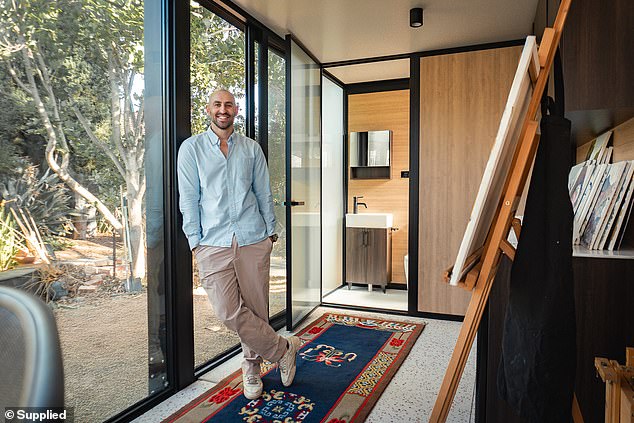
Matt Decarne (pictured) started the company after his mother lost her Byron Bay home in the 2020 floods, exposing the slow, costly and bureaucratic nature of traditional rebuilding

Bunnings is listing the pods online offering two models: a 2.7m × 2.4m room for $26,100 and a larger 4m × 2.4m studio for $42,900

The tiny homes are a flat pack, similar to a high‑tech Lego or a luxury version of Ikea
‘I knew there had to be a better way, not just for families recovering from disasters, but for anyone struggling with housing affordability or wanting a more sustainable option.’
The company has since generated more than $9 million in sales, with demand doubling year-on-year as customers turn to small, energy-efficient housing options ranging from backyard studios and granny flats to three-bedroom dwellings.
‘Everything arrives as a flat pack and our install team assembles it on site. It’s like high-tech Lego or a luxury version of Ikea.’
The rise of tiny homes reflects a broader shift in how Australians are thinking about housing.
The Australian Tiny House Association estimates more than 10,000 people are now living in tiny homes or pods nationwide, a figure expected to rise sharply over the next five years.
Industry data shows the prefabricated building market, which includes tiny and modular homes, is projected to grow at around 7 per cent annually to reach $18 billion by 2030.
Mr Decarne said part of the appeal lies in the ability to avoid lengthy planning processes.
‘Many tiny homes, including some of our designs, don’t trigger planning or building approvals, which is a huge drawcard,’ he said.

Warehouse giant Bunnings is helping to address Australia’s acute housing crisis by selling flat pack tiny homes that can be assembled in a matter of days
Before striking the deal with Bunnings, about 40 per cent of Elsewhere Pods sales were to Airbnb investors seeking income from regional properties, with another 30 per cent going into eco-tourism developments.
‘Our pods are in some of Australia’s most beautiful locations,’ Mr Decarne said. ‘People are paying for a place where they can disconnect, sit in nature and still have a high-quality, design-led home.’
Under the Federal Government’s ambitious Housing Accord, 1.2 million new homes were meant to be built by 2029.
But the nation is forecast to miss that target by a staggering 426,000 homes, according to the latest Propertybuyer’s Australian property market outlook.
The looming gap is expected to intensify pressure on prices, rents and housing affordability, deepening Australia’s housing crisis.
Federal and state building ministers have explicitly positioned modular and prefabricated housing as a necessary part of solving the supply crunch, not a boutique alternative.
Modular housing is shaping up to be NSW’s secret weapon in tackling the housing crisis, with the state among the first in Australia to embrace this technology at scale.
Over the 2025–26 financial year, the NSW Government will deliver 90 modular homes across the state, which includes 80 duplexes on 40 sites across Greater Sydney and regional NSW.

NSW Housing Minister Rose Jackson (pictured) said there are thousands of people who are desperately looking for a roof over their heads
Housing Minister Rose Jackson said there are thousands of people who are desperately looking for a roof over their heads.
‘These aren’t shitboxes. They are beautiful, modern homes built to last. Families will be proud to live in them,’ she said.
‘Modular housing is already used across Europe and around the world.’