Conny Waters – AncientPages.com – Deep within the dense rainforests of northern Guatemala, archaeologists have uncovered newly discovered ancient Maya stucco sculptures, adding to a remarkable, one-of-a-kind collection of expressive sculpted faces recovered from a single ceremonial structure at El Mirador.
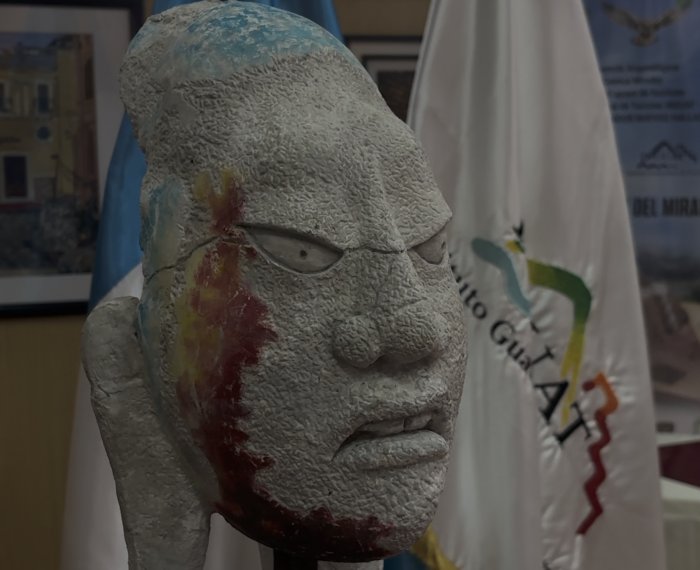
This painted stucco Maya sculpture from El Mirador, Guatemala, still shows some red and blue pigments on its face. Credit: INGUAT
The findings were announced during a presentation hosted by the Mirador Basin Archaeological Project and the Guatemalan Tourism Institute, titled Los Rostros del Mirador, or The Faces of El Mirador. Excavated during the latest field season, the newly found pieces emerge from the Edificio de los Rostros, known as the Building of the Faces, a modest structure located in the Casa del Coral architectural group just east of the colossal La Danta pyramid complex.
An Unprecedented Concentration
With the latest additions, the Building of the Faces has now yielded dozens of sculpted stucco heads and fragments since excavations in the area began more than a decade ago. According to project researchers, no other single building in the Maya world has produced such a high concentration of stucco portraiture.
Project archaeologist Douglas Mauricio Martínez noted that no known example anywhere in the Mayan world has produced so many sculptures from a single structure.
While the newly unearthed sculptures remain fragile and must undergo delicate stabilization and restoration before researchers can determine their specific identities, earlier pieces recovered from the same building depict a vivid cross-section of the ancient Maya cosmos and social hierarchy. Researchers have identified probable deities—including the Maya Death God—alongside mythological figures, ancestors, and prominent members of the ruling elite, such as a female portrait nicknamed La Princesa Azul, or the Blue Princess, for its surviving blue pigment.
Masterpieces Of Ancient Craftsmanship
Unlike El Mirador’s towering pyramids—which date primarily to the Preclassic period—the Building of the Faces sculptures date largely to the Late Classic period. During this era, smaller Maya communities reoccupied the ancient metropolis, honoring their Preclassic ancestors while adorning ceremonial spaces with intricate lime-plaster art.
Hand-molded over limestone supports, the life-sized heads display extraordinary individuality and technical skill. The faces capture distinct ages and human emotions—from furrowed brows to broad smiles—while showcasing traditional Maya aesthetic practices such as cranial deformation and dental modifications. Traces of original red and Maya blue paint still cling to several restored pieces.
Lilian Vega de Zea, restoration director for the Mirador Basin Project, noted that producing the sculptures required a highly coordinated team of specialists, from artisans who mixed the lime stucco and prepared mineral pigments to live models who posed for the portraits. She emphasized that the work demonstrates the advanced technology the Maya possessed in their craft, adding that the prominent display of elite figures served as a message to society depicting individuals who held authority.
El Mirador: Cradle Of Maya Civilization
Long before these Late Classic sculptures were modeled, El Mirador flourished as one of the earliest and largest metropolises of the ancient Maya world. Flourishing during the Preclassic era—centuries before famous Classic cities like Tikal or Palenque reached their peak—the city served as the capital of a powerful early state that pioneered monumental architecture, urban planning, and early hieroglyphic writing.
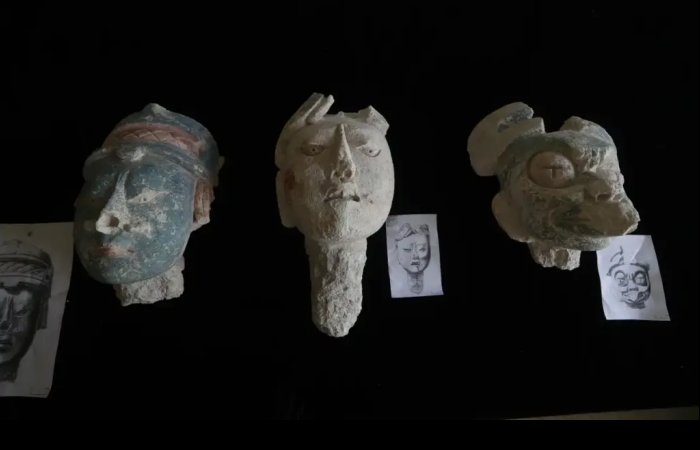
New Maya sculptures have been discovered at El Mirador in Guatemala. Photo credit: Prensa Libre, Erick Avila
Surrounded by vast wetlands and connected to neighboring cities by elevated stone causeways known as sacbeob, El Mirador was an engineering marvel. Its skyline was dominated by massive triadic pyramid complexes, most notably El Tigre and La Danta, the latter ranking among the world’s largest pyramids by volume. Intricate lime-plaster friezes, including early depictions of the Maya creation myth known as the Popol Vuh, adorned its temples and sophisticated water-collection reservoirs.
Following a mysterious collapse and widespread abandonment at the end of the Preclassic period, the great city lay largely reclaimed by the jungle for centuries until smaller Maya groups returned during the Late Classic period to live among—and pay tribute to—the towering ruins of their ancestors.
Preserving A Fragile Legacy
Many of the sculpted heads from the Building of the Faces have already been fully restored, with several housed at Guatemala’s National Museum of Archaeology and Ethnology and others displayed at the project’s conservation laboratory in Guatemala City.
See also: More Archaeology News
Archaeologists note that past looting in the Casa del Coral group disturbed surrounding stonework and scattered architectural context, making careful excavation and laboratory stabilization all the more urgent. As conservationists begin work on the newest finds, researchers hope the growing gallery of faces will shed further light on the spiritual life, artistry, and ancestral devotion of El Mirador’s later inhabitants.
Written by Conny Waters – AncientPages.com Staff Writer
Expand for references
Source:
Diario de Centro América (Guatemala’s Official Government Gazette)
Richard M. Allen – The Terminal Classic at El Mirador, Petén, Guatemala, Brigham Young University (BYU) Scholars Archive