Jan Bartek – AncientPages.com – A tiny, 100-million-year-old flower no larger than a grain of rice has been discovered entombed inside a rock collected over a century ago, offering scientists their oldest look yet at the evolutionary blueprint behind modern palms, grasses, and orchids.
Described in a new study published in the American Journal of Botany, the newly identified species—named Tomlinsoniella pedicellata—dates back to the mid-Cretaceous period. Measuring just 1.5 millimeters high and 1.2 millimeters wide, the blossom represents the earliest known fossil record of a flower displaying the classic structural symmetry of monocots. This massive plant group makes up roughly 20% of all flowering species today.
“Lots of monocots have gone on to evolve more complicated variants on this, but this exhibits the features of the basic monocot flower,” said lead author Bruce Tiffney, a professor emeritus of paleobotany at UC Santa Barbara. “And we’ve got it a hundred million years ago.”
A Chance Discovery In A Century-Old Specimen
T. pedicellata comes from the Dakota Formation, a geologic unit in Midwestern North America famous for the fossils, particularly leaves, within its sandstones. About 100 million years ago, what is now Kansas lay along the coast of a vast interior seaway that stretched across today’s Great Plains. From the 1870s through the 1890s, pioneering paleobotanist Leo Lesquereux collected and studied samples from this formation. Since then, many of these specimens have been held in the Smithsonian National Museum of Natural History’s collections in Washington, D.C.
Pioneering paleobotanist Leo Lesquereux excavated the rock housing the fossil in the late 19th century from the Dakota Formation in Kansas, and it has sat in the Smithsonian National Museum of Natural History’s collections for more than 130 years.
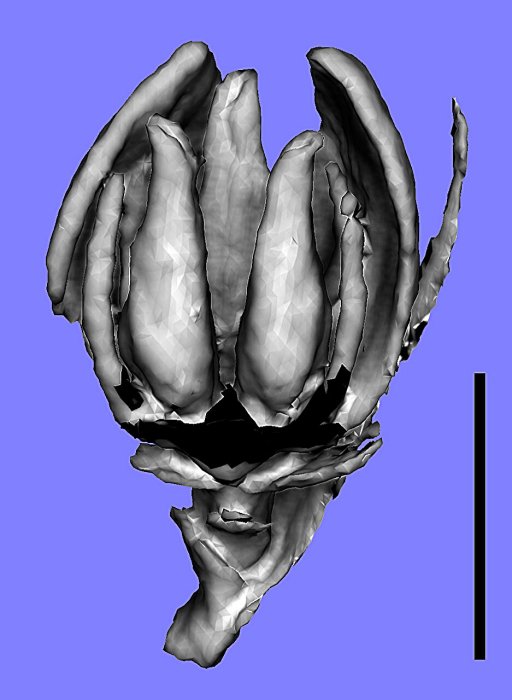
Scientists found this remarkable fossil flower while scanning a sandstone specimen that was collected from the Dakota Formation over 130 years ago. Its shape resembles modern monocots, and experts think it could be an ancient ancestor of today’s palms. Credit: Steven Manchester, Florida Museum of Natural History
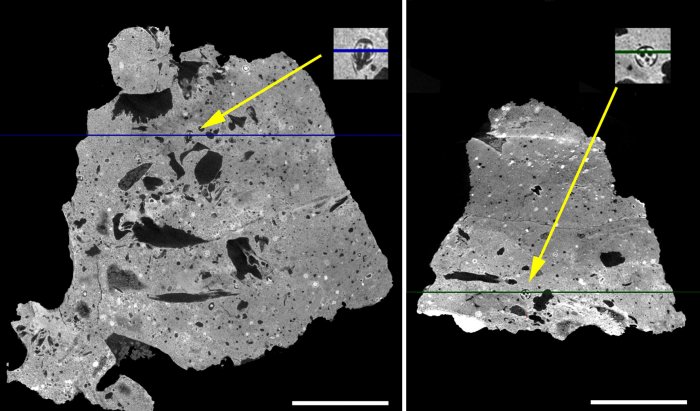
The hidden flower was found entirely by accident when paleobotanist Steven Manchester of the Florida Museum of Natural History borrowed the sandstone specimen to examine a different, surface-level fossil flower using a micro-CT scanner. While using high-resolution X-ray imaging to peer inside the stone, Manchester spotted a hollow, flower-shaped cavity completely encased in rock.
Millions of years ago, the blossom had fallen into clay-rich sand that hardened around it before the organic plant tissue decayed. By digitally inverting the 3D X-ray scan of the remaining void, researchers reconstructed an exact positive model of the ancient flower.
A Familiar Blueprint From The Age Of Dinosaurs
When Manchester shared the 3D scans with UC Santa Barbara paleobotanist Bruce Tiffney and University of Minnesota botanist Walter Judd, the team immediately recognized the flower’s distinct geometry.
Like modern lilies, tulips, and daffodils, T. pedicellata features floral parts arranged in five concentric rings of three: three sepals, three petals, six stamens in two sets of three, and three separate carpels.
The fossil is about the size of a grain of rice. It has three sepals, three petals, six stamens (male parts) arranged in two groups of three, and three carpels (female parts). These traits are typical of monocots. Credit: Steven Manchester, Florida Museum of Natural History
“A cross section of the fossil could easily be taken for a monocot flower diagram found in a modern botany textbook,” the researchers noted.
This basic monocot blueprint is familiar to gardeners today, as shown by lilies, tulips, and daffodils, all of which display this arrangement of flower parts. In fact, a cross section of the fossil could easily be taken for a monocot flower diagram found in a modern botany textbook. “It is simply astounding to find a flower, which would seem familiar to us if we saw it alive today, in such an ancient rock,” said co-author William Baker, senior research leader in taxonomy and systematics at the Kew Gardens, in London.
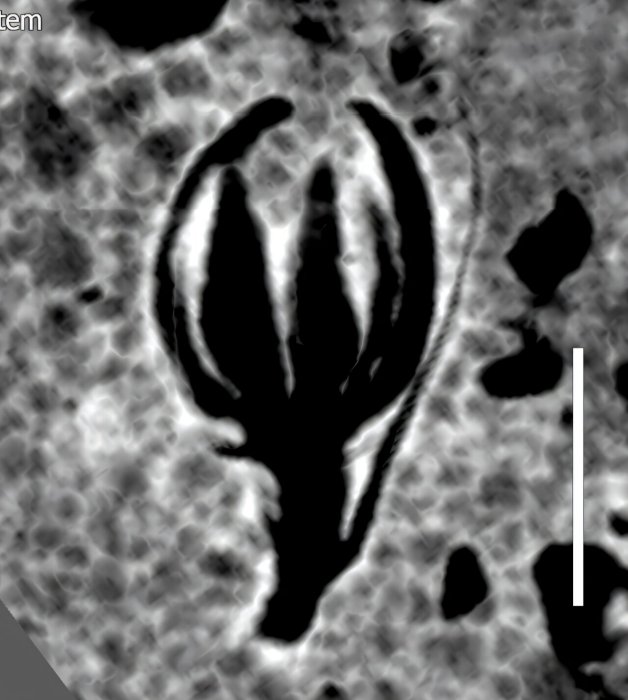
The authors think the Tomlinsoniella fossil looks most like the flower of an extinct palm species, probably from a palm subfamily. Credit: Steven Manchester, Florida Museum of Natural History
Baker, who helped confirm the plant’s identity alongside palm expert John Dransfield, called the find an “incredible thrill,” adding that the 100-million-year-old blossom looks so modern it would not seem out of place growing alive today.
Pushing Back Palm History
Because the flower’s female parts (carpels) are separate rather than fused—a trait seen in very few modern monocot lineages—the team concluded that T. pedicellata is most likely an extinct member of the fan palm subfamily, the same group that includes today’s California and Mexican fan palms. If confirmed, the discovery pushes back the geologic fossil record for fan palms by nearly 20 million years.
See also: More Archaeology News
While DNA evidence has long indicated that monocots originated in the Early Cretaceous, very few monocot fossils have been found in deposits older than the late Cretaceous. This has left scientists unsure how they fit into the early evolution of flowering plants. “The timing of the origins of flowering plants remains one of biology’s unsolved mysteries,” Baker remarked. “A fossil like this brings us a step closer to the answer.”
Additional analysis and research will reveal more about how T. pedicellata fits into the wider tree of life. Its discovery is certainly an important new piece for our understanding of how flowering plants evolved during the age of dinosaurs.
The study was published in the journal American Journal of Botany
Written by Jan Bartek – AncientPages.com Staff Writer