

Jan Bartek – AncientPages.com – Archaeologists excavating at the world-famous Sutton Hoo burial ground have uncovered a rare, fossil-like “sand body” alongside personal artifacts and compelling evidence of a second grave hidden directly beneath it.
The discovery was made during a month-long dig conducted by the television archaeology series Time Team in partnership with the National Trust, which has cared for the Suffolk estate since 1998.
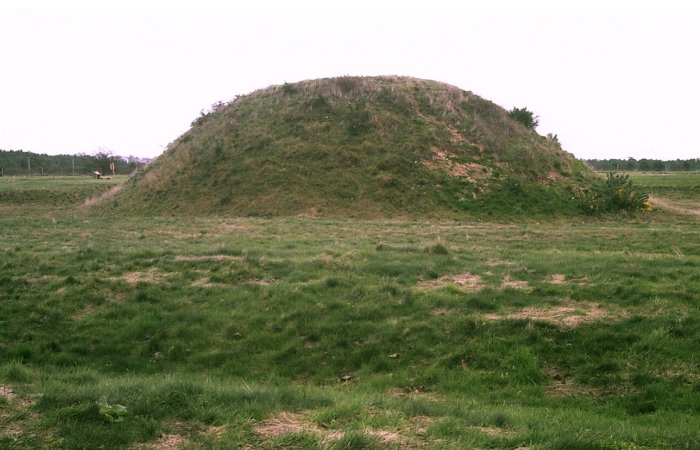
Burial mound 2 at Sutton Hoo, England; as reconstructed after excavation to its supposed original Anglo-Saxon form, looking east, showing the surrounding quarry-ditch. Credit: Dr Steven Plunkett – CC BY-SA 2.5
While Sutton Hoo is internationally renowned for its monumental 7th-century royal burial mounds and the 27-meter oak ship burial unearthed in the late 1930s, this investigation shifted its focus away from royalty. Instead, researchers concentrated on Garden Field—a separate, lesser-known cemetery on the estate that holds the remains of everyday Anglo-Saxons.
A Landscape Steeped In Royal History
To appreciate why the Garden Field findings matter, historians point back to the summer of 1939, when Sutton Hoo forever changed how scholars viewed early medieval Britain. Overlooking the River Deben, the site consists of around 18 earthen burial mounds dating to the 6th and early 7th centuries. At the request of landowner Edith Pretty, self-taught local archaeologist Basil Brown excavated the largest mound, Mound 1.
Beneath the earth, Brown and a team of national specialists uncovered the ghostly imprint of a 27-meter-long oak ship.
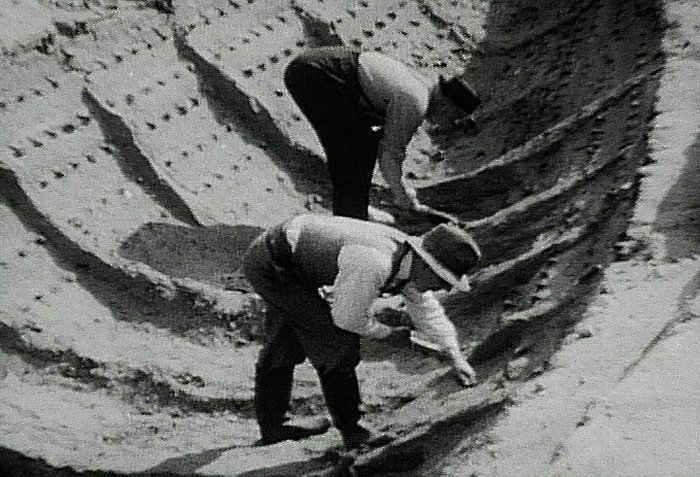
A so-called ‘ghostly’ image of the buried ship was revealed during excavations in 1939. The ‘ghost’ effect resulted from sand discolored by organic matter that had rotted away. Still from a film made by H. J. Phillips, brother of Charles Phillips. Credit: Public Domain
Inside its central burial chamber lay one of the richest intact medieval graves ever discovered in Europe, widely believed to belong to King Rædwald of East Anglia, who died around AD 625. Filled with Frankish gold coins, Byzantine silverware, garnet-inlaid gold and cloisonné jewelry, a ceremonial whetstone, and the iconic human-masked Sutton Hoo helmet—now housed at the British Museum—the treasure shattered the long-held myth that post-Roman Britain had descended into an unsophisticated “Dark Age.” Instead, it proved that East Anglia was part of a wealthy, internationally connected society with trade links stretching across Europe and the Mediterranean.
Later excavations in the 1960s and 1980s, led by scholars such as Rupert Bruce-Mitford and Martin Carver, revealed even more complex details about the site, including execution burials arranged around the royal mounds and evidence of how the cemetery evolved as Christianity gradually took hold in the region.
How A ‘Sand Body’ Forms
The sandy, gravel-rich soil along the Suffolk river valley is notoriously acidic. Over more than a millennium, those harsh chemical conditions dissolve human bones, teeth, and soft tissue completely—which is why no skeleton was ever found inside the great ship burial of Mound 1.
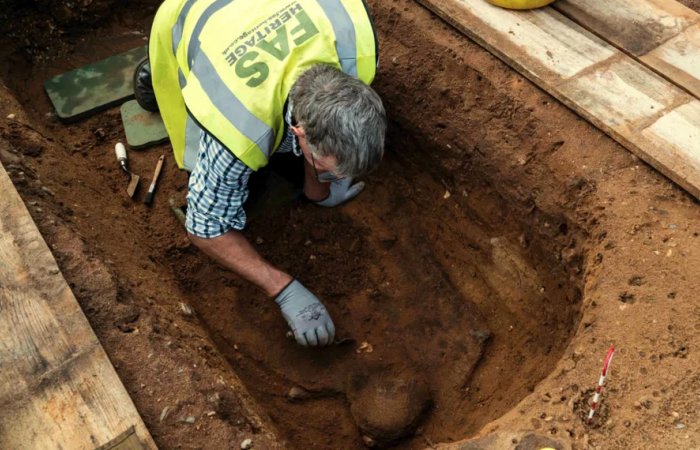
The discovery of the sand body. Image Credit: National Trust
Yet in rare instances, the decaying organic matter stains and cements the surrounding grains of earth. The result is a hardened, three-dimensional dark silhouette in the soil—a phenomenon archaeologists refer to as a “sand body.” First documented at Sutton Hoo during Martin Carver’s major excavations in the 1980s, these impressions preserve the exact posture and proportions of the deceased, resembling a fossil or the famous ash casts of Pompeii.
National Trust archaeologist Angus Wainwright highlighted the significance of uncovering another of these rare profiles in the Garden Field cemetery, which sits near the modern visitor center and was first identified during construction work in 2000.
“Until now archaeologists have focused on the royal burial mounds,” said Wainwright.
“Yet these mounds stood in a landscape of significance to the Saxon kings, as well as one familiar to the everyday East Anglians who lived in the villages and farms of the river valley. This excavation moves the focus to these people and their ancestors and descendants.
“One of the strangest features of the excavations at Sutton Hoo in the 1980s was the discovery of the ‘sand bodies’. These were burials where the bodies and bones had dissolved away in the acid soil, replaced by hard sand which held the form of the person not unlike some of the bodies at Pompeii. It was certainly a high point of this latest dig, to find another of these bodies in the Garden Field cemetery”.
Everyday Artifacts And Stacked Graves
Found during the final week of the dig, the individual was accompanied by personal items including a brooch, decorative beads, a small iron knife, and a pair of tweezers. Such everyday accessories help specialists determine the deceased’s age, gender, and community standing, offering an intimate contrast to the gold and silver weaponry of the nearby royal mounds.
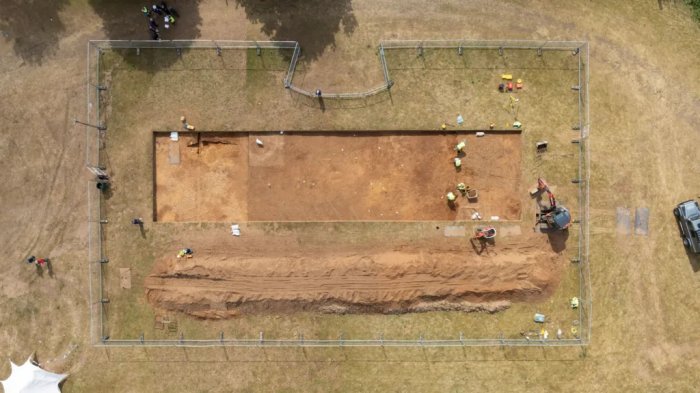
This was the main trench that was opened up by the team during the 2025 dig. Credit: National Trust Images/James Dobson
Remarkably, excavation of the grave cut revealed an earlier burial directly beneath the silhouette, raising questions about cemetery density and potential family or community ties. Wainwright noted that the project shifts attention from royal mounds to the wider landscape inhabited by ordinary villagers and farmers who lived, worked, and farmed along the Deben valley
Broader Research And Documentary
The work in Garden Field forms part of a two-year landscape study aimed at mapping how the entire estate was used before, during, and after the Anglo-Saxon era. Alongside the sand body, the team examined the intact base of the 6th-century Byzantine Bromeswell Bucket, a rare imported copper-alloy vessel decorated with hunting scenes that contained a cremation burial and grave goods.
See also: More Archaeology News
Time Team specialist Dr. Helen Geake acknowledged that laboratory analysis—including soil chemistry testing and radiocarbon dating—will be required to answer remaining questions about when the individuals lived and how the two cemeteries related to one another. The excavation is featured in a four-part documentary series hosted by Sir Tony Robinson on the Time Team YouTube channel.
Source: National Trust, BBC
Written by Jan Bartek – AncientPages.com Staff Writer