


Follow us
Add us as a preferred source on Google
Voyager 1 is about to reach a light-day of distance in space, but Voyager 2 won’t hit the mark until about 2035. Why the big difference?
On Nov. 18, Voyager 1 will be so far away from Earth that it will take a full light-day (24 hours) to send a signal to the distant spacecraft, at 16,094,799,096 miles (25,902,068,356 kilometers). Since light is essentially the maximum speed in the universe (absent using devices like wormholes, or quantum-physics puzzles), it’s a big deal — so big that NASA will be celebrating the milestone by asking fans to shine Morse Code signals at the sky.
But why will Voyager 2 take nearly a decade longer? It comes down to choices made for speed and science during the twin missions’ nearly 50-year journey, specifically during the first bit when they were flying by planets. The result is Voyager 1 is zooming out at a speed of 3.5 Earth-sun distances (astronomical units a year), while Voyager 2 has a more stately speed of 3.1 Earth-sun distances, according to NASA.
Need for speed
The original aim of both the spacecraft, which launched about two weeks apart in 1977 with Voyager 2 going first, was to look at Jupiter and Saturn. If funding persisted, which it did, the hope was to bring Voyager 2 past Uranus and Neptune, taking advantage of a rare planetary alignment. Voyager 1, by contrast, made a turn at Saturn to look at the planet’s rings and the prebiotic (pre-life-chemistry) moon of Titan, before flying outside the plane of the solar system.
NASA had a range of trajectory options to consider when launching the spacecraft, and elected to bring Voyager 1 at a faster trajectory — as illustrated in this video by Britannica, where you can quickly see the spacecraft overtaking Voyager 2 on its way to Jupiter even though Voyager 1. Voyager 1 arrived at Jupiter on March 5, 1979 while Voyager 2 got there four months later on July 9.
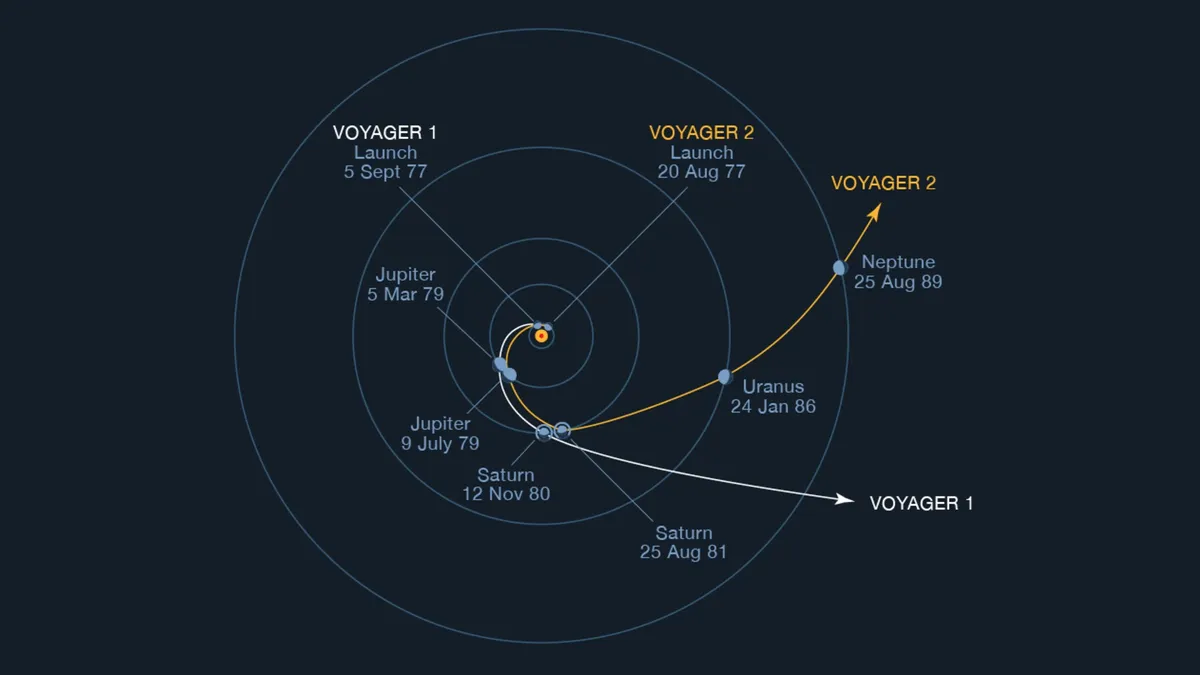
Each of the spacecraft then performed a “gravity assist”—a sort of slingshot around the planet in which they took a tiny bit of momentum from Jupiter to gain speed as the spacecraft flew to Saturn. This technique is used constantly, such as recently when the ESCAPADE Mars mission flew two spacecraft by Earth on the way to the Red Planet, as it allows spacecraft to gain speed while saving on fuel. The planets themselves don’t slow down that much.
“Because the planet is so much more massive than the spacecraft, the transfer doesn’t affect the planet to any measurable extent, but to the spacecraft it’s a big deal,” the Planetary Society wrote. “For example, we can calculate that during the Voyager encounters with Jupiter in 1979, Jupiter slowed down by roughly 10 to the -24th power kilometers per second — a change much too small to measure.”
“But each Voyager gained about 10 km/s [6.2 miles/s], a pretty big number,” the society continued about the Jupiter encounter. This was “enough to put them on a fast path to Saturn — and in the case of Voyager 2, to Uranus and Neptune as well — and eventual escape from the solar system.”
Speeding on to Saturn, and beyond
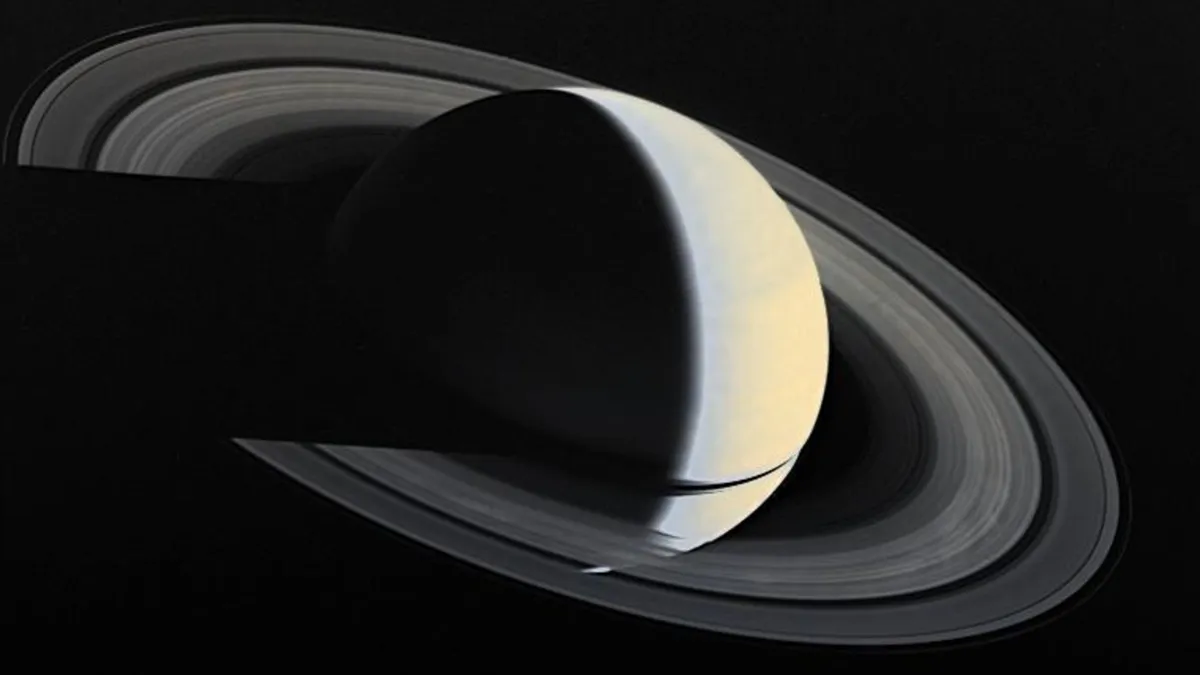
With each flyby, the two spacecraft picked up speed with a single exception — during Voyager 2’s encounter of Neptune. That’s because the spacecraft made a turn to fly by Triton. The maneuver brought Voyager 2 over Neptune’s north pole, before it turned and then was directed to begin “plunging down, out of the plane of the solar system,” losing speed along the way.
Voyager 2, in fact, did not have enough speed to leave the solar system until it flew by Jupiter. “It gained about 10 km/s at Jupiter, about 5 km/s at Saturn, about 2 km/s at Uranus, and lost about 2 km/s at Neptune,” the Planetary Society wrote of the speeds, which are 6.21 miles/s, 3.11 miles/s, 1.24 miles/s and a loss of 1.24 miles/s, respectively.
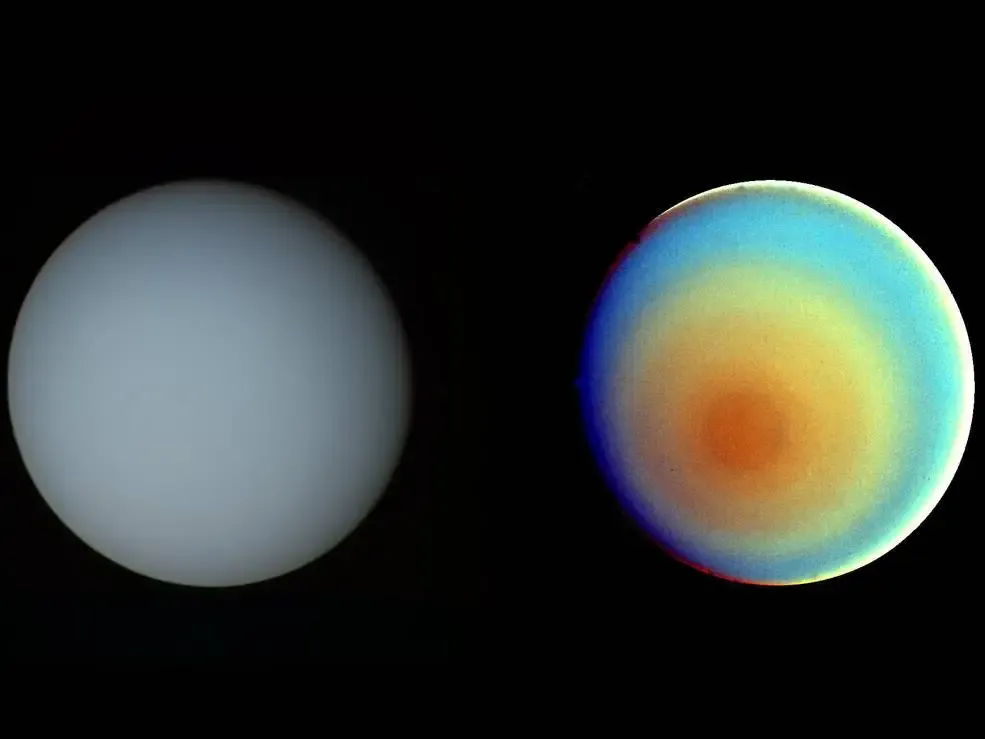
At any rate, these fast speeds allowed both spacecraft not only to go fast, but to eventually reach interstellar space in 2012 (Voyager 1) and 2018 (Voyager 2), respectively. With the light-day milestone now reached by Voyager 1, it is anticipated the spacecraft could work into the 2030s, as long as their nuclear power sources can last.
NASA’s Jet Propulsion Laboratory, which manages the mission, has been carefully turning off instruments as required, and recently did a “Big Bang” procedure on both spacecraft to redistribute power supplies as best as possible. The idea is to maximize science return on both spacecraft, the only interstellar messengers we have, for as long as possible.

