


For weeks now, smoke has hung over the Brazilian city of Manaus, the largest in the Amazon rainforest. On October 17 it had the worst air quality in the world on that day, with fine particulate matter concentrations of nearly 30 times the World Health Organization’s safe daily limit. The country’s civil defense agency has advised residents to wear N95 masks, and schools and universities temporarily suspended in-person classes.
“What’s burning around Manaus is forest,” says Bernardo Flores, an ecologist at the Juruá Institute in Manaus, who studies the Amazon rainforest’s resilience.
In October Brazil’s National Institute for Space Research (INPE) registered 2,271 fire hotspots in the state of Amazonas alone—a 160 percent increase over the same month last year. The blazes mark the beginning of what scientists suspect will be a long and severe fire season—“a year of fires,” Flores says—spurred by a record-smashing El Niño that’s on track to become the largest in living memory. And that has scientists worried for the rainforest’s long-term survival.
On supporting science journalism
If you’re enjoying this article, consider supporting our award-winning journalism by subscribing. By purchasing a subscription you are helping to ensure the future of impactful stories about the discoveries and ideas shaping our world today.
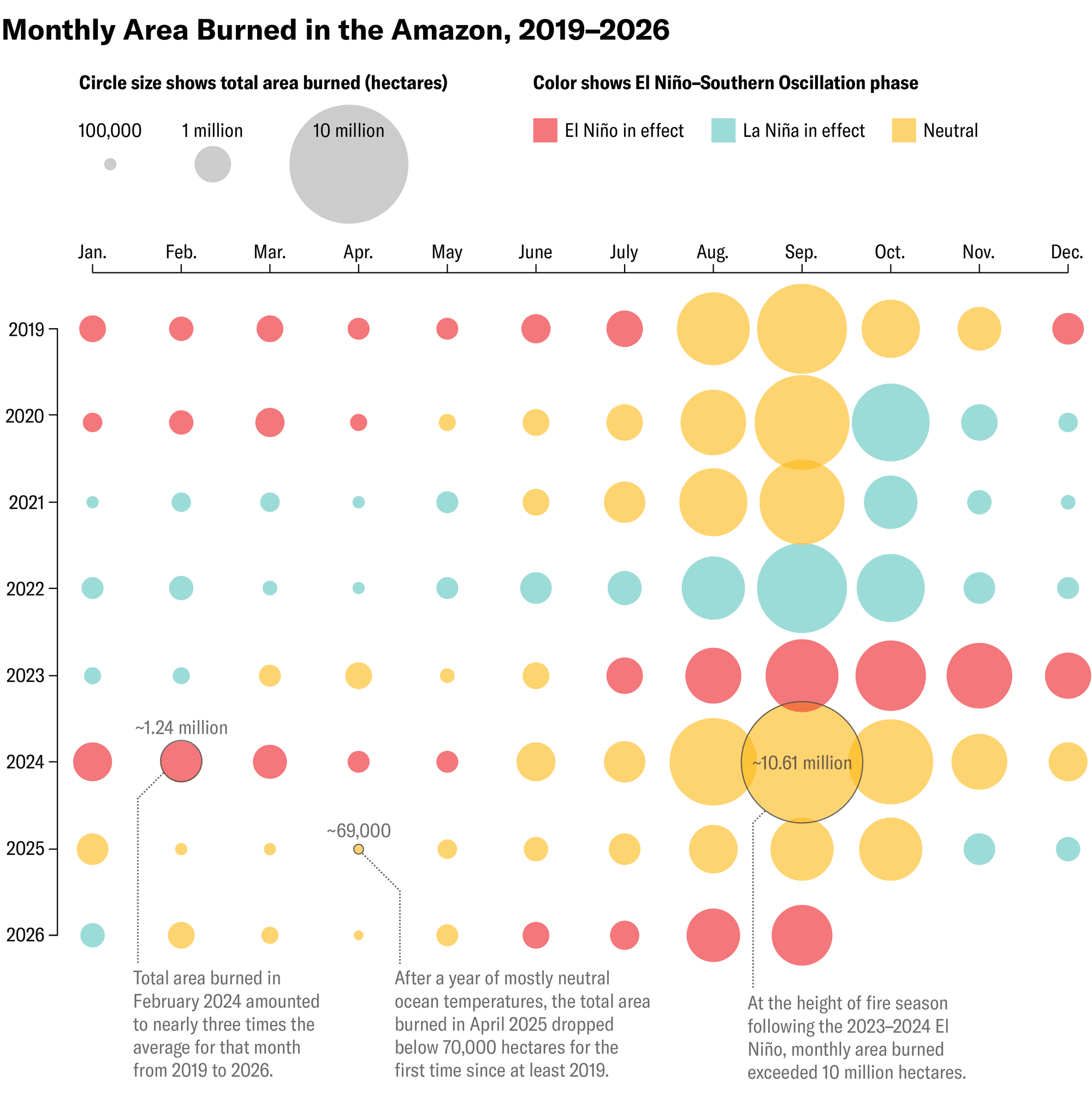
The Amazon is still recovering from drought and fires linked to a strong El Niño in 2023 and 2024, and it has been weakened by decades of global warming and deforestation. Some researchers fear the rainforest could soon reach a “tipping point”—the threshold beyond which a self-reinforcing, runaway cascade of drying, tree death and wildfire would begin to spread across the Amazon basin, irreversibly. In just decades, that cascade could turn rainforest to savanna, releasing into the atmosphere tens of billions of tons of carbon and altering global rain and snowfall patterns.
El Niño and the Amazon
El Niño events—periodic warmings of the eastern Pacific that recur every two to seven years—disrupt weather patterns around the world. As warm water shifts eastward in the tropical Pacific, so does the zone of rising air above it. A corresponding area of sinking air then settles over northern South America, suppressing clouds and rainfall, typically bringing severe droughts to the Amazon basin.
The rainforest has long been able to withstand and recover from a single dry year on its own. But at the same time this El Niño of unprecedented strength is taking shape, the forest is reeling from unprecedented damage caused by the last event, when major rivers reached historic lows and some 15.8 million hectares of the Amazon—an area larger than England—went up in flames. A study published earlier this year projected that more than half of the affected forest will not recover within seven years, a larger share than after any previous drought in the satellite record.
Then there’s deforestation. Like all rainforests, the Amazon generates much of its own rainfall: its trees draw water from the soil and release it as vapor, which gathers into clouds and falls again as rain, often recycling across the basin several times before reaching the Andes. Lost trees can disrupt that natural feedback. In another study, Nico Wunderling, an Earth system modeler at Goethe University Frankfurt and the Potsdam Institute for Climate Impact Research, both in Germany, and his colleagues built a computer model of this “atmospheric moisture recycling” system and ran it through a gauntlet of global warming and deforestation scenarios.
They found that deforestation drastically lowers the temperature at which a collapse becomes possible. Left intact, the Amazon is relatively resilient up to about 3.7 to four degrees Celsius of temperature rise above preindustrial levels. But if 22 to 28 percent of the rainforest were deforested, warming of just 1.5 to 1.9 degrees C could be enough to trigger a near-basin-wide collapse. The world is rapidly approaching 1.5 degrees C of warming, and roughly 17 percent of the Amazon has already been deforested between the 1970s and now.

“We might not be too far away anymore,” Wunderling says. Another tenth of a degree of warming and another five percentage points of forest loss would put the Amazon in what he calls “a really high-risk zone.”
Fire Feeds Fire
There is some hope that deforestation rates can continue to decline with the recent reelection of Brazilian president Luiz Inácio Lula da Silva to a fourth term. After returning to office in 2023, he reversed forest clearing—largely for cattle pasture and cropland—to its lowest level since 1988 after it reached a 15-year high under his predecessor, Jair Bolsonaro. But it’s unclear if it will be enough. “Brazil has roughly halved its deforestation since 2022, but fire did not follow it down,” says Dolors Armenteras, a fire ecologist at the Institute of Forest Science of the Spanish National Research Council, who studies fire regimes in the Amazon. “Less clearing is very good news, but it cannot protect a forest that has dried out this much.”
Once a patch of the rainforest burns, Flores says, it remains more flammable for at least a decade—a factor Wunderling’s study, which Flores co-authored, didn’t account for. Fire kills trees, opens the canopy and dries the forest floor—and the dead wood left behind becomes fuel for the next blaze. In a September study of forests in the Colombian Amazon and Orinoco basins, Armenteras and a colleague found that of the areas that burned three or more times since 2001, only 37 percent were still intact by 2024; 35 percent had been deforested—the canopy permanently lost in a cascade that began with the fires. Ultimately the land was converted, mostly to cattle pasture.
Many of the forests currently burning around Manaus and elsewhere across the Amazon have burned before, during the El Niño-driven droughts of 2015–2016 and 2023–2024. “Every severe fire season makes the next one more likely and more damaging. Repeated fire is really what makes the difference,” Armenteras says.
The worst is still to come, the experts suspect. The El Niño’s projected peak in the next month or so will likely coincide with the height of the dry season in the northern Amazon. And the worst recent fire seasons, in 2016 and 2024, each came in the year after a previous El Niño had peaked. “I would watch the 2027 dry season very closely,” Armenteras says.
“If we continue to have these escalating El Niños—these El Niños that get stronger and stronger—then it’s very concerning,” Flores says. “The area of flammable forest just increases and increases, and it can become exponential.”
“And that’s when you have the risk of a tipping point,” he adds. “That’s how the system collapses.”
