


Follow us
Add us as a preferred source on Google
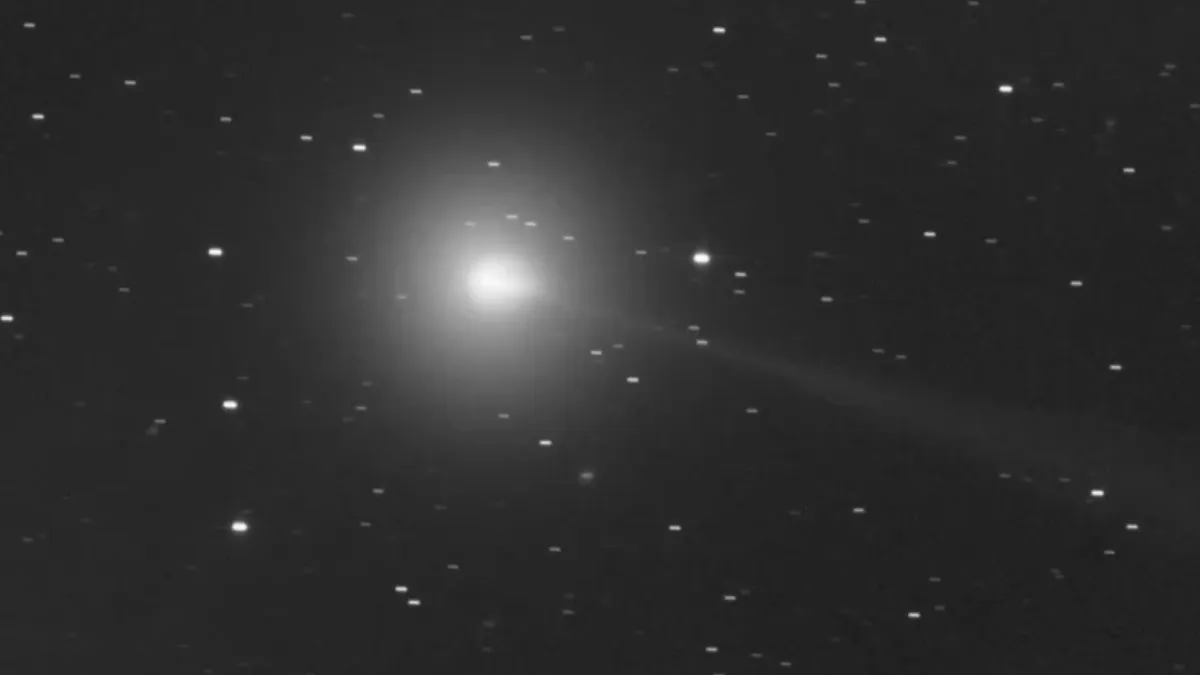
A comet dazzled this summer as the sun’s heat caused ice beneath its surface to turn to gas and rip out through its surface, spewing hundreds of billions of pounds’ worth of dust into space and causing the comet to brighten by thousands of times.
Comet 220P/McNaught was discovered by the prolific Australian comet discoverer Robert McNaught in 2004. It is a periodic comet, the 220th discovered, meaning that it comes back again and again on a regular basis – in 220P’s case, once every five-and-a-half years when it gets about as close to the sun as Mars. Other than that, 220P is fairly nondescript, usually languishing at a feeble brightness fainter than magnitude +15, out of reach of most amateur telescopes. There has been little else to say about the comet, until this year.
On June 14, as it headed towards perihelion – the closest point in its orbit to the sun, at a distance from our star of 1.5 times the distance between the Earth and the sun (known as an astronomical unit), 220P suddenly and without warning burst into life.
On 31 May, the comet was languishing at magnitude +17.39 (the higher the magnitude, the fainter an object is), but within less than 14 hours it had dramatically brightened to magnitude +11.05, bringing it into range for observation with small amateur telescopes.
By June 2, 220P was up to magnitude +8.23 and was technically visible for a short while in 10×50 binoculars from a dark site, prompting amateur astronomers and astrophotographers to chase down this rare event.
By perihelion, the comet had faded back to magnitude +12, but more was to come. A second outburst began at the end of July, brightening from magnitude +14 on 28 July to magnitude 6.1 by 6 August.
Telling the tale of a dirty snowball
Comets are often referred to as dirty snowballs, and beneath their dusty crust are ices made from various volatiles, including water, carbon dioxide and nitrogen. Solar heating, even at the distance of Mars, can cause these ices to rapidly sublimate into gases, and the pressure of the escaping gas rips the surface apart, spewing huge amounts of dust in to space.
Models based on observations of 220P’s outburst indicate that it spewed out between tens of billions and hundreds of billions of pounds’ worth of cometary dust that filled the comet’s coma, the diffuse ‘atmosphere’ that clings to the comet’s solid nucleus. The dust particles, which are just millionths of a meter across, expanded outwards from the comet at about 1,280 feet (390 meters) per second, scattering sunlight and causing the coma to substantially brighten.
“We have concluded that the comet detached localized parts of its crust, creating a dust-rich envelope that increased [the comet’s brightness by] 250 times in half a day,” Josep M. Trigo-Rodríguez, of the Institut de Ciències de l’Espai and the Institute of Space Studies of Catalonia in Spain, said in a statement.
While this is the first time that 220P has been seen to outburst, over the years we have witnessed other comets spectacularly brighten out of nowhere.
A recent and well-known example is comet 17P/Holmes, which brightened a million-fold in the fall of 2007 as it rose from magnitude +17 to magnitude +2.8, becoming a welcome naked-eye sight in the constellation of Perseus for many people as they made the evening commute home.
The short 5.5-year orbit of 220P marks it out as a Jupiter-family comet.
“Jupiter-family comets are extremely interesting objects to study because they originate primarily from the Kuiper Belt and the Scattered Disk region, later migrating inward until Jupiter captures them into short-period orbits,” said Trigo-Rodríguez.
Studying outbursts such as the two experienced by 220P provides vital clues as to the bulk characteristics of Jupiter-family comets, giving us insight into objects that originated from beyond the orbit of Neptune.
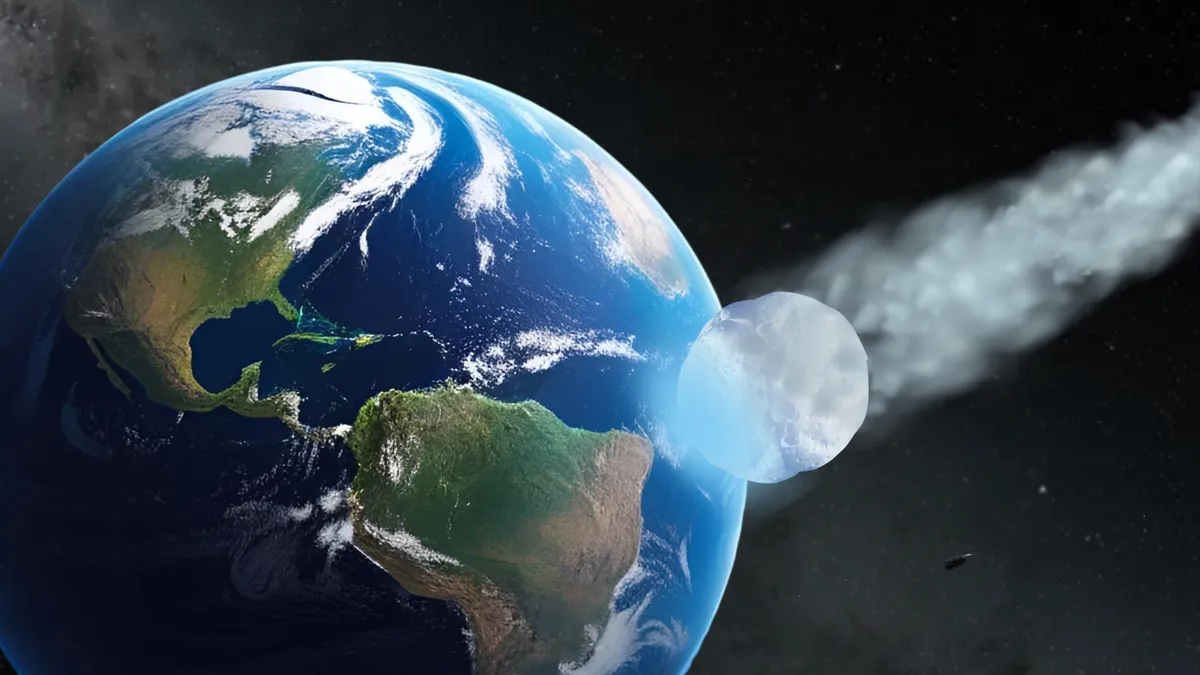
Of particular interest to Trigo-Rodríguez is what we should do were one of these objects ever to be found on a collision course with Earth.
“Particularly we are interested in the tensile strength and nature of comets in the framework of our studies on impact hazards,” said Trigo-Rodríguez. “Some comets seem determined to demonstrate that they are fragile enough and perhaps give us the chance to invoke disruptive approaches that might be substantially different from the ones already tested or proposed for asteroids.”
For now, 220P is heading back out to its furthest point from the sun, which is just inside the orbit of Jupiter at a distance of 4.68 astronomical units or 435 million miles (700 million kilometers). Having passed as close to Earth as it is going to get this time around on 12 October at a distance of 1.04 astronomical units or 97 million miles (156 million kilometres), the comet is currently magnitude +13 and fading. All eyes will be on 220P during its next time around the sun in late 2031.
The findings were published on Nov.3 in the Monthly Notices of the Royal Astronomical Society.

