


Conny Waters – AncientPages.com – At the 125,000-year-old lakeside site of Uruq al-Julaybah in Mundafan, southern Saudi Arabia, researchers found megafaunal remains, stone tools, and rare plant material.
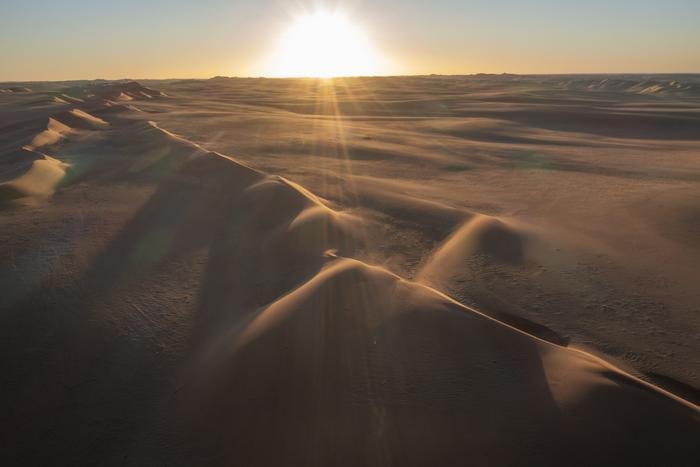
Sand dunes in the Empty Quarter (Rub’ al-Khali), southern Saudi Arabia. Around 125,000 years ago, during the humid “Green Arabia” period, this area held Lake Mundafan, a freshwater lake of about 340 km², and early humans lived along its shores. Image credit: KAUST/Heritage Commission
These finds provide one of the most detailed records of prehistoric human life in Arabia and show how early people lived, hunted, and interacted with their environment when the region was greener and wetter.
Scientists from Griffith University and King Abdullah University of Science and Technology (KAUST) contributed to this archaeological and environmental study.
The results are impressive, offering important evidence of Saudi Arabia’s long human and environmental history and expanding our understanding of early human presence across the Arabian Peninsula.
Researchers used satellite terrain modeling to map the ancient lake, which once covered about 340 square kilometers and reached depths of up to 29 meters. Sediment, landform, and aquatic data show it was a stable freshwater lake surrounded by plants and open grasslands.
The team used grid surveys to collect fossils and stone tools, dated sand and fossil teeth using two methods, applied 3D refitting to stone tools, and analyzed tool surfaces with microscopes and chemical tests. This thorough approach provided direct insights into how early humans lived and adapted during the last Interglacial period, a warm, humid time about 125,000 years ago known as Green Arabia.
The team recorded over 500 fossil specimens of plants and animals, including invertebrates, from more than 130 locations at the site. Animal remains included hippos, extinct long-horned buffaloes, camels, Arabian oryx, gazelles, and ostriches.
Researchers gathered 5,511 stone tools larger than 2 cm from the main study area. More than 98% were made of flint, and analysis confirmed they were made using Levallois techniques.
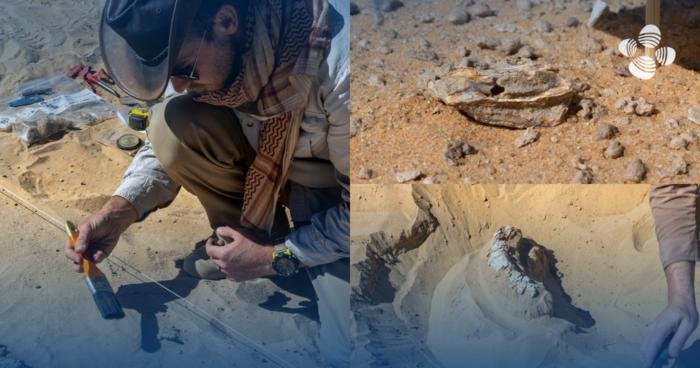
Fieldwork at ‘Uruq al-Julaybah, on the shore of the ancient Mundafan lake in southern Saudi Arabia. Left: a researcher exposes finds along a survey grid line. Top right: a fossil on the surface of the ancient lake bed. Bottom right: a fossil being uncovered from the sand. Image: KAUST / Saudi Heritage Commission
The tools contain residues from many plant types, including some toxic ones. Traces of resin and wood suggest the tools were used as weapon tips, while plant residues show people processed tubers, bushes, and palm leaves. These findings reveal a wide range of plant use for food and daily life. Notably, evidence suggests toxic plant compounds may have been used in hunting technology—one of the first such cases found in Saudi Arabia—and provides some of the earliest signs of palm-related plants in the region. Altogether, these results show that people made diverse and skilled use of their environment.
This site stands out because animal remains, stone tools, and plant material were all found together in one dated layer. This lets researchers piece together the daily lives of the people who lived by the lake in great detail. The site gives a vivid and unusually complete view of human life in Green Arabia.
The findings show that the shores of ancient Lake Mundafan offered freshwater, animals, plants, and raw materials during the humid period about 125,000 years ago. This mix supported many human activities, such as making stone tools, preparing hunting gear, processing animal and plant resources, and working with fibers.
“It is very exciting to see how the teamwork of so many specialists lets us rebuild this uniquely complete picture of life, behavior, and the environment in the distant past,” said Professor Frans van Buchem, KAUST Professor of Geology and co-lead scientist.
Dr. Faisal Al-Jibreen, a researcher from the Heritage Commission and professor of Paleolithic archaeology, called the discovery in the sands of Lake Mundafan in the Empty Quarter an important archaeological find. He said it helps us understand the ancient environment and how it was connected to humans and animals in southern Saudi Arabia’s early prehistory.
“This site gives us a rare and richly detailed view of how people lived in a landscape that looks nothing like Arabia today,” said Professor Chris Clarkson, co-lead scientist and Professor of Archaeology at Griffith University’s Australian Research Center for Human Evolution.
“The combination of animal remains, stone tools, and plant material in a single, dated context is what makes this discovery so significant.”
“Saudi Arabia has an exceptional archaeological heritage. Building Heritage Science capabilities in the Kingdom will enable us to turn the smallest traces into the biggest stories,” said Professor Laurence Hapiot, co-author and Head of Heritage Research at KAUST.
The research reflects KAUST and its partners’ shared commitment to uncovering the Arabian Peninsula’s rich prehistory. It provides key evidence for understanding early human life, movement, and technology.
Source: KAUST
Source
Written by Conny Waters, AncientPages.com Staff Writer
