Conny Waters – AncientPages.com – Researchers studying hieroglyphs at a remote pre-Hispanic settlement in southern Mexico have uncovered the ancient city’s original name, revealing new details about its rulers and regional conflicts during the Maya Late Classic period.
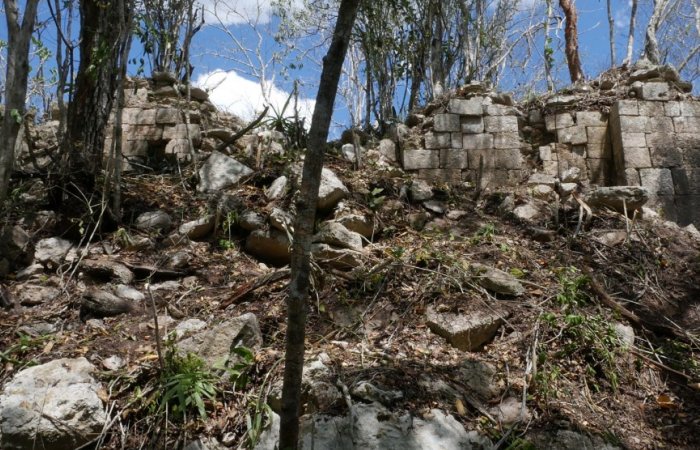
The site was named Minanbé, meaning “no road,” by the archaeological team that discovered it. Photo: Vitan Vujanović, INAH
Originally dubbed Minanbé—meaning “there is no road”—by archaeologists who struggled through dense jungle to find it intact in May 2026, the site north of the Calakmul Biosphere Reserve was known to its ancient inhabitants as Sakil, a Maya word meaning “whiteness.”
The breakthrough was announced during a conference organized by Mexico’s Ministry of Culture and the National Institute of Anthropology and History (INAH). Epigrapher Octavio Esparza Olguín, of the National Autonomous University of Mexico (UNAM), presented the findings as part of an international research project led by archaeologist Ivan Šprajc of the Slovenian Academy of Sciences and Arts.
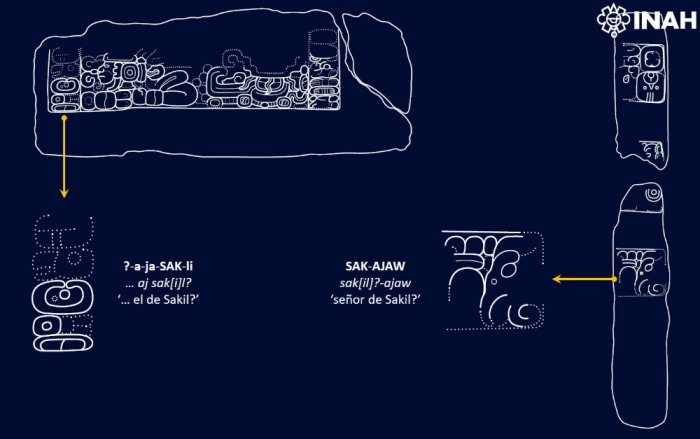
The toponymic title of Sakil recorded on Monument 1 of Ocomtúny and Stela 7 of Minanbé. Drawings by Octavio Esparza, INAH
“The significance of this discovery lies in the fact that it allows us to move beyond simply knowing the location of a site and to learn about part of its history: its name, one of its rulers, and its connections to other Mayan cities,” said Claudia Curiel de Icaza, Mexico’s Secretary of Culture. “In this way, archaeological research expands public knowledge about the political organization of this civilization and the depth of our past.”
Piecing Together A Fragmented Past
Although researchers have identified nearly 20 stone monuments at the 15-hectare settlement, more than a thousand years of abandonment—alongside deliberate dismantling by the ancient Maya themselves—erased much of the carved reliefs.
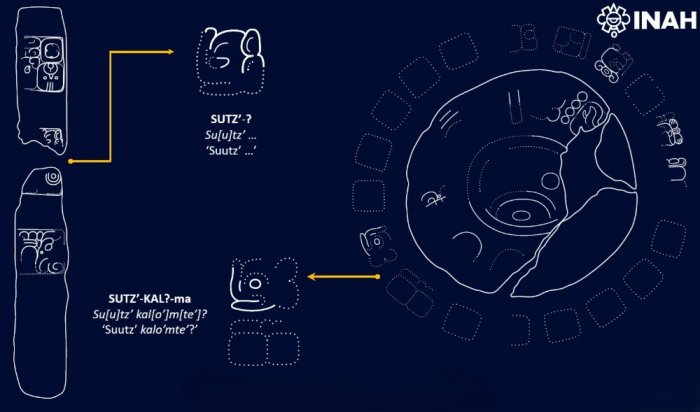
Ruler of Minanbé recorded on Stela 7 and Altar 6. Drawings by Octavio Esparza, INAH
Using advanced photogrammetric 3D modeling and digital light manipulation, Esparza Olguín successfully extracted faded details from five monuments. The critical clues came from cross-referencing Stela 7 at Minanbé with Monument 1 at Ocomtún, a major Maya center located 40 kilometers to the northwest that was originally known as Maatz’.
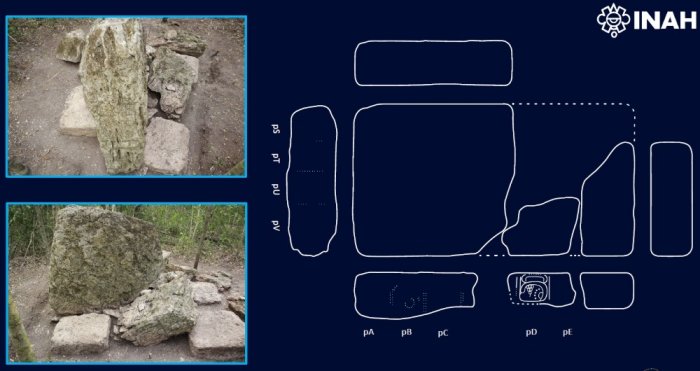
Hieroglyphic text engraved on the edge of Altar 7 at Minanbé. Photo by Quintín Hernández. Drawing by Octavio Esparza, INAH
On Stela 7, which had been broken into three sections, researchers identified a richly dressed local ruler named Suutz’ (meaning “Bat”). Hieroglyphic cartouches alongside the figure paired his name with a place-name title combining the logograms sak and ajaw.
Evidence Of Ancient Conflict
A matching place name appeared on Monument 1 at Ocomtún—a carved stone lintel that had been repurposed as a step in the site’s B6 Complex. The carving depicts a bound captive lying face down next to an animated mountain, with text identifying the prisoner as hailing from Sakil.
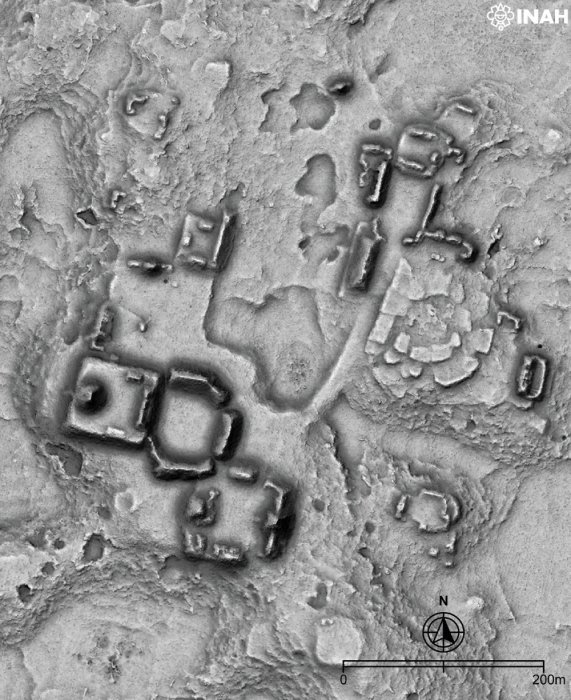
LiDAR coverage of the Minanbé archaeological site. Archive of the Expanding the Archaeological Panorama of the Maya Lowlands Project.
“When we made the connection of this toponym, I said: Eureka!” Esparza Olguín remarked. “It is a fact that Minanbé must have had connections with other nearby sites, such as Chactún, Tamchén or Lagunita. At least, now we know that they were not at all friendly with Ocomtún, at least during a stretch of the Late Classic period.”
See also: More Archaeology News
Further analysis of Altar 6 at Minanbé revealed Suutz’s name once again, this time accompanied by the prestigious title kalo’mte’. While historically reserved for supreme regional overlords during the Classic period (AD 600–900), its appearance in a smaller, 15-hectare settlement illustrates how high-ranking royal titles gradually spread to lesser centers toward the end of the era.
Source: INAH
Written by Conny Waters – AncientPages.com Staff Writer