


Follow us
Add us as a preferred source on Google
If NASA ever hopes to build a permanent moon base for astronauts, let alone aim for Mars, the U.S. space agency is going to need a whole lot of space travelers. And now, you have a chance to be one of them.
NASA on Saturday (Nov. 7) put out the call for a new class of astronaut candidates who think they have the “right stuff” to fly, live and work in space. Those astronaut hopefuls have until Dec. 3 to apply (the application website is here), with NASA planning to make its final selections in late 2027.
“This is an extraordinary time to join NASA’s astronaut corps,” the space agency’s chief, Jared Isaacman, said in an announcement, which was made during NASA’s “Max Power” air show at Kennedy Space Center (KSC) in Florida. “The people we select could walk on the moon, live and work at the Moon Base, and help pioneer the systems and operations that will ultimately carry crews to Mars.”
It’s been two years since NASA last sought applications for astronauts. In 2024, more than 8,000 people applied, though only 10 — five men and five women — made the cut. They’re in the middle of a two-year training program right now.
This new 2027 astronaut group will be the 25th astronaut class in NASA history. Its announcement comes the same year that NASA returned astronauts to the moon for the first time since the Apollo era with the Artemis II moon flyby. Four more astronauts will test Artemis moon landers in Earth orbit on the Artemis III mission in 2027.
NASA currently has 32 active astronauts in its spaceflying corps. The agency has recruited 370 people to fly in space since 1959, when the first seven Mercury astronauts were selected and unveiled to the world.
“There is a lot to be done in order to get all of these new vehicles and the new suits and everything as we continue to work towards the moon, build a base there, stay permanently, and then eventually onto Mars,” NASA astronaut Nichole Stilwell, class of 2021, told Space.com in an interview at KSC during the Max Power event. “And so we just don’t have enough people, and we’re looking for more.”
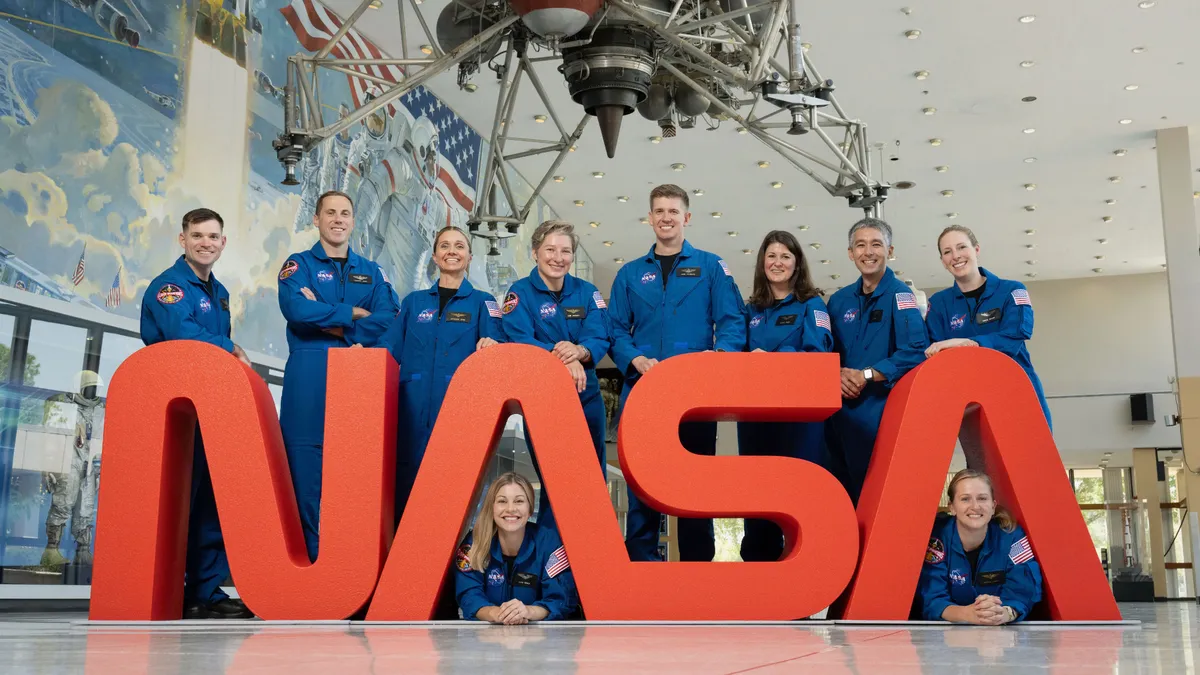
If you’re interested in applying to be a NASA astronaut, you should take a look at the requirements first.
NASA’s core guidelines require applicants to be U.S. citizens and have a master’s degree in a STEM field like “engineering, biological science, physical science, or computer science from an accredited institution,” the space agency said in a statement. You’ll also need at least three years of experience in your related field.
Don’t have a master’s degree? Here’s three other ways NASA might consider your application, according to the agency’s advisory:
- “Completion of at least two years of work toward a doctoral program in an appropriate technical field of engineering, biological science, physical science, computer science, or mathematics.
- “Completion of a Doctor of Medicine, Doctor of Osteopathic Medicine, Physician Assistant, Doctor of Nursing Practice, Family Nurse Practitioner, or a related medical degree.
- “Completion of, or current enrollment in, a nationally recognized Test Pilot School program, provided the program is completed by July 2027. If Test Pilot School is the only advanced technical degree, then completion of a bachelor’s degree in a STEM field, including engineering, biological science, physical science, or computer science is required.”
If you’re a medical doctor and are considering applying to be an astronaut, your residency training can be counted toward your professional experience, but only if it is completed by July 2027, NASA said.
If you want to be a pilot astronaut for NASA, you’ll need some serious flight hours under your belt. Here’s a rundown of some ways to meet that requirement:
- 750 hours flying as pilot in command of high-performance jet aircraft.
- 1,000 total flight hours in a rotary-wing aircraft, with 300 hours as pilot in command.
- 1,500 total flight hours in other fixed-wing aircraft, with 750 hours as pilot in command.
“For those who apply, becoming a NASA astronaut is more than a career opportunity,” said NASA chief astronaut Scott Tingle, who also chairs the Astronaut Selection Board at the agency’s Johnson Space Center (JSC) in Houston. “It is a chance to join a legacy of explorers who have pushed the boundaries of discovery and play a role in the missions that will shape humanity’s future in space.”
Once NASA selects its 2027 astronaut class, the new recruits can expect to begin a two-year training program based out of JSC, which is home to the agency’s astronaut corp and Mission Control.
“The window is open. The mission is waiting.,” NASA Deputy Administrator Matt Anderson said in a statement. “And the only thing missing from the greatest adventure humanity has ever embarked upon is you.”
Space.com Content Manager Chelsea Gohd contributed to this report from NASA’s Max Power event at the Kennedy Space Center in Cape Canaveral, Florida.

