Jan Bartek – AncientPages.com – The discovery of a skeleton has revealed a previously unknown Norse church at Qinngua near Narsarsuaq in southern Greenland, close to Erik the Red’s settlement. This finding expands our understanding of Greenland’s historical society and power dynamics and may lead to further discoveries.
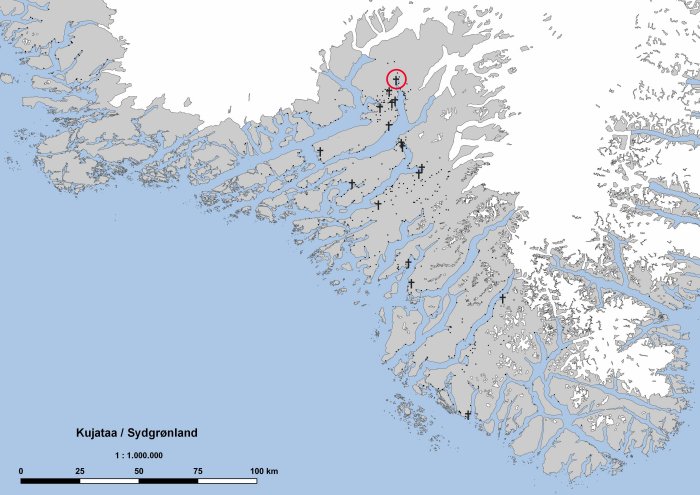
Crosses mark Norse-period churches in South Greenland. The red circle shows the new find. The dots show registered Norse locations. Graphics: The National Museum of Denmark.
“This is a sensation, which means we have to rethink the significance of this whole area to the Norse people. Churches were vital in Norse society, which makes them key to understanding how their society, especially the power structures, developed,” says Christian Edelfelt Koch Madsen, senior researcher at the National Museum and research coordinator of the project.
The discovery was made by a team of researchers from the National Museum of Denmark, Greenland’s National Museum and Archive, University Museum of Bergen and UNESCO Kujataa.
More than 60 years have passed since the last Norse church was discovered in Greenland. Earlier finds were smaller Viking Age churches that were quickly abandoned, while this larger church likely remained in use through the Middle Ages. This discovery provides valuable insight into Greenland’s development during the transition between the settlement’s establishment and decline, a period that remains poorly understood.
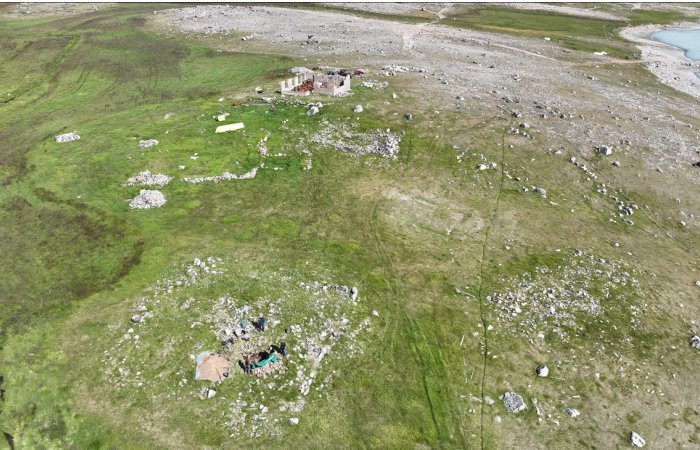
The church ruins are visible in the foreground. The square outer edge that can be seen is the cemetery wall, which surrounds the cemetery and church. The church is the pile of stones in the middle of the square. Photo: Aqqaluaq Frederiksen, Kujataa UNESCO World Heritage Site.
The idea that this site could be a church has long been suggested, based on the rectangular stone wall and central stone building typical of church structures. However, definitive proof required finding a cemetery with graves, which had not been discovered since the National Museum began excavations in the 2000s.
Grave Confirms This Is A Church
This summer, researchers found a skeleton positioned with its head to the east, as is customary for Christian burials. This grave confirms the presence of a cemetery and, by extension, the church.
“This is ‘the smoking gun’. Now there is no doubt that this is a church. Inuit are buried in stone-covered chambers, whereas Norse people are buried in cemeteries, so everything points in the same direction, including the written sources,” says Christian Edelfelt Koch Madsen.
Clues To Other Undiscovered Churches
Medieval written sources mention several names and locations of Norse churches, and one of the more credible ones fits the location of the newly found church well. The account of “Kirkja undir Sólarfjöllum” (the Church under the Sunny Mountains) matches the mountains in the background, which the Norse must have called the Sunny Mountains. They are right by the ice cap and subject to a local high-pressure system that often brings sunny weather.
In the long run, the discovery may thus lead to new church finds, predicts Christian Edelfelt Koch Madsen.
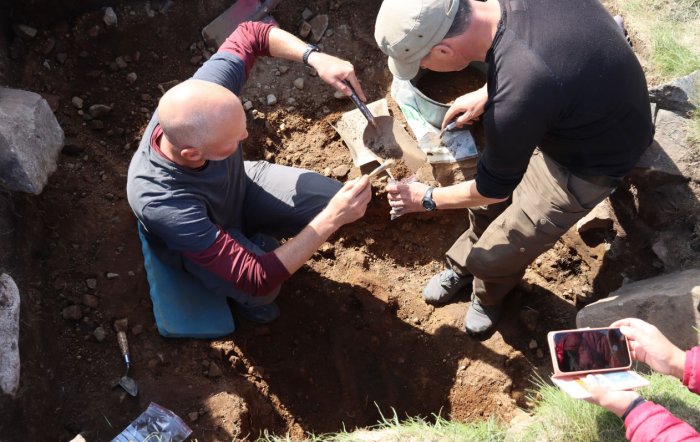
Samples are being taken from the excavation. Photo: Michael Nielsen, Greenland National Museum & Archives.
“As the location of this church fits so well with the descriptions in the sources, it would make sense to try to locate other churches also mentioned in writing, but as yet undiscovered.”
Researchers are still analyzing samples, but the skeleton’s arm placement suggests an early Middle Ages burial. The church’s large size and numerous hewn stones indicate a likely date between 1100 and 1300.
The nearby ruins of two or three farms may indicate the early formation of a village society.
New Insights Into Viking Age History And Power Structures
This discovery is significant as it was made near Erik the Red’s main settlement at Brattahlíð. In this small area, six churches have been found, though only three remained in use into the Middle Ages.
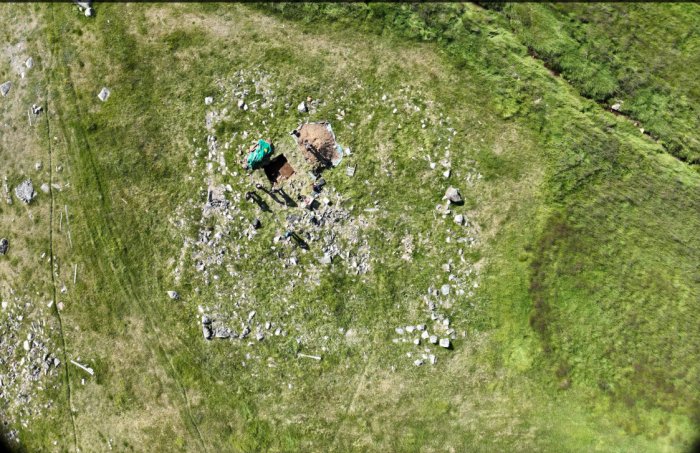
The church ruins seen from above, with the grave excavation. The cemetery wall is visible at the far end, while the church is the pile of stones in the middle. Photo: Aqqaluaq Frederiksen, Kujataa UNESCO World Heritage Site.
“It almost appears there was a competition in this area to build churches and demonstrate power and status. Some may have abandoned their church buildings, as may be the case here. Further research will clarify this. Regardless, this discovery prompts us to reconsider our understanding of Norse medieval societal structures in the area,” says Christian Edelfelt Koch Madsen.
See also: More Archaeology News
The discovery highlights that much remains to be uncovered about Norse history in southern Greenland. Ongoing archaeological work continues to refine our understanding of life among the Greenlandic Vikings from 980 until the collapse and abandonment of Norse society in the 1400s, a topic that has been debated by scholars for decades.
“The new discovery may be another little clue to understanding that mystery,” says Christian Edelfelt Koch Madsen.
Source: The National Museum of Denmark
Written by Jan Bartek – AncientPages.com Staff Writer