


Follow us
Add us as a preferred source on Google
In 1927, Norwegian civil engineer and amateur radio operator Jørgen Hals made an unusual discovery: while monitoring transmissions from a shortwave radio station in Eindhoven, The Netherlands, he began hearing odd, “delayed” radio echoes, arriving approximately three seconds after the original transmissions, that sometimes accompanied the station’s signals.
“From where this echo comes I cannot say for the present,” Hals wrote of his peculiar discovery, adding that he could “only confirm that I really heard it.”
Almost a century after Hals’ discovery, the exact cause of this unusual phenomenon — known today as long delayed echoes, or LDEs — remains unknown. Their baffling nature has prompted a range of potential explanations, most of which focus on a variety of unexplained natural phenomena occurring in Earth’s atmosphere. However, a few more far-out possibilities, including potential evidence of extraterrestrial technology, have also been considered.
Watch On
What do we know?
A curious discovery
The enigma of long-delayed echoes has perplexed scientists since their initial detection by Hals, who at the time reported his odd findings to Norwegian physicist Carl Størmer. This prompted an investigation by Størmer with physicist Balthasar van der Pol, during which the duo was able to reproduce the phenomenon but were unsuccessful in determining its cause.
Since those early observations, ongoing reports of long-delayed echoes have continued to be recorded. Under normal conditions, radio echoes occur whenever a radio signal reflects or “bounces” off an object, although other conditions such as signals traveling through a delayed path can also cause echoes to occur.
Long delayed echoes, by contrast, are generally characterized by radio signals that return after more than 2.7 seconds following their original transmission, although the terminology has sometimes been applied more broadly.
Complicating investigations into this unusual brand of radio phenomena over the years has been their unpredictable nature, along with significant reported variances in the timing and nature of the delays, which has made it difficult for researchers to narrow down a single cause.
Possible explanations
Despite the challenges presented by this unique class of space mysteries, there are several theories that have been put forward over the years about what could cause long-delayed echoes.
In the mid 1980s, researchers R. J. Vidmar and F. W. Crawford conducted experiments in Alaska that aimed to detect long-delayed echoes, which built on earlier research they published involving possible detections in 1970. According to their findings at the time, Vidmar and Crawford hypothesized that radio signals could be captured between ionized layers in the atmosphere and “guided” over long distances.
More recently, University of Oslo researcher Sverre Holm has advanced a similar concept that he calls magnetospherically ducted echo (MDE), in which radio waves may become trapped within electrically charged regions of Earth’s upper atmosphere and guided along magnetic field lines extending far into the magnetosphere. Under certain conditions, these signals may reach as far away as the opposite hemisphere before they are “bounced” back toward Earth, resulting in the delayed echo effect.
According to Holm, MDE “is the best understood mechanism for long delayed echoes” out of five promising explanations he outlines, adding that based on the MDE model, such long delayed echoes “can be predicted to what seems like about 5 ms accuracy using a simple model for the magnetic field lines.”
Still, one problem that arises involves the relatively short delays associated with this mechanism, which may not necessarily account for the much longer, multi-second echoes reported in some historical observations. Since radio waves travel at close to the speed of light, a signal could theoretically cover distances equivalent to the planet’s circumference several times in a single second. While this doesn’t prove the signals actually followed such paths, it does imply that some of the reported instances of long-delayed echoes might correspond to dozens of journeys around the planet.
Speaking with Space about historical cases involving much lengthier long-delayed echoes, Holm was clear in expressing that the MDE theory also has its limitations.
“In my view,” Holm told Space in an email, “Magnetospheric Duct Echoes cannot [account] for those historical LDEs at all.”
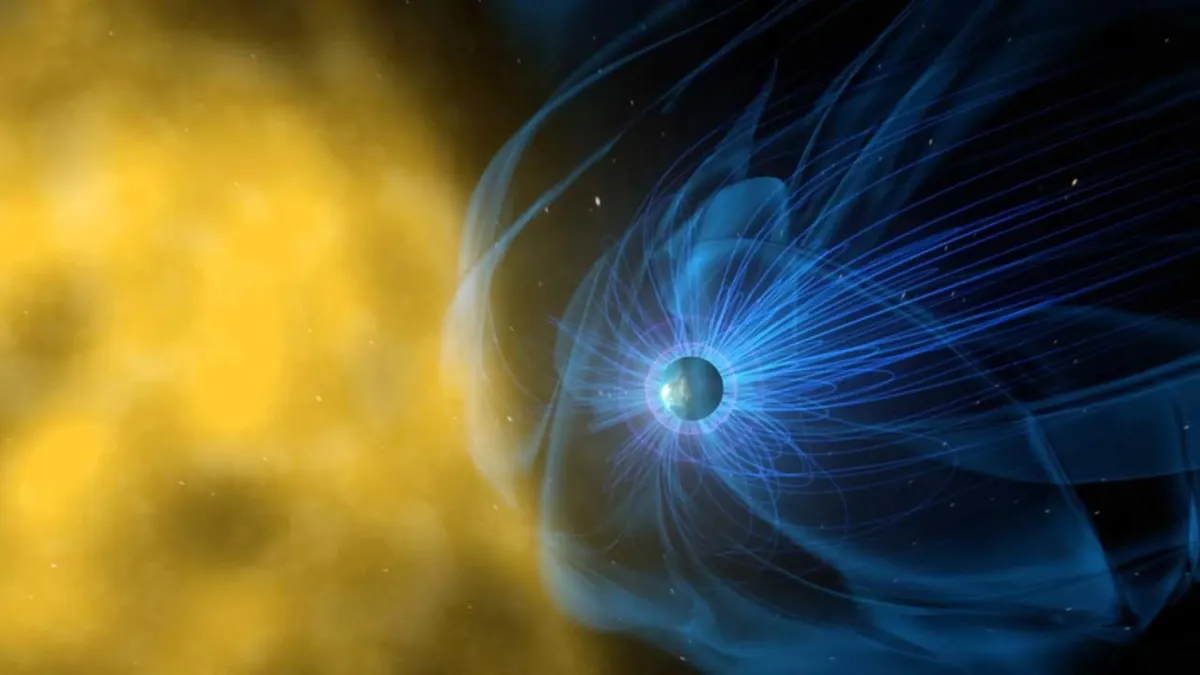
To illustrate this, Holm points to two primary differences. First, the historical echoes were detected at approximately 9.55 MHz, well above the 1–4 MHz frequency range typically associated with MDEs. Additionally, historical LDEs reportedly exhibited delays ranging from 3 to 30 seconds, whereas MDEs generally produce delays of only a few hundred milliseconds.
By contrast, “MDES are only a few hundred milliseconds,” Holm explained, meaning that they cannot account for all the characteristics of the earlier historic observations of long-delayed echoes.
Other theories that might be capable of filling some of the gaps in the long-delayed echo mystery include the idea that electromagnetic radio energy could be coupled into slower plasma-wave “modes” while traveling through Earth’s upper atmosphere, which, according to Holm’s review of the earlier work by Vidmar and Crawford, could potentially create much longer delays than ordinary radio propagation would allow.
After this proposed coupling into a plasma-wave mode, the signals may be converted back to ordinary electromagnetic signals and bounced back down to lower levels of Earth’s atmosphere. Finally, a similar line of investigation has looked at whether clouds of plasma originating from the sun might also be able to produce the well-characterized echo effect.
What remains unknown?
Although scientific research has identified several promising explanations for long-delayed echoes, the mysterious nature of these events has also inspired more speculative theories over the decades, including some involving the search for extraterrestrial intelligence.
This unique dimension to the LDE mystery has its roots in the theories of Australian physicist Ronald Bracewell, who was the first to propose the idea that autonomous interstellar probes might be used by an advanced civilization as a means of establishing contact.
According to Bracewell, the initiators of such a hypothetical contact scenario might choose to reveal their presence by intercepting and re-transmitting radio signals rather than engaging in direct communication. Carl Sagan explored a similar concept in his novel “Contact”, in which transmissions from the 1936 Olympics — the earliest broadcast signals to leave Earth’s ionosphere — are intercepted and rebroadcast back to Earth as a data-encoded message originating from the Vega system.
However, more than a decade before the publication of Sagan’s famous novel, Scottish writer Duncan Lunan attracted international attention for his 1973 article in the journal “Spaceflight” outlining his belief that he had successfully decoded a radio message dispatched from an extraterrestrial probe. According to Lunan, the initial detection of this “hidden” alien signal had taken place decades earlier in 1927, with the famous discovery of long-delayed echoes by Jørgen Hals.
Lunan’s theory essentially went like this: an extraterrestrial civilization in the Epsilon Boötis system had deployed a hypothetical autonomous communications probe (known as a Bracewell probe) to Earth in the distant past, which had been comfortably orbiting in one of Earth’s gravitationally stable Lagrange points for thousands of years.
Using the original long-delayed echo detections from Hals and Størmer’s research decades earlier, Lunan placed the transmitted sequence on a vertical axis, while placing the recorded echo delay time on a horizontal axis, revealing what he believed to be a view of the constellation Boötes as it might have looked 15,000 years ago — right around the time the suspected space probe would have been dispatched to Earth.

Despite Lunan’s imaginative theory, an alternative hypothesis proposing a natural cause behind long-delayed echoes was subsequently advanced by Anthony Lawton, which ultimately garnered an award from the British Interplanetary Society. By 1976, Lunan had withdrawn his ideas in an article published in the Journal of the Society of Electronic and Radio Technicians, although he would eventually revisit a version of the theory in the 1990s.
The mystery continues
While few modern researchers seriously consider extraterrestrial hypotheses to explain long-delayed echoes, these obscure phenomena remain intriguing, even as ongoing research sheds light on their possible causes. Explanations such as Sverre Holm’s magnetospherically ducted echo model offer promising mechanisms that may account for at least some of these unusual signals, although important questions remain unanswered.
For now, long-delayed echoes serve as a reminder of the challenges of studying electromagnetic phenomena, and how even seemingly familiar aspects of our physical world can harbor mysteries that resist straightforward explanations, even after nearly a century of investigation.

