Conny Waters – AncientPages.com – For more than a century and a half, one of the most compelling archaeological mysteries in British history sat quietly within the historic grounds of Westminster Abbey.
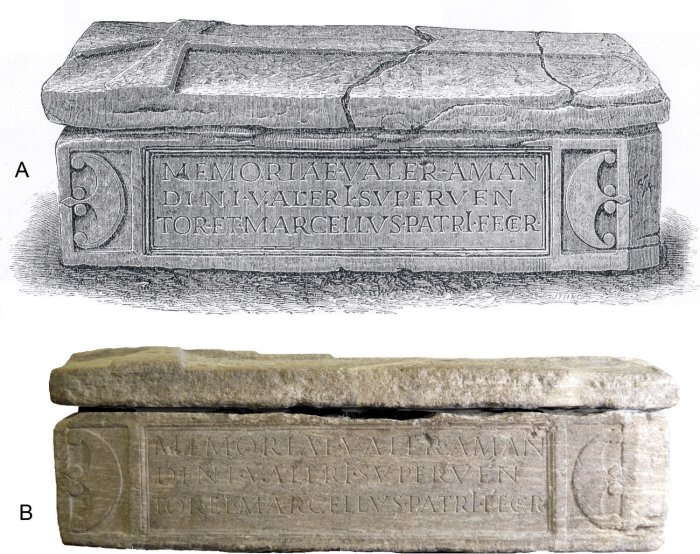
Decorated and inscribed front of the sarcophagus. a. Engraving by R. B. Utting, 1870. b. Photograph after cleaning, 2016. Credit: Journal of the British Archaeological Association, 1–35. https://doi.org/10.1080/00681288.2026.2675788
Inside a heavy, intricately carved limestone sarcophagus originally crafted during the height of the Roman Empire, an unidentified human skeleton lay undisturbed, baffling generations of historians, antiquarians, and scientists. The coffin bore a clear dedication to a wealthy Roman citizen, yet its stone lid was carved with a symbol from a completely different era—centuries after Rome’s fall.
Now, a groundbreaking analytical study published in the peer-reviewed Journal of the British Archaeological Association has finally pierced through the fog of time. Led by Professor Warwick Rodwell, Consultant Archaeologist at Westminster Abbey, a team of multidisciplinary experts has narrowed down the identity of the mysterious individual.
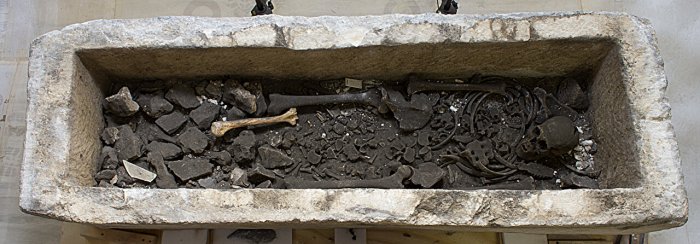
Interior of the sarcophagus. After the removal of rubble and superficial dirt on the bones. Credit: Pre-Construct Archaeology Ltd.
Their findings reveal a fascinating tale of medieval recycling, political status, and religious reverence in early England, showing that the bones do not belong to a Roman provincial at all, but to a high-ranking medieval monk who ruled the Abbey during the turbulent late Saxon period.
A Tale Of Two Eras: The Paradox Of The Limestone Coffin
To understand the scale of this breakthrough, look back to the artifact’s initial discovery. When the massive limestone sarcophagus was officially excavated in 1869, researchers immediately recognized its classical origins. The side of the stone container features a well-preserved Latin inscription dedicated to Valerius Amandinus, a prominent and affluent Briton who lived in Londinium roughly between 300 and 400 AD. Sarcophagi of this caliber were reserved strictly for the elite of Roman society, signaling that Amandinus was a man of immense wealth and social standing.
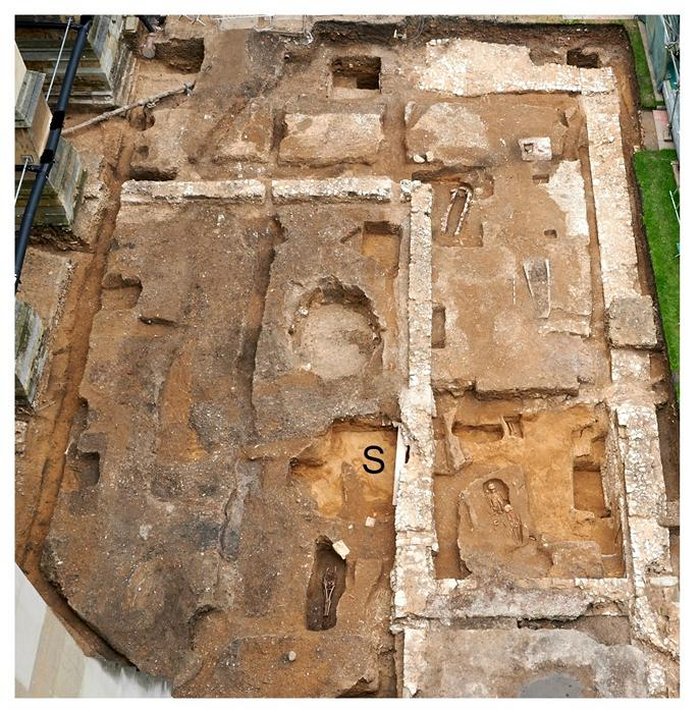 Excavation of the sacristy site in progress, 2019. View west. The pit from which the sarcophagus was removed in 1869 is labeled ‘S’. Credit: Pre-Construct Archaeology Ltd.
However, the team in 1869 was immediately confronted with a jarring historical paradox. A large, distinct Latin cross was carved directly into the heavy stone lid of the Roman coffin. Stylistic analysis placed the cross’s creation much later, around the 10th or 11th century. This stylistic discrepancy strongly indicated that the grave had been reopened, repurposed, and resealed long after Valerius Amandinus was laid to rest.
For 157 years, the identity of the secondary occupant remained an impenetrable secret. Was it an early Christian convert, a wealthy Anglo-Saxon noble, or a forgotten member of the royal court? The lack of surviving written records from the period left a massive gap in the narrative, turning the Westminster sarcophagus into one of the Abbey’s most enduring cold cases.
The Prime Candidates Unveiled
Professor Rodwell’s modern investigation has effectively rewritten this narrative by combining historical sleuthing with structural archaeology. According to his comprehensive paper, the sheer effort required to procure, modify, and re-bury a prestigious Roman sarcophagus means the occupant must have been an individual of supreme religious and political significance within the monastic community.
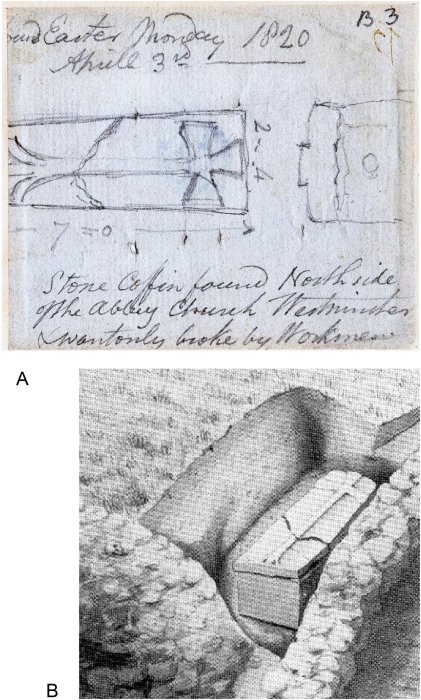 a. Pencil sketch (slightly cropped) on blue paper, recording the discovery of the sarcophagus in 1820. b. Lost watercolor showing the excavation trench of 1869, with the sarcophagus in situ alongside the sacristy wall. Screened image of a much ‘tidied’ view from the north-east. Anonymous. © Dean & Chapter of Westminster
Professor Rodwell has put forward two highly viable historical candidates who fit the profile perfectly: Abbot Aelfwig and his direct successor, Abbot Wulnoth. Both men governed Westminster Abbey during the 11th century, back when the institution operated as a powerful Benedictine monastery.
“We have two viable contenders for the occupant of the sarcophagus,” says Professor Rodwell.
“We do not know the date of birth of either. But either would fit equally well if we assume the Abbot was in his early twenties when he was appointed and close to fifty when he died.
“The fact Aelfwig was already a monk of Westminster might favor him.”
Aelfwig died around 1020, after a distinguished career leading the monastic community. Wulnoth died several decades later, in 1049, right on the eve of the Norman Conquest. Historical records indicate that both Abbots were buried somewhere within the Abbey precinct, though the exact locations of their original resting places were obscured by centuries of subsequent rebuilding projects.
See also: More Archaeology News
Professor Rodwell details another ‘remarkable new discovery’ in his paper. In 2016, researchers found an outline of a rectangular structure in the sarcophagus. This was marked out in a white residue left by lime, a substance traditionally used in burials.
“Although no physical traces of that feature remained, it can only have been a timber coffin, which has completely decayed over the course of the seven centuries that the sarcophagus was buried in the sacristy courtyard,” writes Professor Rodwell.
The sarcophagus is on public display in the Queen’s Diamond Jubilee Galleries at Westminster Abbey.
The study was published in the Journal of the British Archaeological Association
Written by Conny Waters – AncientPages.com Staff Writer