Jan Bartek – AncientPages.com – A newly analyzed set of ancient fossil footprints from the Italian Dolomites has shed fresh light on one of evolution’s most pivotal shifts: how ancient reptile ancestors transitioned from sprawling, low-to-the-ground walkers into the erect, bipedal strides that eventually powered the dinosaurs.
Published in the journal Paleontology, the study was led by Dr. Lorenzo Marchetti of the Museum für Naturkunde Berlin in collaboration with Hendrik Klein of Saurierwelt.
The research centers on newly re-examined and newly described archosauriform footprints—the evolutionary precursors to dinosaurs and modern crocodilians—recovered from the GEOPARC Bletterbach UNESCO World Heritage site in Italy’s Dolomites. Previously, researchers grouped these trackways with Early Triassic footprints like Protochirotherium and assumed the animals already possessed an erect, pillar-like stance.
However, by comparing the tracks’ morphology with specimens housed at the University “La Sapienza” of Rome and the Naturmuseum Südtirol of Bozen, the team determined the footprints belonged to a distinct new ichnospecies: Pachychirotherium gardenaensis (meaning “thick chirotheriid from Gardena”).
The physical measurements and hand-and-foot proportions point to an attribution matching Erythrosuchidae or similar heavy-limbed archosauriforms.
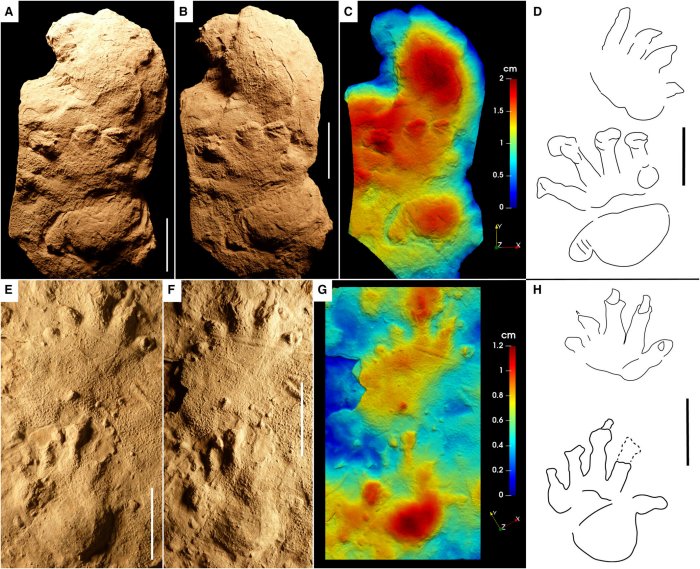
Type material of Pachychirotherium gardenaensis igen. et isp. nov. A–D, UR 75/2, holotype, right pes–manus couple, convex hyporelief: A, photograph with oblique light from the upper side; B, photograph with oblique light from the right side; C, false-color depth map; D, interpretive drawing. E–H, UR-NN 5, paratype, left pes–manus couple, convex hyporelief: E, photograph with oblique light from the upper side; F, photograph with oblique light from the right side; G, false-color depth map; H, interpretive drawing. All scale bars represent 5 cm. Credit: Paleontology (2026). DOI: 10.1111/pala.70089
By mapping trackways spanning the late Permian through the Middle Triassic, the researchers uncovered a gradual, multi-stage evolution rather than an overnight physical overhaul. The ancient ancestors began with a classic sprawling posture in the late Permian, which slowly shifted into a fully erect stance by the Middle Triassic. As their bodies adapted, their middle toes lengthened to support a faster, more cursorial gait, and the animals began walking strictly on their digits rather than flat-footed.
At the same time, a systematic reduction in hand size altered their weight distribution, providing the biological foundation that allowed later dinosaurs to walk successfully on two legs.
As Dr. Marchetti noted, fossil footprints offer invaluable biological insights when skeletal remains are scarce, providing a direct and living record of prehistoric locomotion.
The study was published in the journal Palaeontology
Written by Jan Bartek – AncientPages.com Staff Writer