


Watch On
Japan will launch an epic mission to Mars today (Oct. 19), and you can watch the action live.
The Martian Moons eXploration (MMX) mission is scheduled to lift off atop an H3 rocket from Japan’s Tanegashima Space Center today at 3:41 p.m. EDT (1941 GMT; 4:41 a.m. on Oct. 20 local Japan time).
You can watch it live via the Japan Aerospace Exploration Agency (JAXA). Coverage will begin at 2:45 p.m. EDT (1845 GMT).
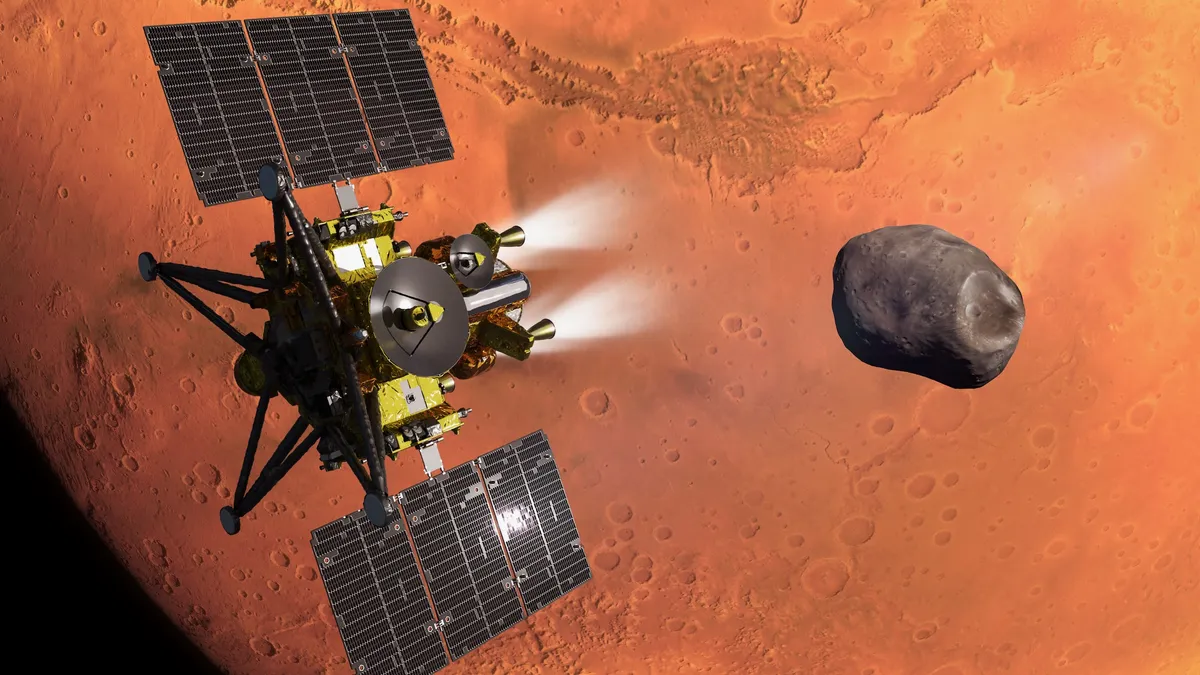
As its full name suggests, MMX will focus on Mars‘ two moons, Phobos and Deimos. They’re both tiny compared to Earth’s own moon; Phobos is just 14 miles (22 kilometers) wide, and Deimos is even smaller, with a diameter of about 8 miles (13 km).
They’re also quite mysterious. While astronomers have a pretty clear understanding of our own moon’s birth — it coalesced from material blasted into space when a Mars-sized planet slammed into Earth long ago — there’s no consensus about Phobos and Deimos’ origin story.
The duo “may be the remains of a massive impact on Mars that sent material into orbit around the planet, or they could be ancient asteroids that were captured by Mars’ gravity billions of years ago,” Tom Statler, MMX program executive and program scientist at NASA Headquarters, said in an Oct. 15 statement. (NASA is a partner on the mission, providing a scientific instrument, a technology demonstration, communication support and funding for American scientists on the MMX team.)
“Having the answer will help illuminate that early era when Earth and the other inner planets may have been acquiring much of their water and organic compounds,” Statler added.
MMX will help provide that answer, if all goes according to plan.
The spacecraft will arrive in the Mars system in August 2027, then slip into orbit around Phobos a month later. It will study that moon and Deimos from a distance for about 18 months, then deploy the French-German Idefix rover onto Phobos’ surface in early 2029.
The 55-pound (25 kilograms) Idefix “has two main tasks: providing information to prepare for the landing of the main spacecraft to collect samples, and analyzing the composition and texture of Phobos’ surface,” European Space Agency officials wrote in an MMX mission description.
“The gravity on Phobos is so low that Idefix will only weigh the equivalent of 15 grams [0.5 ounces] on its surface!” they added.
The MMX mothership’s Phobos landing will occur in 2030. The spacecraft will grab at least 10 grams (0.4 ounces) of samples from the moon, then head back toward Earth with this extraterrestrial bounty. MMX’s return capsule will land here in 2031, after which scientists around the world will scrutinize the Phobos sample for clues about the history and evolution of Mars and our solar system more broadly.
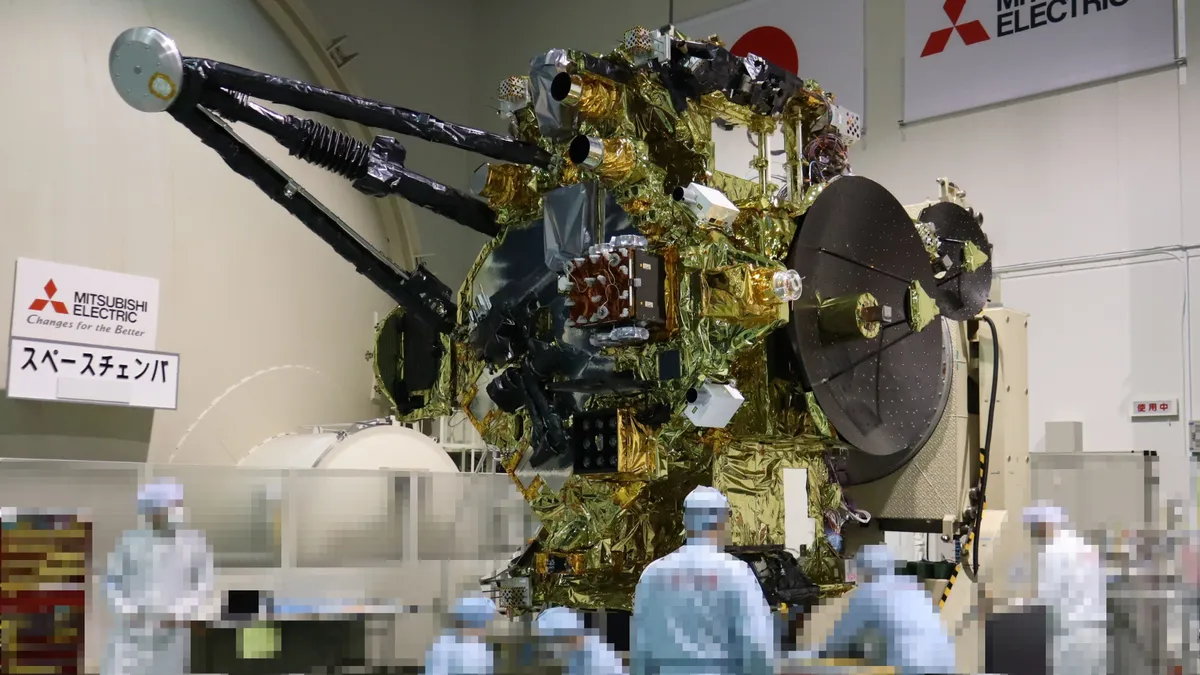
MMX was originally supposed to launch in 2024, but issues with the H3 rocket prevented it from doing so. Mars and Earth align properly for interplanetary launches just once every 26 months, so MMX had to wait a while for its next chance.
Japan already has an impressive sample-return track record. The country’s Hayabusa mission brought home pieces of the asteroid Itokawa in 2010, for example, and Hayabusa2 did the same with material from the space rock Ryugu a decade later.

