


Editor’s Note: Today’s story is the answer to the October Puzzler.
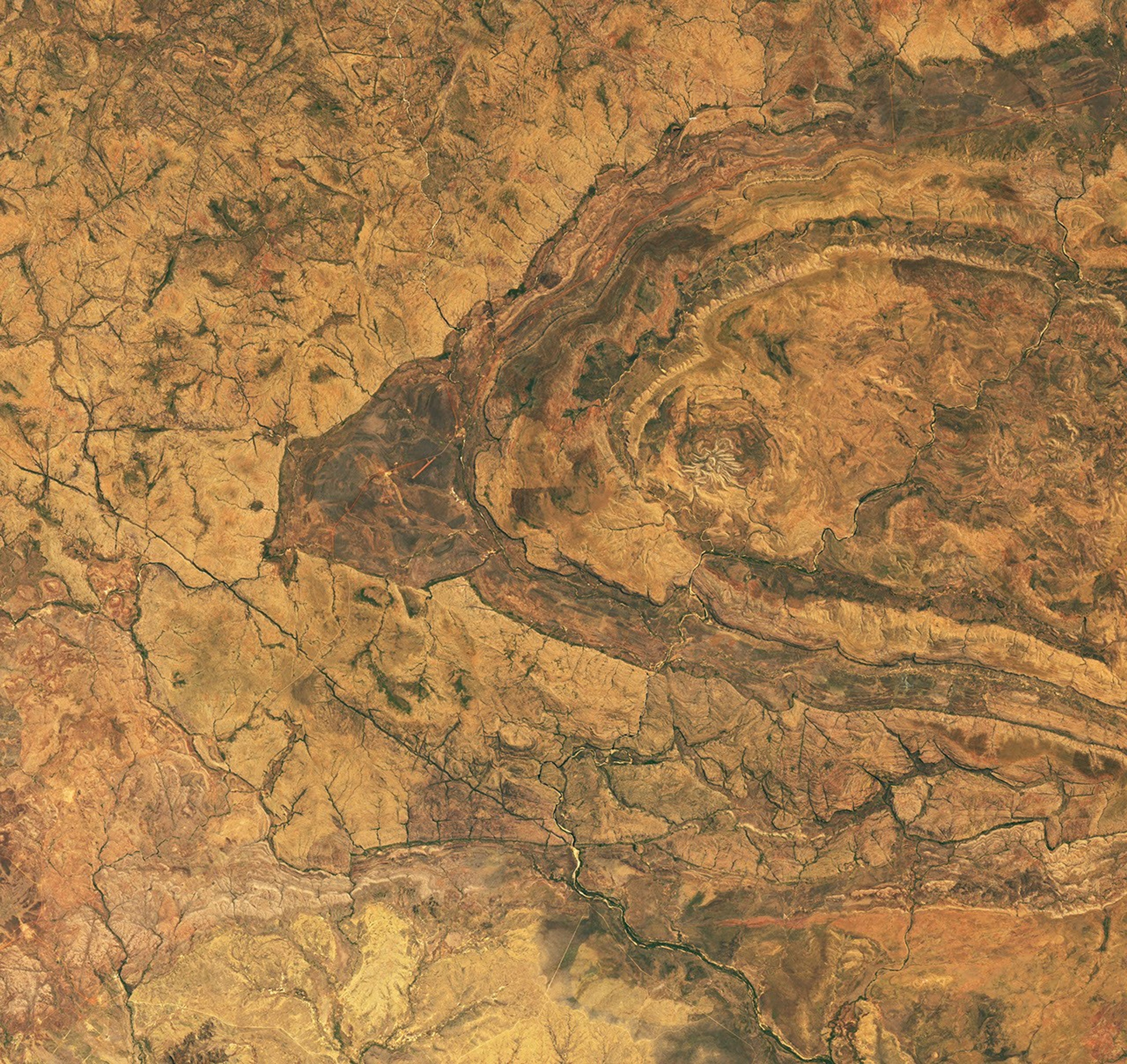
From above, the mere appearance of a curious geologic feature in Western Australia is enough to cause a fright. The aptly named Spider Crater, the product of a meteorite impact followed by hundreds of millions of years of erosion, sprawls across the landscape in the country’s Kimberley region.
The OLI (Operational Land Imager) on the NASA-USGS Landsat 9 satellite captured this image of the crater on September 20, 2026. The full impact structure has an oval shape measuring about 13 kilometers by 11 kilometers (8 miles by 7 miles), with the spiderlike central portion measuring about 4 kilometers (2.5 miles) across.
Geologists believe the unusual arachnoid pattern is the remnant of a central uplift, the raised portion of the crater floor that formed in the rebound of the initial impact shock. The light-colored “legs” are sandstone ridges that have endured while other rock layers in the impact zone have eroded away.
For decades after the feature’s discovery, scientists struggled to weave a tale about its formation. Some proposed it had a volcanic past. But with some legwork in the field, geologists identified telltale signs of a past impact: fan-shaped fractures called shatter cones. These fractures form only when intense shock waves travel through rock, and they are ubiquitous in Spider Crater’s central dome.
Scientists have subsequently performed lab analyses of shocked quartz and zircon crystals from the sandstone, which can help them reconstruct the angle of the meteorite’s impact. The date of the impact is uncertain, but estimates based on rocks in the region place it between about 900 million and 600 million years ago—making Spider Crater a creature of the late Precambrian.
NASA Earth Observatory image by Michala Garrison, using Landsat data from the U.S. Geological Survey. Story by Lindsey Doermann.
- Abels, A. (2005) Spider impact structure, Kimberley Plateau, Western Australia: interpretations of formation mechanism and age based on integrated map-scale data. Australian Journal of Earth Sciences, 52(4–5), 653–664.
- Cox, M.A., el al. (2021) Asymmetric shock deformation at the Spider impact structure, Western Australia. Meteoritics & Planetary Science, 56: 331-351.
- Impact Earth, Spider – Hypervelocity Impact Crater. Accessed October 8, 2026.
- Kenkmann, T. and Poelchau, M. H. (2013) The central uplift of Spider Crater, Western Australia. Large Meteorite Impacts and Planetary Evolution V.
- Lunar and Planetary Institute, Shaping the Planets: Impact Cratering. Accessed October 8, 2026.
- McHone, J.F., el al. (2002) Spider impact structure, Western Australia imaged with Space Shuttle radar. Lunar and Planetary Science XXXIII.

