Jan Bartek – AncientPages.com – Scientists have confirmed that many burials near First Dynasty tombs in Abydos, Egypt, indicate the sacrifice of royal household members after kings died. Flinders Petrie excavated these graves in the 1920s and questioned whether so many people could have died of natural causes at the same time, but he found no evidence of fatal wounds. A recent reassessment of skulls from the site, using modern forensic methods, now shows that at least 39% of these individuals may have been deliberately killed by blows to the head.
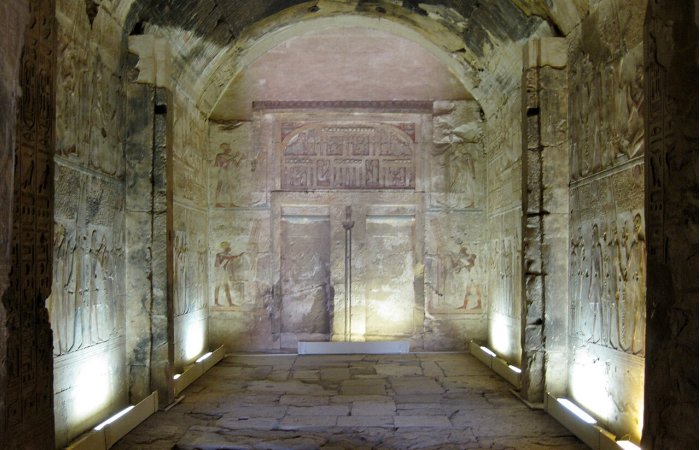
Sanctuary of Amun-Re in the mortuary temple of Seti I in Abydos, Egypt. Credit: Olaf Tausch – CC BY 3.0
“I was drawn to these retainers partly because, even though they were buried around royalty, they are mostly relegated to footnotes in the grander narrative,” said Dr Roselyn Campbell of Purdue University, author of the article in Frontiers in Environmental Archaeology and of a forthcoming book, State-sanctioned Violence and Human Sacrifice in Early Dynastic Egypt (Routledge Press). “Who were these people, and how did they view the ruler and their own role in his or her life and death?”
A Cold Case
The funerary complexes at Abydos, constructed around 3000 BCE by Egypt’s first unified kings, included royal tombs, chamber tombs, and enclosures likely used for funerary rituals. Subsidiary burials also surrounded these structures.
“Each subsidiary burial was a simple chamber in a row of dozens of others,” said Campbell. “Some people had a simple coffin. Most people had a few grave goods, like ceramic vessels, and many graves also included small objects like copper tools, projectile points, or small ivory figurines. Petrie found a few grave markers that had names and sometimes official titles on them. The titles seem to mostly refer to lower- or mid-level officials as well as artisans.”
The large number of subsidiary graves, with some tombs surrounded by hundreds, led Petrie to suspect they represented retainer sacrifice.
“Retainer sacrifice is a type of human sacrifice where those close to a ruler are killed when the ruler dies,” explained Campbell. “In many cultures, retainer sacrifice is practiced because of beliefs that the sacrificed individuals will continue to serve the ruler in some kind of afterlife, but retainer sacrifice can also be a visceral display of the ruler’s power. Some retainers might have volunteered to die to achieve eternal life or honor, others may have been chosen or even forced.”
However, Petrie found no evidence of lethal trauma, casting doubt on his hypothesis. To address this, Campbell sought out remaining evidence from Petrie’s excavations and evaluated it with modern forensic methods.
Fresh Evidence
Petrie maintained detailed records but reburied most excavated remains, keeping only the skulls, some of which he sent to the UK. Campbell located 46 of these skulls in the Duckworth Collection at Cambridge University and re-examined them, uncovering important new evidence of violence. Eighteen of the 46 crania showed significant cranial trauma, specifically linear fractures that Petrie appears to have misidentified as natural damage. Advances in forensic science now allow us to recognize these as perimortem injuries.
“The injuries on the preserved crania are generally linear fractures, which would likely cause rapid unconsciousness, internal bleeding, and death,” said Campbell, who also reported evidence of sharp-force trauma on some of the 18 skulls, including a chopping injury to one individual’s eye.
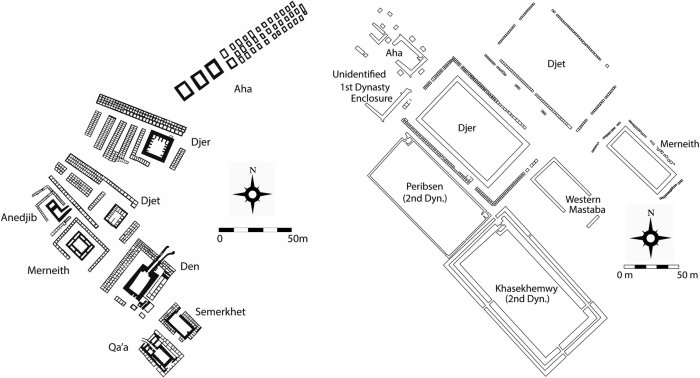
Plan of the royal tombs and subsidiary burials (left) and funerary enclosures with associated subsidiary burials (right) at Umm el-Qaab. Credit: Campbell RA (2026)
Campbell explains that the cause of these deaths remains unknown. While Egyptian kings are often shown striking enemies with a mace, these retainers were not enemies, and a mace would have produced depressed fractures. Linear fractures typically result from a flat, wide weapon or a fall. However, a fall severe enough to cause a cranial fracture would likely have broken other bones, which should have been evident in Petrie’s photographs or notes.
The fate of the other retainers is also unclear. Some may have died of natural causes. Others could have been killed in ways that do not leave skeletal evidence, such as asphyxiation, or in ways that could be identified if the rest of their skeletons were available for examination.
See also: More Archaeology News
“If I had unlimited resources, I would love to figure out where the bodies of these individuals might be and analyze them!” said Campbell. “Still, this study demonstrates how much new information about the past can be uncovered by revisiting previous data with updated methods and knowledge, even when working with incomplete or imperfect datasets,” Campbell concludes.
The study was published in the journal Frontiers in Environmental Archaeology
Written by Jan Bartek – AncientPages.com Staff Writer