Jan Bartek – AncientPages.com – For hundreds of years, Romans used amulets to protect themselves and their environment. According to PhD candidate Patricia Kret, this practice carried on even after Christianity began to spread.
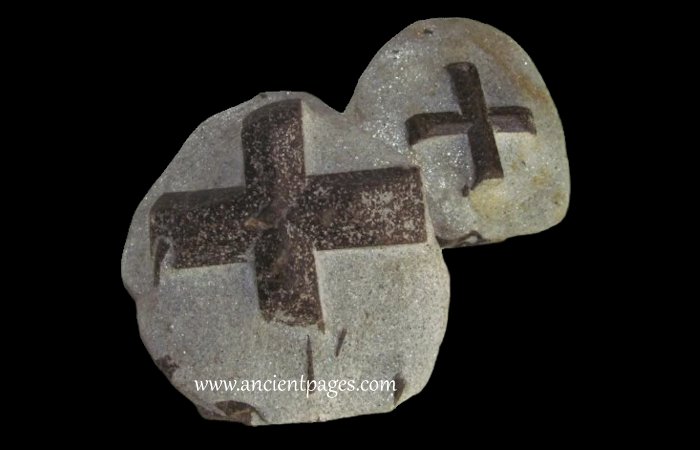
Between 100 BC and 600 AD, amulets were common throughout the Roman Empire. People hung them on houses, placed them near fields, or wore them. Kret explains, ‘Location is important when it comes to amulets. The object must be placed in the spot it is intended to protect, heal or bring supernatural benefits to.’ She notes that this key part of their use stayed the same even after Christianity arrived in the Roman Empire.
Kret also found that the amulets’ appearance changed very little. ‘Body amulets, for example, often remained pieces of text, written on a metal plate or a scrap of papyrus, which hung around the neck of the person to be protected.’ The main difference was in the text itself. ‘It gradually became more Christian in nature, just like the shape of the amulet,’ says Kret. ‘It takes the form of a cross, for instance, but people still wear it round their necks with the aim of being protected.’
Bishops Versus Priests
This Christianisation stands out because Christianity, in principle, rejects the use of amulets. Kret explains, ‘The upper echelons of the ecclesiastical institutions were strongly opposed to the use of amulets during this period.’ For example, bishops warned in sermons that using amulets could lead to excommunication. Yet, in those same sermons, they also told priests to stop making amulets. We know priests often made them, since the amulets frequently included Bible quotations. At that time, only priests usually had access to Bible manuscripts to copy from.
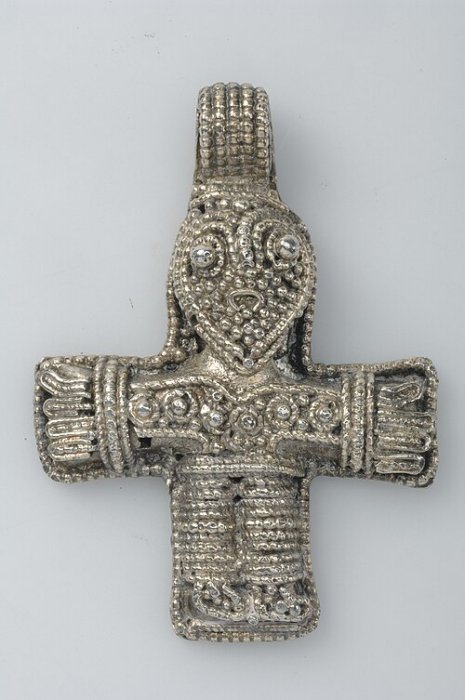
A pendant crucifix, considered in Christian tradition as a defense against demons, as the holy sign of Christ’s victory over every evil. Credit: The Swedish History Museum, Stockholm, Sweden – CC BY 2.0
In this way, amulets did more than protect their owners; they also helped bring Christianity closer to them. Kret says, ‘The world is becoming increasingly Christian. In that new, Christian context, amulets offer a new Christian experience. It was often the only part of the Bible people had access to. Like relics, which also emerged during that period, amulets fulfilled the need for a tangible Christian faith. It was something Christian that people could take home with them.’
From Bible Text To Abracadabra
While manuals can help reconstruct how amulets were made, figuring out how they were actually used is harder. Kret explains, ‘We have little text describing how people used the amulets. I have mainly looked at the objects themselves: what might they have smelled and felt like?’ The writing on the amulets can also provide clues. ‘In the end, I analyzed about three hundred of them,’ says Kret. ‘Sometimes the amulet literally states the illness against which it offers protection, or specifies the distance within which it is effective. That was very useful for my analysis of the relationship between the amulet and the place where it is found.’
See also: More Archaeology News
At other times, she found less clear information. ‘Sometimes it literally said “abracadabra” on the top line,’ she says. ‘In the lines below, the outermost letters would then be omitted. As the number of letters gradually decreased, so too was the fever supposed to subside.’
Reusable Protection
Another key finding is that people often reused amulets. ‘Sometimes it was an heirloom; at other times, so many centuries had passed that we don’t know exactly why it was brought back into use, but it shows that faith in amulets was strong.’
Krets’s favorite example is also a reused amulet. ‘It’s a small metal plate bearing an inscription stating that it is used to treat migraines,’ she explains. ‘It was found alongside three other amulets in a single grave, but it is much older than the rest. Migraines run in families, so perhaps that is why it has been passed down through the generations.’
Source: Leiden University