Jan Bartek – AncientPages.com – A small 2,000-year-old artifact has proven more important than once thought. This decorated Iron Age terret, now on display in the European Prehistory Gallery at the Ashmolean Museum in Oxford, was found in Suffolk, England.
It is made of copper alloy and shows the typical La Tène style, with carved designs and colored glass inlays. The red glass is known as the distinctive “sealing wax” often found in high-status metal objects from this time. The source and meaning of the dark, see-through blue glass are still a mystery.
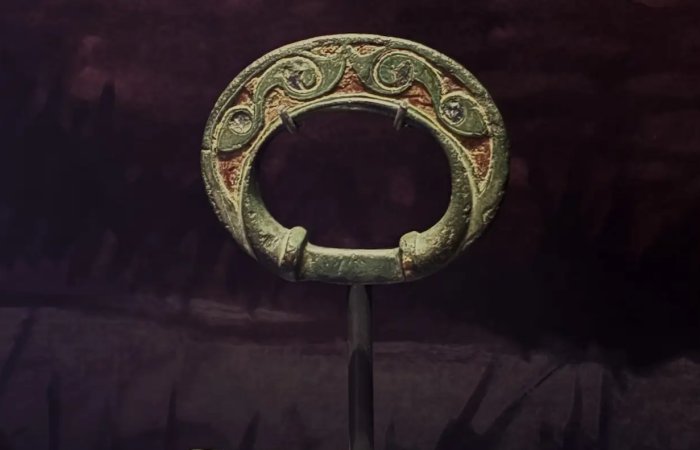
The Ashmolean Museum houses the 2,000-year-old bronze ring. Credit: Diamond Light Source – Ashmolean Museum
Recent X-ray analysis has revealed that the Iron Age ring has a more complicated history than experts first thought.
Late last year, curators from the Ashmolean Museum went to Diamond to study this 2,000-year-old artifact, which had not been closely examined before. By using the microfocus beamline at I18, researchers learned more about Iron Age craft methods and were able to update the artifact’s date.
The artifact studied was a bronze terret, made sometime between 50 BCE and 75 CE. This period included major political and social changes around the Roman invasion in 43 CE. Archaeologists note that objects from this period show a mix of local traditions and outside influences, especially in metalwork.
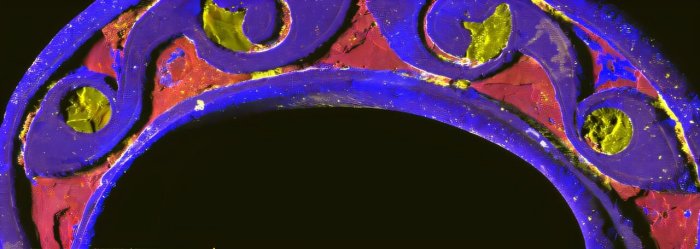
The elemental map shows lead in red, copper in blue and iron in yellow. Credit: Diamond Light Source
The terret in the Ashmolean collection helps us understand how trade and outside influences shaped the things people made. A terret is a small piece attached near a horse’s harness to guide the reins of a chariot. This one stands out because of its detailed red and blue glass inlays. With help from the I18 team, researchers used their data to make an elemental map of the terret.
The elemental map showed that the terret’s metal surface is mostly copper with a lot of lead mixed in. The red glass has a very high lead content, while the blue glass is mostly iron with some copper.
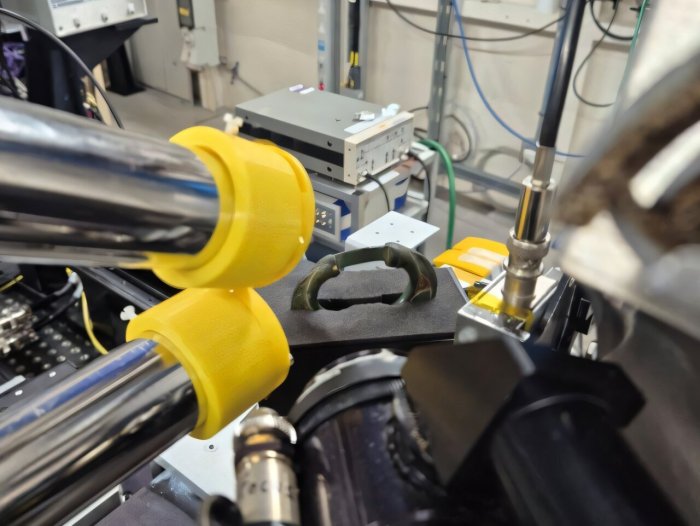
Setting up the terret at I18’s microfocus beamline. Credit: Diamond Light Source
The blue glass’s chemical makeup shows the ring was not made in Britain. Experts think it was brought from Egypt as beads and later made into the terret.
On the other hand, researchers found that the red glass was a type often used in Iron Age Britain from the Middle Iron Age to the first century CE.
This small artifact is evidence of long-distance trade and shows how foreign and local traditions came together to shape Iron Age culture.
See also: More Archaeology News
Beamline scientist Susan Nehzati, who helped with the research on the I18 beamline, said: “We believe the science we do here at Diamond should be seen and accessible to everyone, which makes this exhibit at the Ashmolean very exciting and rewarding. The public are integral to the scientific process and play a vital role in shaping future discoveries.”
You can see the terret at the Harnessing Power exhibit in the Conservation Gallery at the Ashmolean Museum.
Source: Diamond Light Source
Written by Jan Bartek – AncientPages.com Staff Writer