Jan Bartek – AncientPages.com – A centuries-old Highlands story of forbidden love, war, and a legendary curse is now being investigated as a true-crime case. Forensic experts hope to uncover the real facts behind this medieval mystery.
For generations, the Grant family kept a human skull linked to a violent Highland legend, warning that moving it could bring disaster to the clan. Now, more than six hundred years later, forensic experts are studying the remains to see if the skull belonged to the medieval figure from the story. Grantown Museum in Scotland is leading the investigation as it gets ready for an exhibition and podcast called The Legend of the Highland Skull. The project will look at themes like forbidden love, powerful clans, murder, and a rumored curse.
The Dark Secrets Of Castle Grant
The story takes place at Castle Grant in Strathspey, a 15th-century tower house north of Grantown-on-Spey in the Scottish Highlands. For centuries, it was the ancestral home of the Chiefs of Clan Grant.
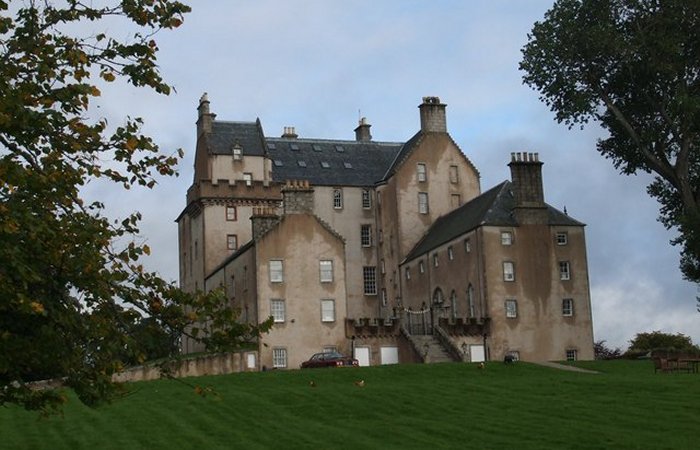
Castle Grant. Credit: Ronnie Leask – CC BY-SA 2.0
The castle was first called Freuchie Castle, which means “place of heather.” It dates to a 15th-century Z-plan tower house originally held by Clan Comyn. Clan Grant and Clan MacGregor joined forces to take the land from the Comyns.
An 1857 letter from Grigor Stuart, a minister from Kingussie who visited the Countess of Seafield at Castle Grant, says the skull now being studied belonged to the head of Clan Comyn. He was reportedly killed in a violent fight with the Grants and MacGregors over the stronghold, which was then called Freuchie Castle. The Grants later took over and renamed it Castle Grant.
Legend says the skull was kept as a family talisman, with a warning that if it ever left the Grant family, the clan would lose its land, influence, and place in Strathspey. Although it is seen as folklore, the tradition remains connected to the legend and continues today.
After the Grant family sold Castle Grant in 1983, the public no longer saw the relic. Later, Lord Reidhaven, a descendant of the Grant chiefs, found it in a family storeroom. It was reportedly inside a Harrods box along with the 1857 letter.
Earlier this year, Lord Reidhaven took the skull to Dan Cottam, the Curator of Grantown Museum, and asked, ‘Is this the skull of the medieval chieftain mentioned in the letter?’
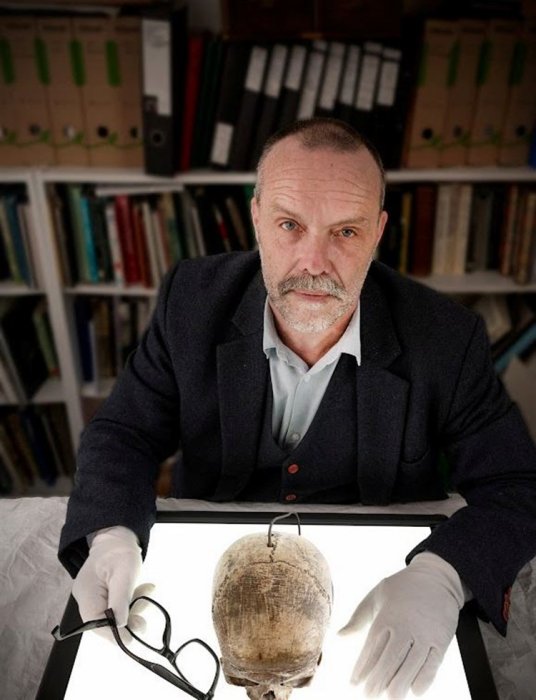
Curator Dan Cottom was immediately captivated by the skull’s legend. Credit: Jim Dunn
Cottam was interested and explained that the document found with the skull tells a 13th-century story about a young Grant clansman who ran away with the daughter of a MacGregor chieftain.
While they were escaping, the couple stopped in Strathspey so the young woman could give birth.
When the MacGregor chieftain finally caught up, the Grant young man tricked him by making him believe he was surrounded by 100 armed men. At this point, the story takes an unexpected turn and the investigation starts. The main question is what science can tell us about the mysterious skull.
Scientific Investigation Of The Cursed Scottish Skull
Experts in human remains and bones, including Cat Irving from Surgeons’ Hall Museums in Edinburgh, are studying the skull. Their initial look has raised new questions. The skull seems to have been cut across the forehead on purpose, with a metal hinge and hook added to turn part of it into a container. Researchers are trying to learn basic facts that could support or challenge the old story, such as the person’s sex, age, and any signs of injury or disease. Most importantly, dating the skull and comparing the evidence with the historical story will be key to seeing whether the legend is true.
See also: More Archaeology News
The timing is notable. The skull has now left the Grant family, which the legend says would cause the clan’s downfall. Still, the goal is not to test the curse. Grantown Museum is using this investigation to explore how stories last, change, and gain power over time. The project brings together historical research, forensic study, and storytelling, instead of treating the supernatural as fact.
The Legend of the Highland Skull project includes a four-part podcast, an animated short film, and an exhibition. The exhibition will be at Grantown Museum from September 7 to October 31, 2026, and the podcast started releasing episodes in September. After almost 600 years, one question may finally be answered: whose skull is it?
Written by Jan Bartek – AncientPages.com Staff Writer
Expand for references