


Eddie Gonzales Jr. – AncientPages.com – One of the most complete diplodocid skeletons ever discovered in Europe is reported by paleontologists from the Fundación Conjunto Paleontológico de Teruel-Dinópolis in the peer-reviewed Journal of Vertebrate Paleontology.
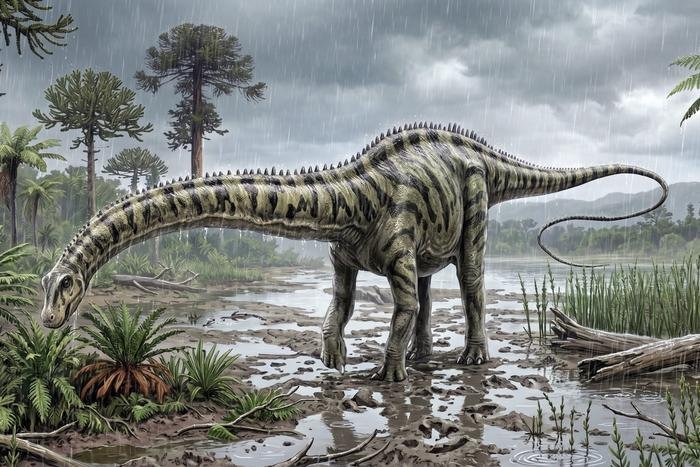
An illustration of the Diplodocus by Carmelo López. Image credit: Carmelo López
This remarkable sauropod find – vertebrae and chevron bones dating to about 150 million years ago – is the first evidence of the iconic Diplodocus outside North America.
It challenges our understanding of dinosaur distribution in the Late Jurassic.
The team made this fascinating and historic discovery at the La Tejería site in El Castellar, Teruel, Spain. The site where the specimen was found is known for several other dinosaur fossils like sauropods, theropods, stegosaurs, and ornithopods.
Over time, a team of paleontologists from the Fundación Dinópolis excavated 14 exceptionally preserved caudal (tail) vertebrae and several chevron bones. Previously, all confirmed Diplodocus specimens were found only in the Morrison Formation of the western United States.
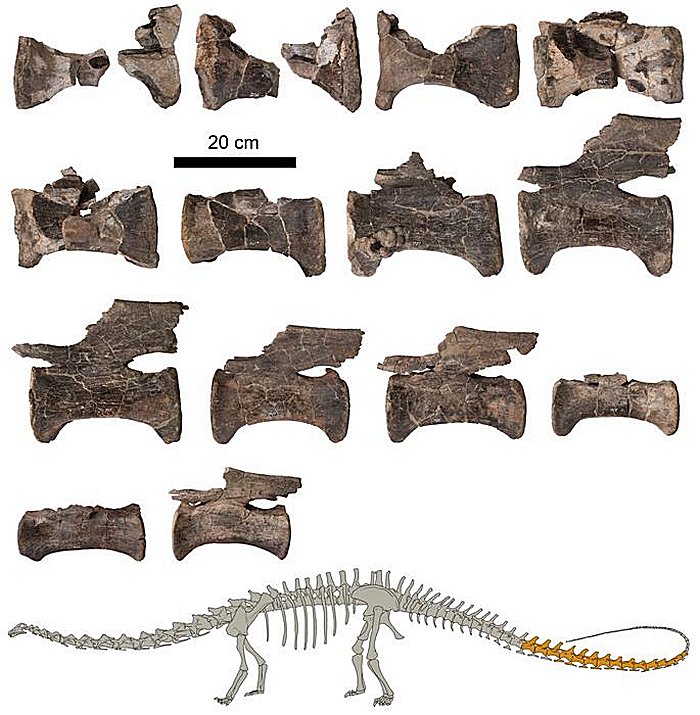
Tail vertebrae of the Diplodocus from El Castellar (Teruel, Spain), together with a figure indicating the studied fossils in dark. Image credit: Sergio Sánchez Fenollosa / Journal of Vertebrate Paleontology
“It was an exciting and continuous process of seeing the pieces of the puzzle gradually fall into place. From the early stages of the osteological study, we noticed strong similarities with several diplodocine sauropods. As we looked more closely at the anatomy, we began to identify a combination of features characteristic of Diplodocus species. Then, as we carried out different evolutionary analyses, they kept pointing in the same direction.
With each new result, the picture became clearer: we were looking at a Diplodocus,” said Sergio Sánchez Fenollosa, PhD student in biodiversity and evolutionary biology at Fundación Dinópolis and lead author of the article. This excavation provides some of the strongest paleontological evidence for dispersal and faunal exchange between the two continents across the proto-Atlantic Ocean during the Late Jurassic. It also sheds more light for Iberian Mesozoic ecosystems and the variety of sauropod dinosaurs that lived in Europe during the Jurassic period.
The Spanish Diplodocus lived about 150 million years ago, at the end of the Jurassic Period. Finding it in Europe strongly suggests that dinosaurs could move between North America and Europe during the Late Jurassic, probably crossing temporary land bridges that appeared when the early North Atlantic Ocean shrank.
See also: More Archaeology News
The Diplodocus specimen from El Castellar measured about 25 meters long (82 feet) ), comparable to its North American relatives. It had a long whip-like tail, and relatively small head.
This discovery identifies it as one of the giant sauropods of the Spanish Jurassic, alongside other sauropod dinosaurs from Teruel, such as Turiasaurus and Losillasaurus, which show characteristics very different from those of diplodocids.
The unearthed fossils are on display in the dinosaur gallery of the Aragonese Museum of Paleontology at Dinópolis (Teruel).
Paper
Written by Eddie Gonzales Jr. – AncientPages – MessageToEagle.com Staff Writer

