


Conny Waters – AncientPages.com – A major Viking Age treasure was recently found in Finland by treasure hunter Kalle Lappinen. On September 3, 2026, Lappinen made a unique discovery: a silver treasure near the church in the village of Sysmä, in southern Finland’s Päijät-Häme region, on the shore of Lake Päijänne.
Sysmä, like other villages in Päijät-Häme, has a long history closely tied to the landscape, as well as to Viking raids and unrest that marked the later Iron Age.
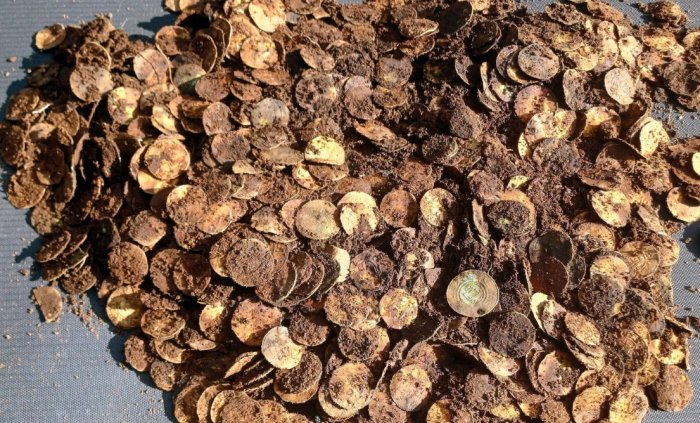
Image credit: Esko Tikkala, Lahti Museums.
Esko Tikkala, an archaeologist at the regional museum, visited the site with his team, which recovered and inspected the cache. According to their estimate, the silver coin cache dates to the Late Iron Age and is the largest known in Finland to date.
Among the silver coins are other silver pieces, including a clasp, a bracelet, and a bead. They were found in the ground, at a depth of about 45 centimeters at a distance of about 12 meters apart, buried among the stones and hidden from view.
Researchers will examine the containers in detail; the total weight of the coins is estimated at 4.5 kilograms, and there are thousands of them.
At first, the collection will be cleaned, separated or counted. This will help determine the exact weight and quantity of the pieces. Until today, Finland’s largest known Viking Age money cache was found in Nousiainen in 1895. It consisted of about 1700 coins and other objects, weighing about 2.2 kilograms.
Future studies of this unique Finnish silver discovery will most likely determine when the silver collection was hidden at the site of the village of Sysmä.
Sysmä, like other villages in Päijät-Häme, has a long history closely connected with the landscape. The region’s rich history is also tied to the ancient province of Häme and was shaped by waves of migration and trade contacts after glaciers retreated 11,000 years ago.
At this time, the first settlers arrived in Päijät-Häme, and as the climate warmed, people lived near ancient lakes and bays. By 5100 BC, the Comb Ceramic culture thrived. The arrival of the Battle Axe culture around 3200 BC brought new tools and pottery styles. During the Bronze Age (1900 BC), cremation burials and large stone cairns became common.
See also: More Archaeology News
In the Iron Age, settlements shifted to better farming areas near waterways. Viking raids and unrest marked the later Iron Age. Christianity arrived during the Crusades (1050-1300 AD).
Lahden museot
Written by Conny Waters – AncientPages.com Staff Writer

