


Conny Waters – AncientPages.com – A Roman law expert from the University of Cincinnati has edited and translated a Latin legal text that was pieced together from fragments buried in the Egyptian sands for more than 1,600 years. The text deals with taxes.
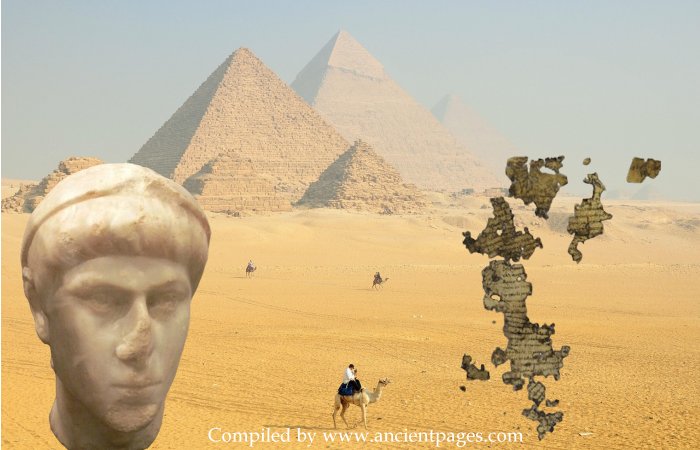
Left: Possible head portrait of Constantius II found in modern al-Bab, Syria (Penn Museum). Credit: Mary Harrsch – CC BY-SA 2.0, Middle Egyptian desert. Public Domain. Right: Deciphered fragments. Credit: Penn Museum. Image compilation AncientPages.com
UC Assistant Professor of Classics Matthijs Wibier translated the double-sided page, which does not appear in any other known ancient Roman books. He thinks the text probably came from a small collection of imperial laws from the late fourth century, meant for tax officials or for landowners and their lawyers.
“We don’t have a book like this that we know of, which makes it the first of its kind,” Wibier said. “I don’t think it contained thousands of laws like most of the Roman codes we know. I think it was a book that traveling officials could put in their pocket.”
The 50 animal-skin fragments are part of the Egyptian antiquities collection at the Penn Museum at the University of Pennsylvania in Philadelphia. The museum bought the fragments from an antiquities dealer in Egypt in 1911.
Ancient Egyptian Parchments Uncover Unexpected Roman Legal Rules
The 50 animal skin fragments are part of the Penn Museum’s Egyptian antiquities collection at the University of Pennsylvania in Philadelphia. The museum acquired them from an Egyptian antiquities dealer in 1911.
With the museum’s assistance, Wibier reconstructed the page from the seven largest fragments. Their uneven borders resemble an island archipelago.
These fragments enhance our understanding of imperial law during the reigns of Constantius II and Julian the Apostate, who ruled from 337 to 363.
Translating fragmentary texts is valuable because few books from that period remain intact. Scholars rely on damaged or partial manuscripts to reconstruct them. These laws provide insight into daily life, society, and the economy in ancient Rome, including government priorities and the resolution of private conflicts.
Wibier noted that one side of the page contains three instances of red ink highlighting important information.
Science, History And Language Unlock Secrets Of Penn Parchment
By noting the absence of highlights on the reverse side of the pages and considering the imperial decrees, Wibier determined the pages’ orientation. Animal skin has one smooth side and one textured side. The textured side appeared first, as the odd-numbered page on the right when the book was open, while the smooth side appeared on the left.
Wibier used ultraviolet light to enhance the ink contrast, aiding in the recovery and translation of the Latin text. He said his interest in Latin initially led him to study Classics.
“I love languages, Latin in particular. Working on these pieces and seeing how they fit together was tremendously gratifying,” he said.
He said the book was likely intended for Roman officials responsible for enforcing laws, as well as wealthy taxpayers and their lawyers.
“To dodge the law you have to know the law,” Wibier said.
Wibier compared the pages to surviving texts, focusing on the Codex Theodosianus, a 16-volume collection of over 2,500 imperial laws issued between 311 and 437. He concludes that the Penn parchment is likely not a missing section of the two relevant books of the Theodosian Code that address similar topics, though he cannot entirely rule out this possibility.
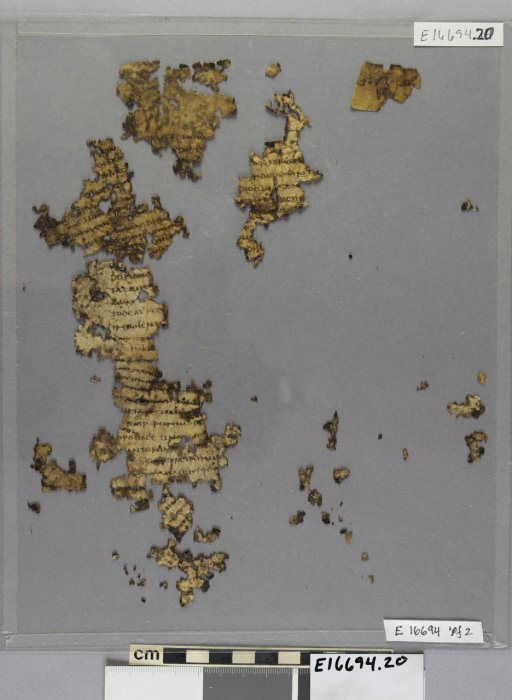
UC Classics Assistant Professor Matthijs Wibier pieced together and translated an ancient Roman legal text from tattered fragments that survived the sun and wind of the Egyptian desert for more than 1,600 years. Photo/Penn Museum
“What makes this discovery particularly remarkable is that, unlike nearly all other fragmentary Roman law books, this text does not correspond to any known imperial legal code,” said UC Professor Daniel Markovich, head of UC’s Department of Classics.
“If I had to guess, this could have been an official’s book,” Wibier said. “It was produced with great care. The handwriting is beautifully executed. This is high-quality scriptorial writing.”
What laws did it contain?
“They addressed the public road system and the collection of taxes to maintain infrastructure,” Wibier said. “If I had to speculate, this law may have required wealthy citizens to maintain roads and supply grain for the food supply.”
“Another law warned people to stop treating public buildings like they were private property.”
Wibier described the painstaking work that went into the translation in a chapter of the upcoming book “Il Codice Teodosiano“ edited by Detlef Liebs and Dario Mantovani scheduled to be published this year by Pavia University Press.
Recovered Parchment Reveals Secrets Of Ancient Rome
During the reigns of Constantius and Julian, Ancient Rome extended from present-day England across Europe to Syria and Egypt. The capital was Constantinople, now known as Istanbul, Turkey.
Wibier noted that the emperors governed tens of millions of people.
“The empire prioritizes keeping the population fed, especially in cities. If there is not enough grain in Constantinople, people will protest, which is dangerous,” he said. “They also ensure the military is well provisioned. These are major concerns.”
The emperors also owned most of the land to maintain political control.
“There is concern about having too many wealthy individuals who could raise their own armies,” he said. “The empire ensures essential services are provided, funded by those with means. The system is hierarchical, but it prevents challenges to the emperor.”
The project received grants from the European Research Council and the Semple Classics Fund. Wibier acknowledged the valuable assistance of the Penn Museum.
The museum preserves hundreds of manuscripts from Egypt, many of which survive only in fragments, said Jennifer Houser Wegner, curator-in-charge of the Egyptian collection. These texts appear on materials such as papyrus, vellum, and animal skin, and are written in scripts ranging from Egyptian hieroglyphs to Coptic, Arabic, Hebrew, and Greek. However, the parchment Wibier examined is the only Latin manuscript in the collection.
“The document is highly fragmentary; nevertheless, Wibier has skillfully deciphered the text and made a translation,” Houser Wegner said.
See also: More Archaeology News
“Beyond its interesting content, Wibier’s research on this parchment highlights the immense potential within Museum collections that house unpublished manuscripts,” she said.
“As these fragmentary texts receive greater scholarly attention through careful study, translation, and commentary, these documents have the possibility of expanding our understanding of the ancient world.”
Source: University of Cincinnati
Written by Conny Waters – AncientPages.com Staff Writer

