




A mysterious hum of gravitational waves that fills the cosmos may be the echo of “dark stars” that served as the seeds of the first supermassive black holes.
These low-frequency gravitational waves were detected back in 2023 using an array of cosmic lighthouses, or pulsars, in a so-called “pulsar timing array.” Pulsars are neutron stars that spin rapidly and regularly while blasting out collimated beams of radiation from their poles that can be used to detect tiny fluctuations in space and time. Such fluctuations are caused by the gravitational waves, or ripples in spacetime.
For a long time, the source of this particular low-frequency gravitational wave background has been somewhat shrouded in mystery, but scientists have hoped that they may be encoded with the secrets of the universe as it was around 13 billion years ago. Indeed, the team behind this research believes this hum of spacetime ripples could help explain how supermassive black holes grew so rapidly before the universe was even a billion years old. They link this solution to hypothetical supermassive “dark stars” that may have collapsed and died in the early universe to birth massive black hole seeds, giving supermassive black hole growth a head start.
“Dark stars were originally proposed as objects that might be seen directly at cosmic dawn,” Ilie said. “This work points to a completely different way of testing their possible role in cosmic history,” team member Cosmin Ilie of Colgate University said in a statement. “Their descendants could leave a gravitational-wave imprint that persists all the way to the present-day universe.”
Cosmic clocks and collapsing Dark Stars
Pulsar timing arrays detect gravitational waves when their passage squashes and stretches space as the waves ripple past them, causing tiny delays in the pulsars’ beams of radiation reaching Earth.
Detecting a gravitational wave background, however, required monitoring pulsar timing arrays for many years.
“Pulsar timing arrays are usually thought of as probes of supermassive black-hole binaries in the relatively recent universe,” Ilie said. “What our work shows is that the signal may also contain information about how the ancestors of those black holes formed at cosmic dawn.
“In that sense, gravitational waves observed today could provide a new window onto the birth of the first supermassive black holes.”

The currently favored explanation for this background is a cosmic history of binary black holes spiraling together before merging, particularly pairings with combined masses of over 1 billion times the mass of the sun.
However, that doesn’t explain where these supermassive black holes came from and how the James Webb Space Telescope (JWST) is routinely detecting them before the universe was even 1 billion years old — despite the fact that the feeding and merger chains proposed to create supermassive black holes should take over 1 billion years.
Ilie and his Colgate University colleague Sohan Ghodla questioned if supermassive balck hole growth began with heavy seeds, and if these heavy seeds were created by the collapse of dark stars.
Dark stars are hypothetical primordial stars that, rather than producing energy through nuclear fusion, are instead powered by self-annihilating dark matter within their cores. As dark matter fuels these primordial stars, they would remain cool compared to other stellar bodies, allowing them to continue to accrete matter throughout their lives.
This process would continue until Dark Stars reached masses millions of times that of the sun and collapsed under their own gravity, creating massive black holes; seeds that collide and merge to form supermassive black holes.
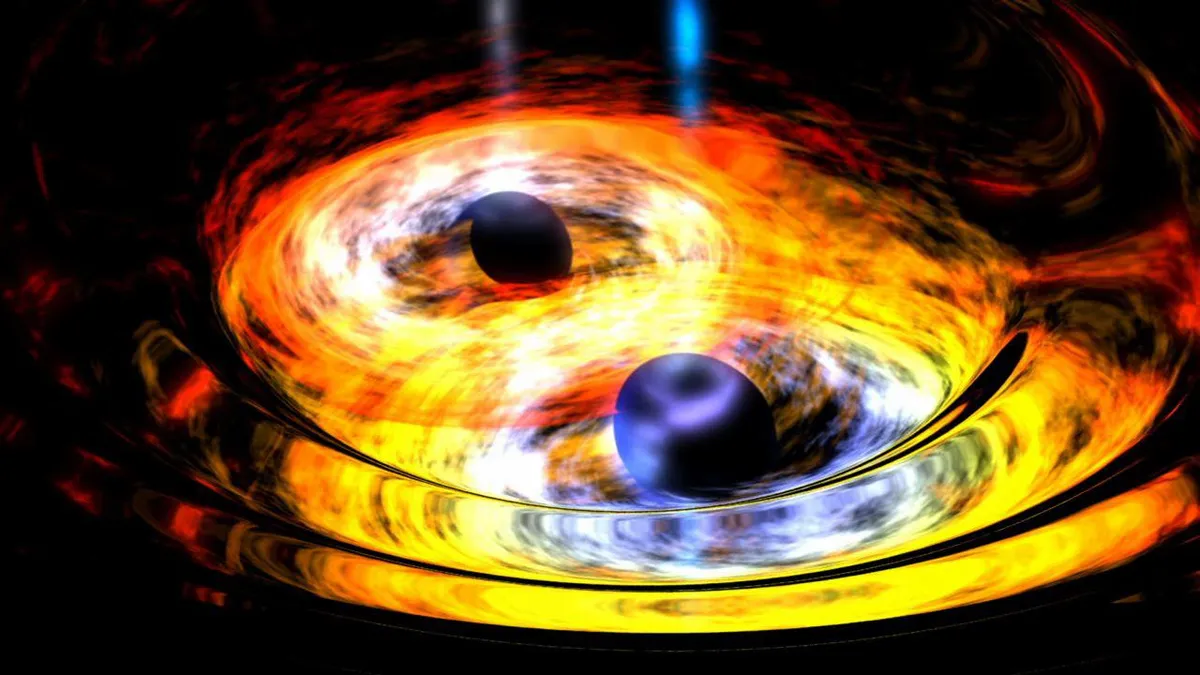
Ilie and Ghodla modeled the environment in which the resultant black hole seeds would exist and merge, calculating merger rates and the influence on the gravitational wave background.
They found supermassive dark star remnants could indeed provide a major, perhaps dominant, contribution to the gravitational wave background detected in 2023. That means the measurements provided by pulsar timing arrays could help determine how abundant heavy black hole seeds were in the early universe.
“Produce too many of these massive seeds, and you end up over-producing the pulsar timing array-detected signal,” Ghodla said. “Produce too few, and you need other sources to efficiently assemble these supermassive black holes later in the life of the universe to match pulsar timing array observations.”

The key determining factor here would be the masses of the dark matter haloes in which the dark stars live and in which the heavy black hole seeds form.
Determining if the researchers’ theory is correct may have to wait for improvements in pulsar timing array measurements of the gravitational wave background, along with a better understanding of populations of black holes and their characteristics in the early universe.
The team’s research was published on Monday (August 17) in the journal Physical Review D.
