Jan Bartek – AncientPages.com – If you have a cat and enjoy reading, you may have noticed that cats often sit on books. This behavior appears to date back to the earliest days of books. Cats frequently keep us company while we read, write, and do many other activities.
Scientists say cat paw prints have been found in no fewer than three of the oldest printed books in Utrecht University Library.

Credit: Utrecht University
Evidence of these unusual ‘users’, or maybe we should call them ‘readers’, was recently discovered during a University Library project to digitize and recatalogue all 15th-century printed books, known as incunabula.
For this project, cataloguers and scan operators are reviewing all 900 incunabula in Special Collections. While previous catalog descriptions exist, this initiative focuses on each copy’s unique features, including binding, provenance, annotations, decoration, and even cat paw marks. These details offer insights into a book’s historical use, location, and ownership. The University Library now provides online access to both the scanned pages and the exterior of each book from all angles.
A Cat In The Monastery?
Two of the books with cat paw prints were originally held by the Nieuwlicht Carthusian monastery in Utrecht (X fol 81 (Rariora) and X fol 98 (Rariora)), while the third copy comes from the Janskerk (B fol 140 (Rariora) dl 1-6). It is unclear whether the paw prints were made while the books were in these institutions. However, cats served a practical purpose in monasteries as mousers and may also have provided companionship while reading.
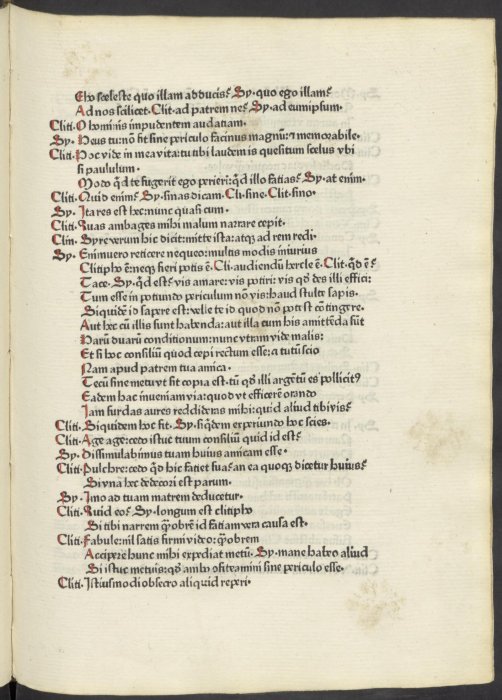
Credit: Utrecht University
The university library is built on the medieval monastic and chapter libraries of Utrecht, which hold the city’s oldest surviving book collections. Interns are cataloging incunabula from these collections in the international database Material Evidence in Incunabula, recording every trace of previous ownership. This database helps researchers study how 15th-century books were owned, used, and circulated across different countries.
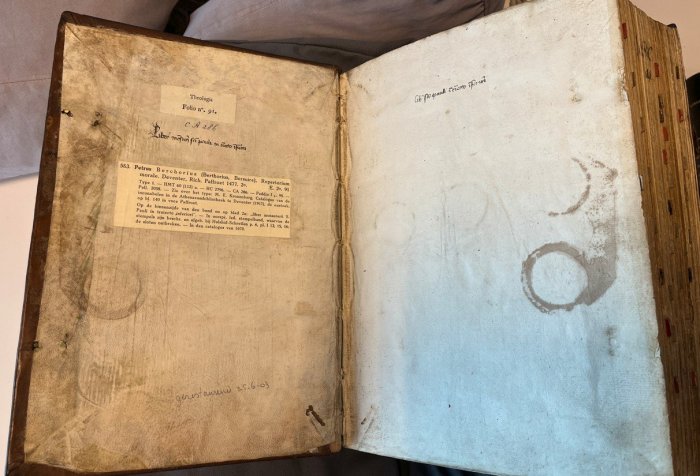
Credit: Utrecht University
Interns Josefien Wijker and Mylou Eggermont, both Research Master’s students in Art History, have traced the intriguing ownership history of an incunabulum from the monastery of the canons regular in Utrecht.
Surprising Discoveries
The Utrecht University Library’s incunabula project is now well over halfway through: more than 560 incunabula have been scanned and the catalog entries enriched. This has already led to numerous surprising discoveries. As well as cat’s paw marks, a print of a pair of spectacles has turned up (E fol 91 (Rariora)), bird droppings (RAR 6-43 qu), smudged ink stains (G fol 321 (Rariora)) and all sorts of little drawings in the margins (for example, in E fol 320 (Rariora)).
See also: More Archaeology News
Moreover, five copies have been misidentified for over 100 years. For example, our copy of the treatise Flores musice by the 14th-century music theorist Hugo Spechtshart turns out not to be the edition of c. 1492, as had been assumed since 1922, but the rarer edition of c. 1490 (F qu 348 (Rariora) dl 3). The misidentifications were discovered by comparing the Utrecht copies with digitized copies held in other institutions.
The aim is to complete the incunabula project by 2028.
Source: Utrecht University
Written by Jan Bartek – AncientPages.com Staff Writer