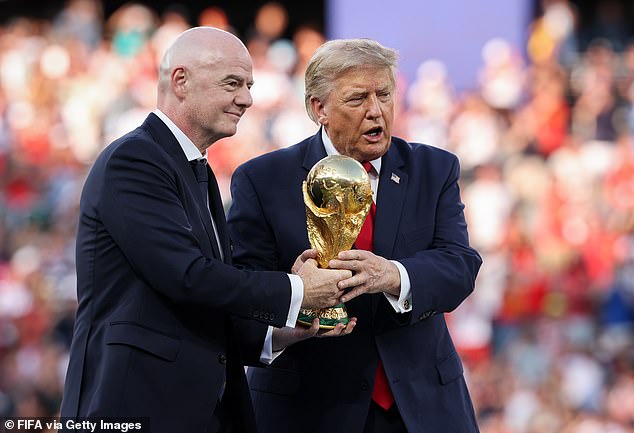
It’s only two weeks since Gianni Infantino joined President Donald Trump in handing over the Jules Rimet trophy to Spain in New Jersey, wearing a dark suit, blindingly white trainers and the self-satisfied grin of a man celebrating a World Cup triumph of his own.
The FIFA president declared the tournament – and its new 48-team format – a huge success after spending the previous six weeks flitting around North America in a private jet to see his vision become reality.
Anybody else might have been inclined to spend some time reflecting on a World Cup that produced more than its fair share of talking points, or even have some time off.
Not Infantino. He was already moving onto his next project; one that backfired spectacularly this week and has left the 56-year-old Swiss fighting to stay in power.
It took less than four days for his grand plan to sell off football’s crown jewel to private investors for £3.1billion to go up in smoke, from the bombshell news breaking at lunchtime on Tuesday to Infantino’s humiliating statement in the early hours of Saturday confirming it has been scrapped in the face of widespread opposition.
At the end of a seismic week for world football, it is hard to see how he can survive after leading confederations and even senior executives at FIFA turned on the embattled president, and UEFA made the first move towards removing him from office with a vote of no confidence on Saturday morning.

Just days after lauding the 2026 World Cup as a huge, almost personal, success Gianni Infantino saw his iron grip on FIFA’s presidency unravel
Why did it unravel so quickly? How did Infantino, a skilled political figure, get it so horribly wrong?
It was clear this wasn’t going to end well from the immediate sense of shock and outrage when The Times revealed that Infantino wanted to create a subsidiary company called FIFA Forward Enterprise to run its flagship events, primarily the World Cup, in a deal that could be worth up to £15bn.
Private investors would have been able to buy stakes in FFE through a group led by Thrive Eternal, a US venture capital company founded by Joshua Kushner, the brother of Trump’s son-in-law Jared.
The 211 member associations were offered a £30m cut if they agreed with the proposals by September 19.
UEFA were the first to voice their opposition with a strongly worded statement agreed unanimously and co-signed by the English FA and Europe’s other 54 associations. They criticised Infantino for ‘a profound failure of leadership’ and presiding over ‘governance by intimidation’, adding: ‘None of us are the owners of football. It is not FIFA’s to sell.’
UEFA followed that up with a threat to boycott the World Cup if Infantino refused to back down and abandon his plans.
Two other Confederations then came out against Infantino on Thursday and Friday. CONCACAF, which represents 41 countries across North America, Central America and the Caribbean, rejected the proposal and expressed ‘deep concerns about the lack of due process surrounding the proposal and the artificially short deadline imposed’.
The Asian Football Confederation followed, saying: ‘Football should never have been placed in such a position. It has exposed fundamental weaknesses in FIFA’S consultation and decision-making processes that must now be addressed.’
Infantino needed a majority of the 211 member nations to vote through his proposals, but already 136 of them were opposed to him.
He doubled down on Friday morning when FIFA issued a statement insisting that ‘nobody is selling football’ – but opposition was growing at an alarming rate.
New Prime Minister Andy Burnham weighed into the controversy, questioning whether Infantino is the right man to lead FIFA anymore.
‘This was an outrageous suggestion,’ said Burnham. ‘The idea that it could even be brought forward, in my view, shows that the FIFA president is the wrong man to lead the organisation.’
More damagingly for Infantino, two of his senior aides turned against him in the space of a few hours.

President of the US Soccer Federation Carlos Cordeiro was a key Infantino ally before he fell on his sword
Carlos Cordeiro, who was FIFA’s representative on the White House taskforce for the World Cup and at Infantino’s side throughout, said: ‘As a senior adviser to the FIFA president, a former banker, and a lifelong football fan, I cannot stand by while FIFA considers selling a stake in the World Cup.
‘I had no involvement in this proposal, and I oppose it unequivocally. It is a bad deal for FIFA’s member associations, a bad deal for football, and a bad deal for the long-term future of the game.
‘Selling a permanent stake in football’s most valuable asset to raise $4.2bn makes little sense. It is mortgaging football’s future without any compelling justification.’
If that wasn’t bad enough for Infantino, FIFA’s chief operating officer Kevin Lamour then quit, claiming that Infantino had ‘deceived’ his own administration and accusing him of a ‘lie by omission’. He blasted the plans as a ‘the project of one person’.
‘This (lie) and unilateral exercise of power are not trivial,’ added Lamour. ‘They are indicative of a lack of trust, a lack of transparency, a lack of discernment, a lack of good governance. And a serious lack of respect.
‘Not only must this project not go ahead, but the time has now come for football political leaders to ask themselves the right questions and make the right decisions.
‘My colleagues – some of whom have dedicated their lives to football – deserve better than contempt and intimidation.
‘The ball is now in the court of those who have the power to change things. I know I have a duty of loyalty to my employer. But I also, and above all, have a duty of loyalty to certain values and to the upbringing I have received, and a duty to support my colleagues. And if that means I lose my job, then so be it. I will understand and respect that decision. At least I’ll sleep well tonight.’
Shortly after midnight, Infantino inevitably bowed to the pressure and announced he was scrapping the proposals because ‘it has become clear that the project has created divisions of a nature that, regardless of the level of support, are no longer in the interest of the objective set out in the first place’.
If he thought that would be the end of the matter, however, it quickly became clear on Saturday that the implications could be far greater when UEFA declared a vote of no confidence in him.
Europe’s governing body hit out at Infantino for the ‘shabby, back-room, opaque deal he hatched’ and promised to work with the other confederations in world football to ‘identify those responsible and hold them to account’.
It added: ‘This is a victory for the whole game. But it must not be the end of the story. The proposal has gone. The task of rebuilding trust in FIFA has only just begun.’
So what next for Infantino? He has been in power for 10 years and was expected to win re-election for a fourth term unopposed at the next FIFA congress in Morocco in March.
But with support dwindling fast and UEFA on the warpath, it looks increasingly likely that a rival candidate will stand against him.
CONCACAF president Victor Montagliani has emerged as an early contender, along with current FIFA general secretary Mattias Granstrom and Dariusz Mioduski, a vice-president of the European Football Clubs body.
Two weeks after he had the whole world in his hands, it feels as though Gianni Infantino’s time is almost up.