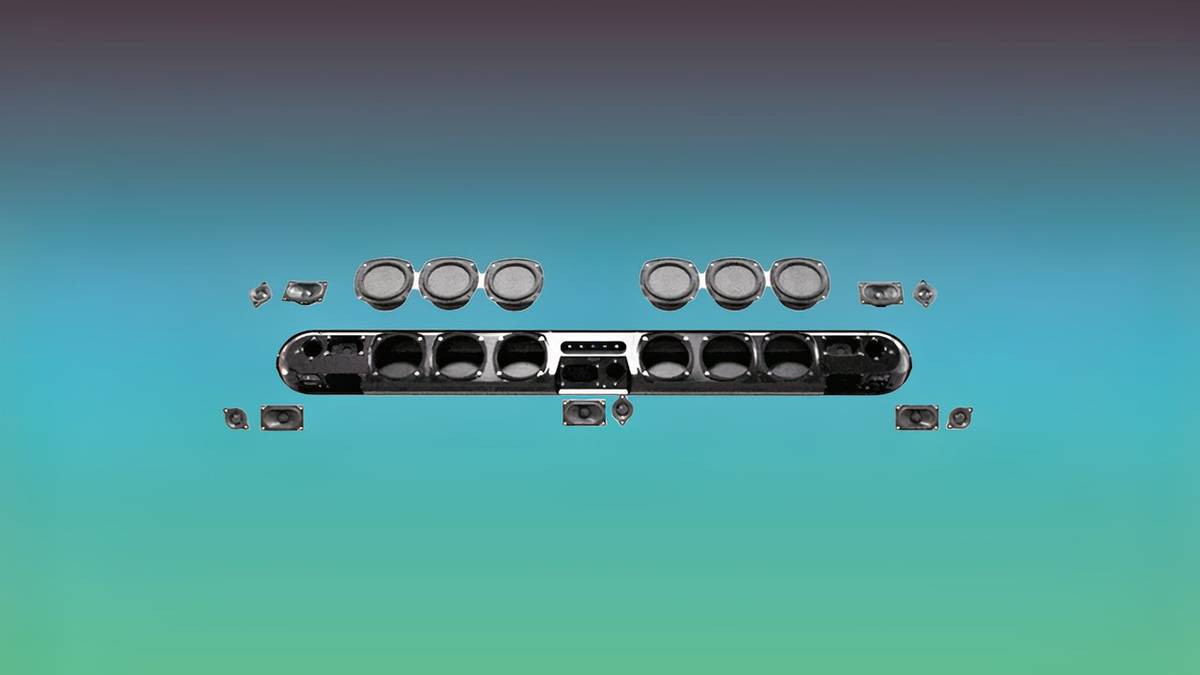
There are a lot of great, entry-level and mid-range options on the market when it comes to soundbars. For entry-level, we’re talking in the $300 or less price range. For up to a couple hundred dollars more, you can find some with up-firing drivers for full Dolby Atmos support, and many that support lossless audio transmission with eARC and a single HDMI output to your TV. As good as some may be, most just won’t match the power output, connectivity options, sound quality, and hardware configurations of premium soundbars.
What do you really get when you save up for a premium soundbar? Is that actually worth the money you’re going to spend? While I can’t answer that second question for you, I can answer the first question so that you can decide if a premium soundbar system is going to be worth the money spent for your viewing habits and your budget. So, I have five reasons for you to save up your cash so you can buy that premium soundbar!
True “surround” sound
Hardware-based, real wrap-around sound

Entry-level and mid-range soundbars often employ virtual surround effects to compensate for the lack of hardware that can reproduce real surround sound. This means you aren’t really hearing a film or TV show as the engineers and artists who mastered it intended. Looking at a phrase many of you are already familiar with, Dolby Atmos, the main component of Atmos is what they call “height effects.”
Height effects are achieved by manufacturers placing speakers in your soundbar that face up toward the ceiling to bounce sound off of it and give a sense of something happening above you. A good example of this is Spider-Man: Homecoming’s ferry scene. At the end of the scene, Tony Stark flies in on a helicopter. When that was mixed in Atmos, the engineer made it so that the sound of that helicopter is sent to the rear surround speakers and to the speakers in the soundbar that are pointed up at your ceiling, the “up-firing speakers.” This gives a realistic sense of the helicopter flying into the shot from behind and above you, moving through the shot until it is landing in front of you. As good as any virtualization may be, it’s only a good enough representation when compared to actual hardware doing the work.
“You can’t please everyone”
With a premium soundbar, you actually can

In your home, the gamers, audiophiles, and cinephiles alike will all benefit from a premium soundbar. John Rambo passed through a small town and darn near burned it down, but your soundbar’s pass-through has the power to light your “town” up with joy! While less expensive soundbars may have more than one HDMI input/output, premium bars with eARC and HDMI 2.1 often support a more feature-rich version of something called ‘pass-through.” What that means is that you can connect your Xbox, high-end streamers like the Nvidia Shield Pro, and PS5 directly to the soundbar, and it will pass those gaming signals at 4K resolution with 120Hz high-frame-rate support. For those high-end streaming boxes and 4K UHD Blu-ray players, you’ll get lossless Dolby Atmos pass-through support, and the equipment to play it back properly with your premium soundbar system. We’ve written about the other technologies this enables, such as VRR and ALLM, so you can better understand why those features may be important to you.
What if you have younglings in the home who are more music-focused? You can please them with a premium soundbar, since many support hi-res music streaming via Spotify or Tidal Connect — I’m sure you’re also concerned about pleasing the kids who aren’t paying the premium for it. I’ve tried this on the Bluesound Pulse Cinema, and it was a wonderful way to get gorgeous sound without needing multiple sound systems in the living room. If you or your gremlins use iOS, you also have AirPlay 2 on many premium soundbar setups. This allows you to wirelessly stream lossless audio to that setup, as long as the music files are stored directly on your iPhone.
Subs that dominate
More money, more explosive, haptic sound

If you want to experience big explosions, creepy low-frequency cinematic sound design, and lossless music with subbass that hits like Mike Tyson, the premium experience often includes a subwoofer that can be used wired or wirelessly. The difference between premium subwoofers and entry-level subwoofers is that a premium subwoofer can move enough air that you will literally feel your space vibrate.
This power isn’t only in the actual wattage but also in the size of the subwoofer that wattage drives and the quality of the magnets used in its construction. You’re looking at 8-12 inch subs, or those with very technical passive radiators that will give you that haptic bass that places you in the middle of space battles, or allows you to be immersed in the silence of a movie like A Quiet Place, where they sprinkle low-frequency sounds throughout to punctuate or foreshadow events in the film.
Room-filling sound
More drivers than a NASCAR race

Ok, maybe not that many, but with a premium soundbar, you’re going to get an embarrassment of riches when it comes to the number of speakers built into the soundbar itself. And that’s before we even get to the rear and side surround and sub speaker count. For example, the Samsung HW-Q990 series has 20 drivers for 11.1.4 channels, but the soundbar itself has 15 internal drivers, including front-firing drivers, side and up-firing drivers, and racetrack woofers and tweeters across the front and sides. The Sonos Arc, a standout soundbar, has 11 internal drivers: three front-firing tweeters, eight elliptical woofers, and up-firing Atmos and side-firing drivers.
Expanding the sound field that you’ll be ensconced in, you can count on rear surrounds and subwoofers to add to the total speaker count and your total enjoyment! Looking again at the Samsung HW-Q990 series, specifically the Q990H, you’ll get rear-channel speakers with built-in up-firing and side-firing drivers, plus a wireless subwoofer.
Sound like this will make you quite a bit more selective about leaving your home to experience the cinema. For me, a film really must be a true cinematic experience to leave the home and pay premium dollars for it. That means a film like The Odyssey, playing on 70mm IMAX. I can’t get that kind of sound or visual scale in my home, even with all of those speakers.
Intelligent sound and expansion
It’s all about integration, AI, and whole-home sound

Premium systems, first and foremost, will use all kinds of AI tricks to make your sound as good as possible. One such trick is room calibration. Under various names, room calibration uses your speakers and, often, the microphone on your smartphone to bounce sound all around your room and calibrate your system so that the distance you’re sitting from each speaker is accounted for by adjusting things like EQ and spatial mapping, which measures and adjusts the volume output and timing in relation to the other speakers in the set, and in relation to any obstructions like furniture, or problematic surfaces that harshly bounce sound around the room.
Other AI enhancements often come in the form of machine-learning algorithms that isolate voices from frenetic background sounds, making even whispered dialogue easily audible without raising the volume, rewinding a moment to listen more actively, or turning on subtitles.
AI may also come in the form of Alexa or Google Assistant integration. Often, that includes the ability to control certain functions of your setup with your voice, as well as to interface with your AI assistant directly through your home theater setup rather than through a dedicated smart speaker.
There are definitely other features to consider when looking at premium soundbar systems. Things like the aesthetic design, the long-term durability of the premium materials used to construct your system of choice, and the statement they make in your space. That said, we’ve covered the most impactful features that will set your premium setup apart from those that are a little easier on the wallet.

- Brand
-
Bluesound
- Connectivity
-
2x dual band WiFi 5, Two-way Bluetooth 5.2 aptX Adaptive, IR sensor, Bluetooth headphone output, RCA/Wireless PULSE SUB+ output
- Integrations
-
AirPlay 2, Spotify Connect, Tidal Connect, Roon Ready, Creston, Control4, RTI, Nice, URC, Lutron, Amazon Alexa Skills
- Ports
-
HDMI eARC, Gigabit ethernet, Toslink Optical, RCA analog, USB Type A
- Audio Format
-
MP3, AAC, WMA, WMA-L, OGG, OPUS, FLAC, MQA, ALAC, WAV, AIFF, MPEG-4 SLS, DSD256
- Power
-
500 watts