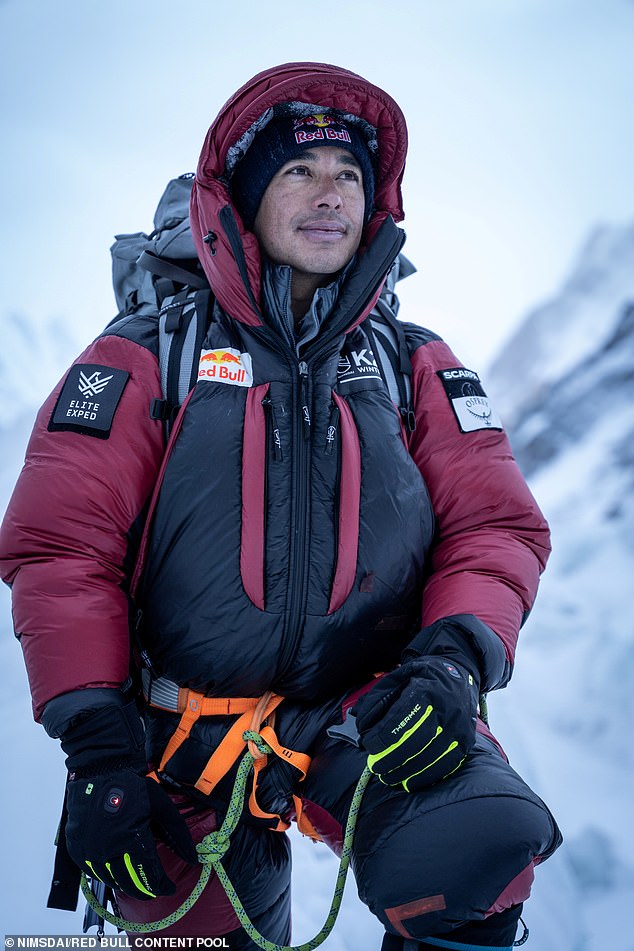
A celebrated Brit mountaineer and former Royal Marine is among ten people missing after an avalanche on one of the world’s tallest mountains.
Nirmal Purja, a mountaineer who served in the British military for 15 years and was the subject of Netflix’s 14 Peaks documentary, went missing after leading an expedition up Pakistan’s Broad Peak.
The snowslide hit the 8,047-metre (26,400 ft) peak in the Karakoram range at around midday on Thursday. Since then, there has been no communication with Purja’s team.
Senior Pakistani government officials said four bodies were located on Friday and rescuers are continuing to search for the other six. The officials did not give details about the identities of those found.
The Alpine Club of Pakistan said that Puja was leading a Pakistani climber, one from China, an American, an Omani and five climbers from Nepal.
The group said: ‘Every possible effort is being made to ensure that helicopter support and all available rescue resources are mobilised at the earliest opportunity, subject to weather and operational conditions.’
Purja, known as Nims, rose to prominence in 2019 when he climbed all 14 of the world’s mountains with peaks above 8,000 metres (26,247ft) in 189 days – smashing the previous record by more than seven years.
The challenge was the focus of a Netflix documentary called 14 Peaks: Nothing Is Impossible.

Nirmal Purja, a mountaineer who served in the British military for 15 years, is among those missing

Lance Corporal Nirmal Purja poses for a picture holding his Member of the Most Excellent Order of the British Empire
Purja powered to the top of the mountains, each with peaks in the so-called ‘death zone’, starting with Annapurna on April 23 2019 and taking in Everest in May and K2 in July.
At the time, he said: ‘It has been a gruelling but humbling six months, and I hope to have proven that anything is possible with some determination, self-belief and positivity.
‘I could not have made it happen without the unending support of my friends and family who have been in my heart this entire time. We started with nothing, but look how far we’ve come.’
Born in a village in western Nepal, Purja joined the Gurkhas – a brigade of Nepalis in British army famous for their fearlessness – in his teens.
The adventurer told AFP in a 2019 interview that even a pair of flip-flops were a luxury for him when he was a child.
Purja served in the British military for 16 years, 10 of which were spent in the special forces, and he was awarded an MBE by the Queen in 2018 for his achievement in extreme high-altitude mountaineering.
He became the first Gurkha to join the elite unit, and worked as a cold-weather warfare specialist.
The cold weather warfare specialist said he was the first Gurkha to climb Everest while serving in the British military.
His tryst with mountaineering began on a trek to an Everest base camp in 2012 when he summited the 6,119-metre (20,075-foot) Lobuche.
He climbed his first ‘8,000er’ in 2014. Two years later, when a period of leave following a deployment to Afghanistan coincided with the climbing season, he made his first ascent of Everest.
‘If you are from Nepal, everyone asks you about Everest. So I then used my breaks for mountaineering,’ he said.

Nirmal Purja pictured in 2019 on the summit of Kangchenjunga

This handout photograph taken and released by Alpine Club of Pakistan on July 31, 2026 shows rescue mountaineers before departing from Skardu Air Base in Pakistan

The group were on an expedition up Pakistan’s Broad Peak (file photo)
Though he has been banned from discussing his work, he claimed to have been involved in all theatres of war Britain was involved in during his time in the military.
Purja said he was once wounded by a sniper who narrowly missed his neck, instead striking the stock of his rifle.
He said he passed on an invitation to join the SAS, instead resigning from the SBS as a Lance Corporal in 2018 to focus on his mountaineering work.
Purja has climbed Mount Everest six times in his career, the latest climb taking place in 2022.
In 2016, he broke mountaineering conventions to rescue a climber left in the ‘Everest death zone’, bringing her to safety alone.
In 2019, he climbed all 14 of the world’s 8,000m plus mountains in just over six months.
In the interview with AFP, Purja had said he hoped his feat would inspire the next generation of Nepali climbers to break his records.
‘As a Nepali, I hope my climbs put a spotlight on the talented climbers here,’ he said.
Nepali guides, usually ethnic Sherpas from the valleys around Everest, are the backbone of the country’s lucrative climbing industry, but often do not get as much credit or accolades as international climbers.
Long relegated to supporting roles, Nepali climbers began gaining recognition in their own right as Purja’s global profile shone a spotlight on their achievements.
Through his foundation, Purja funded education and mountain clean-ups. He also built a porter’s house on the Everest route to provide safe housing for them.
Despite several records under his belt, Purja constantly sought new adventures.
‘There are always (new) boundaries,’ he told AFP, ‘(That’s) human, that’s what we do.’