


Jan Bartek – AncientPages.com – Analysis of the centuries-old remains of two Medici brothers has resolved a long-standing Renaissance mystery.
In 1562, Cardinal Giovanni de Medici, a member of the influential family that led politics and banking in Tuscany during the Renaissance, died of malaria. Twenty-five years later, his older brother, Grand Duke Francesco de Medici, also died from the disease.
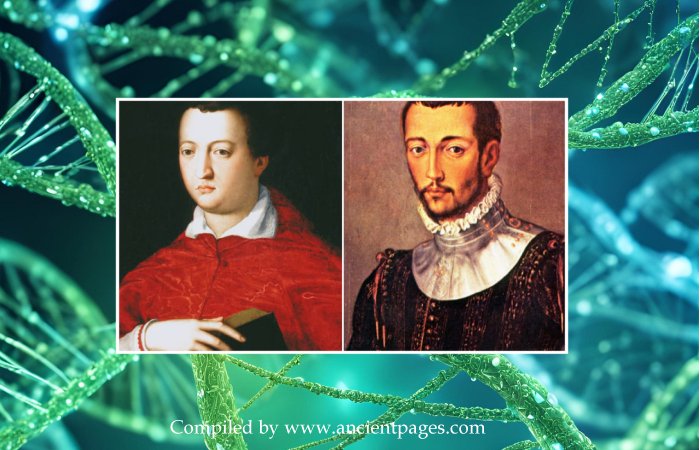
Cardinal Giovanni de Medici (left) and Grand Duke Francesco de Medici (right). Via Wikimedia Commons image compilation AncientPages.com
In a new study, Yale researchers, in collaboration with paleopathologists from the University of Pisa in Italy, conducted a genetic analysis of the brothers’ skeletal remains to detect several Plasmodium species, the parasitic protozoa that cause malaria.
They found a novel strain of Plasmodium falciparum, the species that causes the deadliest form of human malaria, in the bones of Giovanni de Medici. The researchers also discovered molecular traces of P. falciparum and a second species, P. malariae, in the remains of Francesco de Medici.
These findings support ongoing efforts to track the spread and evolution of malaria in Central Italy during the Renaissance and later periods. They also provide insights into the genetic diversity of P. falciparum and the evolution of malaria species.
The results provide scientific evidence that dispels persistent speculation that Francesco de Medici was poisoned, according to the researchers.
“Our study is a great example of how we can use advanced ancient DNA laboratory methods to map the history of this deadly pathogen,” said senior author Serena Tucci, assistant professor of anthropology in the Yale’s Faculty of Arts and Sciences.
Their work not only illuminates historical events, said Adalgisa Caccone, senior research scientist in Yale’s Department of Ecology & Evolutionary Biology and co-author of the study. “It also generated data that can inform current and future research on malaria, which remains a deadly disease affecting millions worldwide,” she said.
Malaria was endemic to Central Italy from antiquity until the 20th century, when eradication campaigns eliminated it from the region. However, the disease remains a significant public health threat elsewhere. In 2024, there were approximately 282 million malaria cases worldwide, resulting in 610,000 deaths, according to the World Health Organization.
For this study, researchers extracted DNA from four rib samples: three from the grand duke and one from the cardinal. The brothers are entombed in the Medici Chapels, mausoleums within the Basilica di San Lorenzo in Florence, Italy, where principal members of the Medici family are buried.
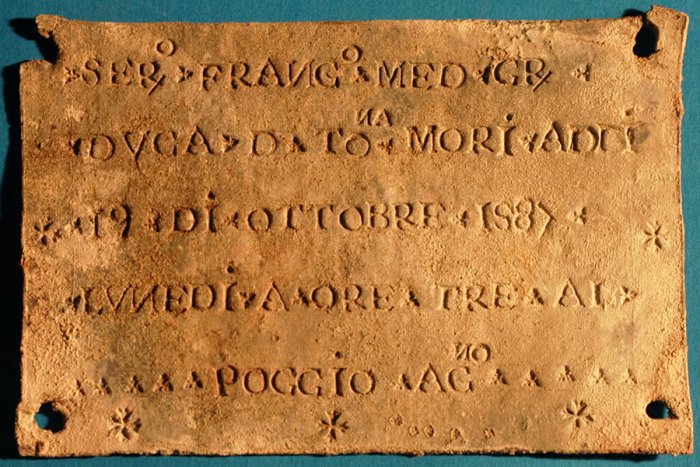
The nameplate from the tomb of Grand Duke Francesco de Medici, who succumbed to malaria in 1587. Courtesy of Valentina Giuffra
The discovery that Francesco de Medici had traces of two malaria species is consistent with earlier analyses of Belgian samples from the same period, which also showed co-occurrences of malaria. However, Ochoa said further genetic sequencing is needed to confirm that both species co-existed in Central Italy during the 16th century.
The P. falciparum strain recovered from Giovanni de Medici contains two unique genetic mutations that likely resulted from demographic expansion as the parasite spread across Europe, according to the study.
“The study of ancient DNA offers us an opportunity not only to diagnose malaria in the remains of individuals from the past, but it also offers us a window for understanding the evolution of malaria species, Plasmodium falciparum in this case, which can help scientists better understand how the pathogen adapts over time,” Ochoa said.
Cardinal Giovanni de Medici contracted malaria with his mother, Eleonora of Toledo, and younger brother, Garzia, during a 1562 trip to the Tuscan coast, where the marshes were known to be a breeding ground for malaria. All three endured recurring fevers that killed them over the course of a month. The cardinal was 19 years old.
In 1587, Francesco de Medici and his wife, Bianca Cappello, visited the Medici family’s villa in Poggio, which was located amid swampy rice fields where mosquitoes thrived. The couple died on consecutive days after suffering intermittent fevers consistent with malaria. Their quick deaths spawned rumors that Francesco’s brother and rival, Cardinal Ferdinando de Medici, had them poisoned with arsenic.
Archival sources, including contemporary reports from court physicians, describe the symptoms the brothers suffered that are consistent with malaria, which was called “febbre terzana” by residents of Central Italy at the time.
The reports also describe the treatments to which the stricken were subjected, including bloodletting, a common practice that likely did patients more harm than good.
Prior immunological analyses conducted by the team at the University of Pisa indicated that both Giovanni and Francesco carried P. falciparum. But, until now, no genetic assessment had been made on their skeletal remains to confirm those findings, the researchers said.
“At the time, both were diagnosed with symptoms, such as intermittent fevers, consistent with malaria,” said study co-author Valentina Giuffra, full professor of history of medicine at the University of Pisa. “This genetic analysis confirms the historical accounts as well as prior research. Now we can say with scientific certainty that malaria, not poisoning, killed Grand Duke Francesco de Medici.”
Other co-authors of the study are Samantha Miller and Patrick Reilly of the Yale Human Evolutionary Genomics Laboratory and Gino Fornaciari, Antonio Fornaciari, and Giulia Riccomi of the Department of Translational Research and New Technologies in Medicine and Surgery of the University of Pisa.
The study was published in the journal iScience
Written by Jan Bartek – AncientPages.com Staff Writer

