


Jan Bartek – AncientPages.com – For decades, scientists have disputed the meaning of the weapons found in the burial chambers of some ancient Egyptian princesses. Were they symbolic or practical tools? Now a reassessment of five royal women’s mummies from the Middle Kingdom has shown that some princesses buried with weapons could use them.
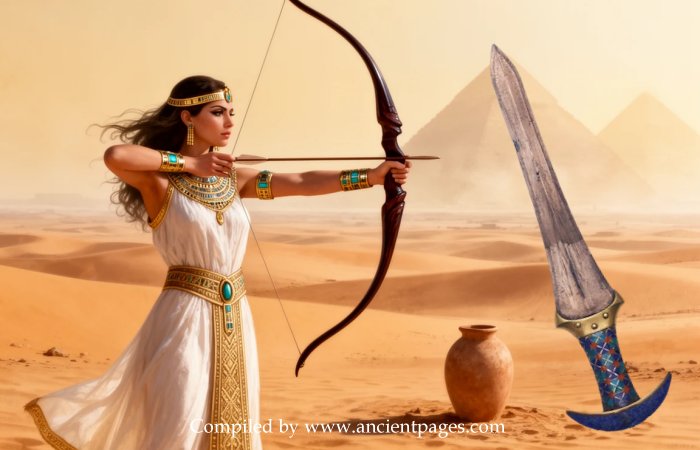
The researchers studied six royal mummies found at Dahshur, a funerary complex of pyramids and shaft tombs, in the 1890s. These mummies had been lost for years and were rediscovered in the Egyptian Museum during a curation project in 2020.
Four of the six were sisters, daughters of the pharaoh Amenemhat II, buried in matching underground chambers: Princess Ita next to Princess Khenmet, and Princess Itaweret alongside an anonymous woman provisionally identified as Princess Sathathormeryt. They were buried with items like bows and arrows which are traditionally associated with men; Princess Ita’s coffin contained a particularly beautiful dagger. Similar regalia was buried with the other two royals evaluated: Princess Noub-Hotep and King Hor.
“Members of the royal family, especially the women, were active participants in skilled, physically demanding activities such as archery and hunting,” said Dr Zeinab Hashesh of Beni-Suef University, lead author of the article in Frontiers in Environmental Archaeology. “This conclusion is supported by the way their bones developed to sustain heavy muscle use, which corresponds directly to the weapons discovered in their tombs.”
Rediscovered Skeletons
Researchers examined six royal mummies discovered at Dahshur, a funerary complex of pyramids and shaft tombs, in the 1890s. After being lost for years, the mummies were rediscovered in the Egyptian Museum during a 2020 curation project.
Four of the six mummies were sisters, daughters of Pharaoh Amenemhat II, and were buried in matching underground chambers: Princess Ita beside Princess Khenmet, and Princess Itaweret with a woman provisionally identified as Princess Sathathormeryt. They were interred with items such as bows and arrows, which are traditionally associated with men. Princess Ita’s coffin also contained an ornate dagger. Similar regalia was found with the other two royals studied, Princess Noub-Hotep and King Hor.
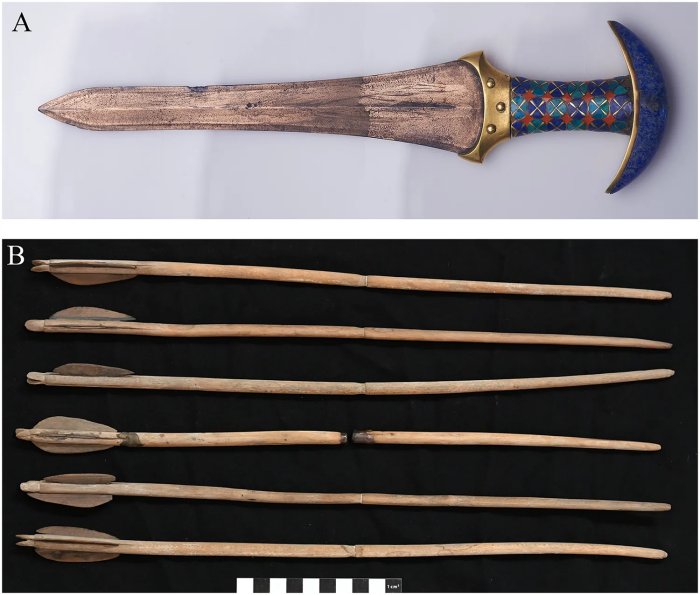
(A) Dagger of Princess Ita, courtesy of the Egyptian Museum; (B) Arrows of Princess Noub Hotep, courtesy of Eman Shawky.
Despite careful mummification, the soft tissue had disintegrated and some bones were not preserved, including the princesses’ skulls, which were lost in the early 1900s. The remaining bones, however, were well preserved, enabling archaeologists to estimate age at death, height, sex, and to identify signs of illness or injury.
“Princess Ita was a young woman aged between 28 and 34 with strong upper-body muscle attachments, suggesting she habitually used weapons like maces or daggers,” said Hashesh. “Princess Khenmet was a woman in her late 30s or 40s who showed signs of thinning bones, but had very robust ligament attachments. Princess Itaweret was a young woman aged between 20 and 34 who survived broken ribs and foot fractures; her skeleton shows she was a skilled archer.”
The robust muscle attachments on the sisters’ bones indicate a high level of physical activity consistent with the weapons found in their burials. Similar findings suggest that Princess Noub-Hotep and King Hor were also archers.
“We found pronounced development in the upper limbs of these individuals, which correlates to repetitive, high-intensity actions like pulling a bowstring or stabilizing a weapon, proving these activities were habitual throughout their lives,” explained Hashesh. “This directly explains the presence of bows, arrows, and maces in the women’s tombs; these were not just symbolic gifts but tools they actively used.”
Injuries such as Princess Itaweret’s broken ribs, likely caused by a blow or a fall from a height, were common. Several individuals also showed signs of infections and nutritional deficiencies. The sisters shared rare spinal abnormalities, indicating close familial relationships among their parents and extended family.
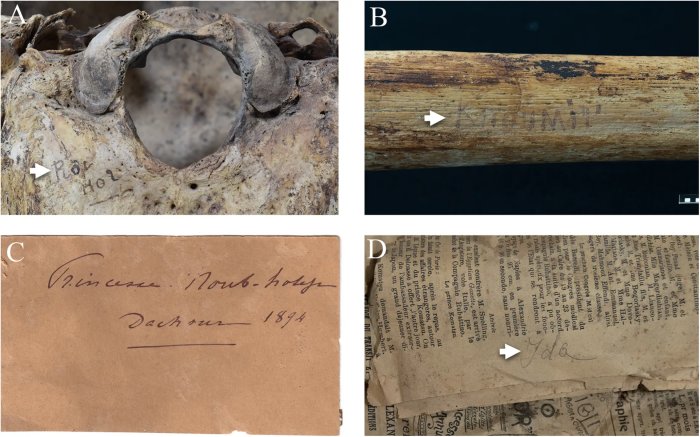
Original nineteenth century handwritten identifications preserved on bones, (A) Roi Hor written in black beside the foramen magnum of king Hor skull, (B) KnOUMiT written on the lateral aspect of Khenmit right tibia. Also, on old labels and wrapping materials, (C) princess: noub hotep / Dachour 1894, (D) Ida written in black on an old newspaper used as wrapping material for Ita remains. Credit: Hashesh Z, Gabr A and Walker R (2026) Front. Environ. Archaeol. 5:1844402. doi: 10.3389/fearc.2026.1844402
“These injuries were most likely caused by accidents, falls, hard blows, or other impacts linked to an active lifestyle, whether through hunting, military training, or other demanding activities,” said Hashesh. “What is remarkable is that the injuries healed well, which suggests they had access to advanced medical care for their time.”
Uncovering Life Stories
However, archaeologists note that the loss of the princesses’ skulls limits their analyses. They have also not yet completed all planned tests, such as stable isotope analysis, which could provide further insight into possible nutritional deficiencies.
“Our goal is to go beyond identifying the Dahshur royals,” said Hashesh. “We aim to reconstruct their life stories, including their families, health, and political roles, in as much detail as possible. In addition to scientific study, we plan to preserve the remains, create 3D prints for education and virtual exhibitions, and display them with their jewelry, weapons, and funerary objects. All of this will be done respectfully, ensuring the remains are presented ethically, as they were originally buried.”
See also: More Archaeology News
“Their objects and jewelry are truly fascinating, breathtaking in their craftsmanship. Yet, while archaeologists have long focused on preserving these treasures, the people themselves were often forgotten. Our study seeks to change that.”
The study was published in the journal Frontiers in Environmental Archaeology
Written by Jan Bartek – AncientPages.com Staff Writer

