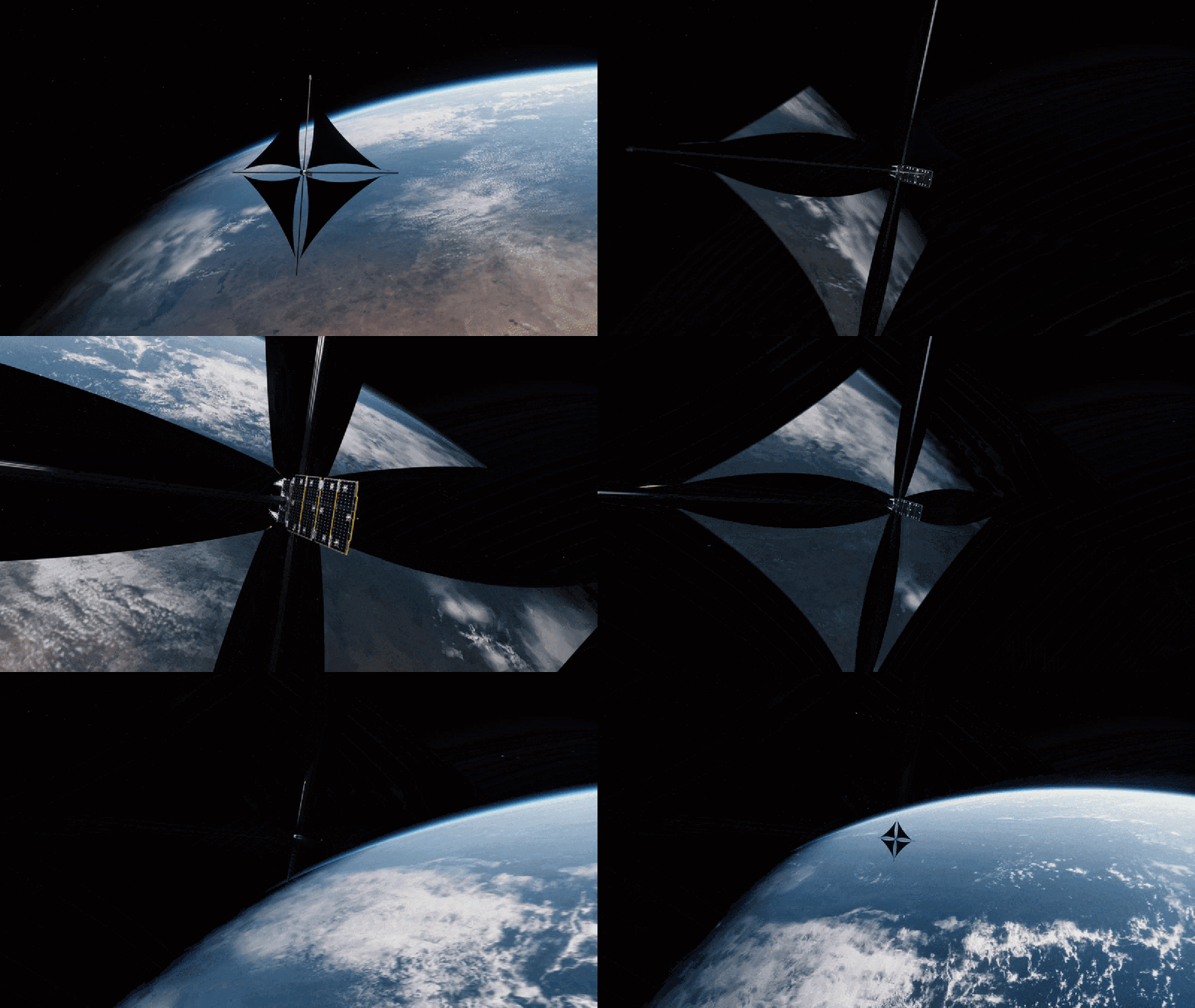
A “space mirror” test satellite meant to beam sunlight and turn night into day on targeted swaths of Earth just received approval to proceed—and astronomers are aghast. The satellite, called Eärendil-1 and built by the California-based startup Reflect Orbital, would be the first of some 50,000 similar spacecraft the company hopes to launch by 2035. Critics say such plans are wholly unacceptable because light pollution from so many large, bright satellites would radically degrade views of the night sky.
Eärendil-1’s formal approval to proceed came last week from the U.S. Federal Communications Commission (FCC). That ruling addressed not only Reflect Orbital’s proposal but also more than 1,800 public comments expressing concerns about the project’s potential impact on the night sky and Earth’s orbital environment. To these objections, the FCC had one response: that’s not our problem.
Reflect Orbital’s sunny proposition is to provide “sunlight on demand” for solar power plants, emergency search and rescue operations, and round-the-clock construction projects. Once launched, Eärendil-1 would deploy an 18-meter-wide steerable mirror to demonstrate that technological feat; anyone or anything in the path of its beam would see the satellite as a glaring dot shining up to four times brighter than a full moon.
On supporting science journalism
If you’re enjoying this article, consider supporting our award-winning journalism by subscribing. By purchasing a subscription you are helping to ensure the future of impactful stories about the discoveries and ideas shaping our world today.
The FCC’s decision “really scares me,” says Samantha Lawler, an associate professor of astronomy at the University of Regina in Saskatchewan, “because it shows what gigantic holes there are in the regulatory framework for outer space and lets Reflect Orbital just sail on through one of those holes. I’m really worried about the future of astronomy.”
Lawler and many other scientists are concerned about Reflect Orbital and Eärendil-1 for a few reasons. Whether for people, wildlife or astronomical observatories, the beam from this single test satellite is far from innocuous. Directly viewing it through a telescope, for example, could permanently damage eyes and sensors alike. And even outside the direct beam, the scattering of its photons through the atmosphere would create a still-bright smudge of light pollution in the surrounding night sky.
The FCC’s accompanying commentary for its decision pointedly notes the approval only applies to Eärendil-1 and that it had to consider “the small risk” of damage to individuals “against the benefits of permitting American companies to test innovative technology in space” via a single experimental satellite.
But 50,000 satellites is a different story. Olivier Hainaut, an astronomer at the European Southern Observatory, recently conducted a study on the potential light pollution from Reflect Orbital’s plans, based on computer simulations of the satellites and their operations in space. The full complement of satellites, he found, could collectively make the global night sky three to four times brighter than it is today, all around the world. Even the planet’s darkest skies could become about as bright as the heavens above a suburban town, he says.
For many animals, this brightening could disrupt circadian rhythms. For naked-eye stargazers, it could vastly limit what can be seen in the night sky. For astronomers, it could make much of their observational work effectively impossible.
“We astronomers are certainly not in favor of forbidding satellites,” Hainaut says. “And I would say that as citizens of planet Earth, it’s really in the interest of everybody to take this into account before it happens, not to slow progress but just not to do anything stupid.”
Hainaut’s study also looked at the broader implications of the rising overall numbers of satellites, with more than 14,500 now active and orbiting our planet. More than 10,000 of those are members of SpaceX’s Starlink megaconstellation for global broadband internet. And the surge is just beginning: proposals now exist for more than 1.7 million additional satellites, including Reflect Orbital’s mirrors and SpaceX’s space-based data centers. These satellite constellations, he says, would dramatically change the night sky and greatly increase risks of spacecraft collision and debris.
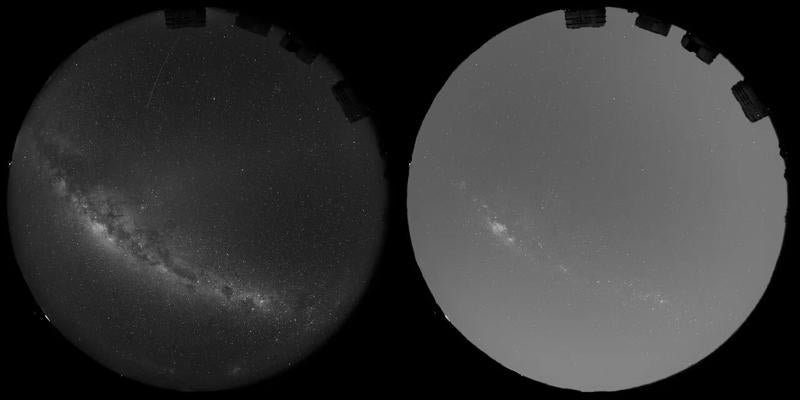
Scattered sunlight from a 50,000-satellite fleet proposed by the company Reflect Orbital could greatly brighten the night sky. A study from the European Southern Observatory offers a current view of a patch of dark sky (left) compared to a predicted far brighter view were all of Reflect Orbital’s planned satellites in operation (right).
European Southern Observatory
Because of its jurisdiction over use of the radiofrequency spectrum in the U.S., the FCC is responsible for the regulation of U.S. commercial satellites, which use that spectrum for communications. This also means, however, that the FCC controls access to U.S. markets for any foreign companies downlinking to U.S.-based ground stations or offering satellite-based services to U.S. customers. And, in coordination with the International Telecommunication Union (ITU), the FCC ensures that anything launching into space won’t interfere with other radio transmissions to and from orbit. Simply put, for commercial satellite regulations, the FCC leads, and the rest of the world follows.
Yet because most opposition to Reflect Orbital’s Eärendil-1 concerns optical problems, the FCC declared in its approval commentary that such issues are “beyond the scope” of its authority.
This leaves astronomers and other worried onlookers wondering: Whose authority is it?
The U.S. is a member of the United Nations’ Outer Space Treaty, which was created in 1967 to regulate and ensure peaceful activity in space. The treaty, among other things, names signing members responsible for the actions of spacecraft launched on their territory and says states must avoid “harmful contamination” of space and celestial bodies. Some astronomers say Reflect Orbital’s light pollution would qualify as such.
Right now, the U.S. has no regulatory body other than the FCC that upholds the Outer Space Treaty before harm is done. And that’s a big problem, Hainaut says, because for astronomers trying to catch rare or singular celestial events, regulatory penalties after the fact of lost observations are an insufficient remedy.
He offers a hypothetical example to illustrate his point. “If we lose 30 percent of our observation time, and I say that’s worth 30 million Euros for my telescope, the satellite operator might give us that 30 million—but that’s useless. The data are lost. We’re not going to replace them,” he says. “So we don’t want to fix the problem; we want to avoid the problem.”
The American Astronomical Society (AAS), which published a petition in March for the FCC to deny Reflect Orbital’s proposal, hopes to bring the issue to Congress, says Roohi Dalal, the organization’s deputy director for public policy. Preexisting Congressional organizations like the Office of Space Commerce or newly created regulatory bodies, she says, could handle the environmental and astronomical oversight of satellites.
Some believe the FCC’s controversial decision could spur corresponding pushback on an international level.
Betty Kioko, a space lawyer who serves as ESO’s representative in the United Nations Committee on the Peaceful Uses of Outer Space (COPUOS), says many COPUOS members are increasingly concerned about the national regulation of satellite companies and the degree to which these companies should be responsible for publicly sharing specific information and data about their launches.
“I think we’re going to see a more concerted effort at an international level to try and address these challenges because there’s going to be a bigger recognition on the impact of decisions of a single state on the international community,” Kioko says.
This May the national science academies of the G7 countries released a statement recommending the creation of a governing body similar to the ITU but with a broader focus on regulating “traffic management, orbital carrying capacity, environmental and astronomical impact.” The statement also calls for a new international treaty explicitly dealing with the positive and negative effects of satellite constellations.
As for Reflect Orbital, the company’s Eärendil-1 has for now sidestepped the concerns of its critics and could launch later this year. In a statement to Scientific American, a company spokesperson says that Reflect Orbital will provide data from the test mission to outside parties and is developing a coordination agreement with the U.S. National Science Foundation to reduce the impact of its satellites upon astronomical activity.
“At Reflect Orbital, we recognize that responsible deployment at scale requires clear rules. We welcome oversight and want to play an active role in shaping it,” the spokesperson says. “We believe it is our responsibility to work alongside governments, scientists and regulators rather than ahead of them.”
For the vast numbers of other satellites awaiting approval, Dalal says that the AAS and its members are urging the FCC not to exclude astronomers from the regulatory process.
“In their order and authorization, the FCC talked about the public interest of fostering American technological innovation in space,” Dalal says. “I would just emphasize that scientific research and astronomical research has actually been at the forefront of American innovation and global leadership for decades. That innovation that they’re looking to foster can’t come at the cost of imperiling scientific research.”