Henry Nowak’s killer confessed to repeatedly stabbing the teenager in a recorded conversation with his brother in the back of a police van.
Vickrum Digwa, 23, admitted to his brother, Gurpreet, that he had used a kirpan – a Sikh ceremonial knife – to stab his 18-year-old victim in the face and chest.
The pair were speaking in Punjabi during the exchange, which took place within 36 hours of the murder when they were being driven between a police station and a court for a custody extension hearing on December 5 last year.
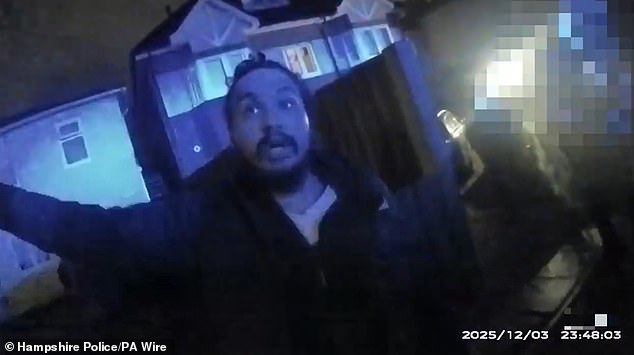
Digwa did not know his teenage victim but lied to his family and officers at the scene by claiming Mr Nowak had shouted racist abuse, punched him and knocked off his turban.
Mr Nowak was then arrested as he lay covered in his own blood, before dying ‘alone, humiliated and handcuffed’.
The conversation with his brother was the first time Digwa had told the truth about what happened.
A transcript of the exchange, translated from Punjabi into English and released by the Crown Prosecution Service to the BBC, reveals the killer describing the nature of the attack and calling himself ‘a fool’.
Gurpreet Digwa, 27, did not witness his brother stabbing Mr Nowak, but arrived at the scene shortly afterwards

Police bodycam footage showed Vickrum Digwa as he lied to police at the scene, insisting he was the victim

Digwa, 23, was found guilty of murdering Henry Nowak with an eight-inch ceremonial blade

Henry Nowak was a finance student at the University of Southampton and was described by his family as ‘kind and talented’

Police bodycam footage shows the innocent 18-year-old being handcuffed as he lay dying
When Gurpreet asked Digwa, ‘What did you do? Did you even do anything?’, the transcript describes how he pointed to his shoulder and said: ‘One here, towards the face and one on the chest.’
Gurpreet told him: ‘You should not have done it.’ Digwa responded by saying it was his fault, or mistake.
Several times during the conversation, Gurpreet told his brother that he should have ‘just pushed’ Mr Nowak or ‘hit him or beaten him up’.
‘Why did you use the kirpan?’ he asked.
Digwa responded: ‘I am a fool.’
The use of the word ‘kirpan’ to describe the eight-inch murder weapon is disputed by many Sikhs, who insist a kirpan is a smaller ceremonial blade that is usually curved.
Gurpreet told his brother to claim he had been acting in ‘self-defence’, despite the killer having already admitted three times to having stabbed Mr Nowak.
He questioned why he had not run away from the scene and urged him to pray.
At the time of the exchange, the pair’s mother, Kiran Kaur, and father, Moga Singh, were also in police custody.
The transcript revealed the brothers discussing how their parents might cope if Digwa was convicted.
Digwa said: ‘Mum was making a lot of noise. It was my fault.’
Kiran Kaur was convicted of assisting an offender by removing the murder weapon from the scene at Digwa’s request. She will be sentenced later this month.
Neither Gurpreet nor his father faced charges relating to the murder – even though evidence at the trial suggested he may have committed perjury, assisted an offender and obstructed police.
The trio have pleaded not guilty to possessing weapons, including machetes, knuckledusters, flick-knives and a manriki-gusari, a traditional Japanese weapon that includes a weighted metal chain.

Digwa did not know his teenage victim but lied to his family and officers at the scene by claiming Mr Nowak had shouted racist abuse, punched him and knocked off his turban

Digwa’s brother Gurpreet covering his face during a hearing at Southampton Magistrates’ Court

The pair’s father, Moga Singh, also tried to cover his face when arriving at the hearing earlier this month
While in the police van, the brothers also talked about their solicitors, with Gurpreet warning Digwa to ‘listen to them’ and not to ‘show off or try to act all hard’.
‘No I will not,’ Digwa agreed.
The conversation ended with the brothers trying to tally their accounts of what had happened and criticising each other over things they believed the other ‘should not have said’ to police.
Bodycam footage, which sparked riots in Southampton, showed officers initially ignoring Mr Nowak when he said he had been stabbed, with a male officer telling him ‘I don’t think you have, mate’.
Andrew Mortimore, who lives on the street where the stabbing took place on December 3, 2025, told Digwa’s trial how Mr Nowak had repeatedly said ‘I’m not a racist’.
He told the court: ‘During the time I was observing these people outside the block of flats, I think I heard a male voice say, “I’m not racist.” I couldn’t hear anything else that was being said. These are the only actual words I think I heard.’
Nicholas Lobbenberg KC, prosecuting, told the jury: ‘Even as Henry is dying [he said] I’m not a racist… That was heard by Andrew Mortimore, one of the witnesses that was read to you, and as he lay dying, Henry denied that he was the attacker.’
The two police officers who dealt with Mr Nowak are now under investigation for potential gross misconduct.
The Independent Office for Police Conduct (IOPC) said the probe relates to potential failures by the officers to realise that the teenager needed urgent medical attention, to take action when he said he had been stabbed and could not breathe, and the decision to arrest and handcuff him instead of providing first aid.
One officer is also under investigation for potentially breaching conduct standards by dismissing Mr Nowak’s claim he had been stabbed.
The watchdog will also look at whether race or religion played a part in the officers’ decisions.
The Daily Mail had previously been told the IOPC was sticking to its decision not to probe the officers’ conduct, instead treating them as witnesses.
Digwa was sentenced to life with a minimum of 21 years in prison for murder, but is seeking to appeal both his conviction and sentence.
The killer has now made an application to the Court of Appeal in the hopes of reducing his jail term – despite Solicitor General Ellie Reeves KC applying for his jail term to be reconsidered under the Unduly Lenient Sentence scheme.
The Court of Appeal confirmed Digwa’s case had previously been referred to them as ‘unduly lenient’. A judge is now set to decide whether Digwa should be given the opportunity to appeal.