President Donald Trump’s nominee for Director of National Intelligence took blame for insufficient redactions of material released about Jeffrey Epstein’s victims in a congressional hearing on Wednesday.
Jay Clayton admitted that the buck ultimately stopped with him when a batch of files was released in January, which was chalked up to a ‘technical review error.’
The released information included addresses and even nude photos of potential Epstein victims in the release, and victims’ lawyers said this re‑traumatized survivors and ‘turned their lives upside down.’
Clayton currently holds the role of the US Attorney for the Southern District of New York, and part of the Epstein case was investigated in his jurisdiction.
As the US Attorney for the Southern District of New York, Clayton was tasked to personally certify that unsealed grand jury material did not disclose victims’ personal information.
The judge added this requirement so that a clearly identifiable DOJ official would ‘take ownership’ of reviewing sensitive discovery.
Senator Martin Heinrich of New Mexico invoked Harry Truman’s saying, ‘The buck stops here’ and asked where the buck stops in this case, to which Clayton answered, ‘for the Southern District documents, it was me.’
Clayton finally took his seat before the Senate Intelligence Committee on Wednesday, roughly a month after President Trump torpedoed his own nominee’s confirmation hearing in a pre-dawn Truth Social post that threw Capitol Hill into chaos.

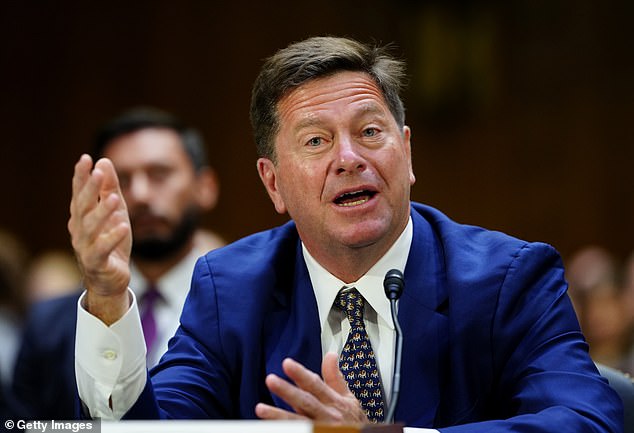
Jay Clayton appears before the Senate Intelligence Committee during his confirmation hearing on Capitol Hill July 15, 2026 in Washington, DC. Currently serving as US Attorney for the Southern District of New York

Jeffrey Epstein as seen in an Epstein documentary on his crimes: The Full Story on Jeffrey Epstein Revealed
The irony: Clayton had been sailing toward an easy, bipartisan confirmation, with senators in both parties eager to replace acting spy chief Bill Pulte, who has no intelligence background. Then Trump pulled the plug himself.
In June, the president abruptly canceled the hearing and vowed to keep Pulte in place, refusing to let the nomination advance until a string of separate demands were met, among them the confirmation of Jamie McDonald as US Attorney and passage of the SAVE America Act, his voter-ID bill.
‘We are canceling the Senate Hearing RE: DNI today, and will not be going forward until Jamie McDonald is approved to be U.S. Attorney,’ Trump wrote at the time. ‘In the meantime, Bill Pulte will remain as the Acting Director of National Intelligence.’
The stunt drew a pointed rebuke from the committee’s ranking member, Mark Warner, who used his opening statement to needle the president. Warner said he could not recall another nominee senators had agreed, on a bipartisan basis, to ‘move heaven and earth’ to confirm quickly, only for the president to yank the hearing and, in the process, blow up the critical FISA authorization. ‘I know you had nothing to do with that,’ Warner told Clayton. ‘So I guess congratulations about getting finally in front of this committee.’
The urgency is real. Section 702 of the Foreign Intelligence Surveillance Act, a key spy power, has been expired for over a month since it lapsed in the middle of June, and lawmakers in both parties want a confirmed, credentialed DNI in place.

Democrat Mark Warner of Virginia and Tom Cotton, an Arkansas Republican, attend the nomination hearing for Jay Clayton before the Senate Intelligence Committee on Capitol Hill July 15, 2026 in Washington, DC

Clayton’s chief vulnerability is that he has never held a formal national security role. Committee chairman Tom Cotton moved to inoculate him, casting Clayton’s day job as US Attorney for the Southern District of New York as perhaps ‘the number one national security-related U.S. Attorney’s office in the country.’
That office prosecuted the case against captured Venezuelan leader Nicolás Maduro. Clayton also chaired the SEC from 2017 through the Covid pandemic, a stretch Senator Mike Rounds of South Dakota called ‘a period of significant uncertainty for financial markets.’
‘National security and economic security are synonymous,’ Clayton told the committee. Rounds added that Clayton already has a working relationship with CIA Director John Ratcliffe to build on.
Clayton was Trump’s second choice.
His first pick, Federal Housing Finance Agency head Bill Pulte, drew swift blowback over his lack of intelligence experience.
The vacancy opened when Tulsi Gabbard resigned to support her husband, Abraham, through cancer treatment.
Asked Wednesday whether he had been told why his hearing was delayed, Clayton declined to reveal the internal discussions.