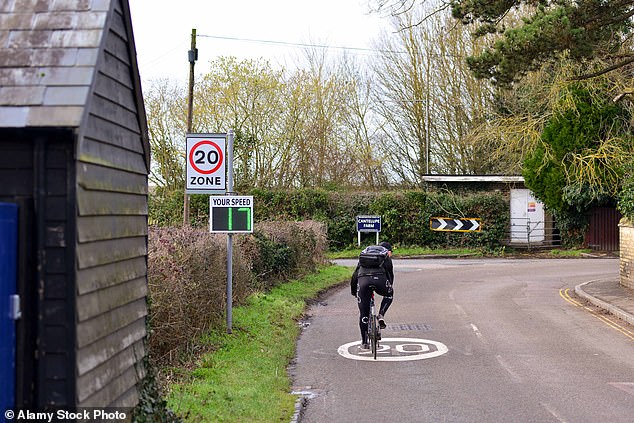
Speed limits on rural roads in towns and villages across England should be cut to 20mph, according to government guidance.
The guidance says that councils should also consider narrowing roads and use more bollards in a bid to protect cyclists and suggests removing the centre line separating the two lanes of traffic in another measure to lower speeds.
Most country lanes are currently derestricted and are subject to the national speed limit of 60mph, however, this new guidance would see it potentially reduced to 20mph.
Councils will not be legally compelled to follow the guidance, but the 253-page document claims that it promotes ‘best practice’.
The measures are outlined in a new Rural Design Guide by Active Travel England, an independent Department for Transport agency responsible for promoting walking and cycling.
More than a sixth of British roads now have a 20mph speed limit – 39,000 miles of the nation’s 246,500-mile road network, according to the transport consultancy Insight Warehouse.
In Wales, the Labour government cut the default speed on most residential and built-up roads in 2023 from 30mph to 20mph.
More than half of London’s roads have a 20mph limit, according to Transport for London, which is chaired by Labour mayor Sir Sadiq Khan.

Speed limits on rural roads in towns and villages across England should be cut to 20mph, according to government guidance

The guidance said that ‘traffic speed should be no more than around 20mph’ in rural settlements and villages or where people ‘walking, wheeling and cycling share space on country lanes with motor traffic’
And while in rural areas, the rollout has been more limited, Surrey and Oxfordshire have seen some of their country roads reduced from 60mph to 20mph.
The government document said that 17 per cent of England’s population, around 10 million people, live in an area defined as rural, with almost two-thirds of road deaths in 2024 happening on rural roads in Great Britain
The guidance said that ‘traffic speed should be no more than around 20mph’ in rural settlements and villages or where people ‘walking, wheeling and cycling share space on country lanes with motor traffic’.
While it noted local authorities are ‘best placed’ to decide where limits would work, the guidance stated that a ‘whole-settlement 20mph limit’ may prove cheaper and cause less confusion.
It added that local authorities would be able to reduce traffic on these roads as it would make it ‘less attractive’ for drivers to use.
Other ways councils can deter motorists, the guidance claims, is by removing ‘centre lines’ on carriageways, narrowing roads by creating a footway and putting a textured strip in the middle of the road or using islands or bollards.
Limits are also suggested for routes that make up the ‘active travel network’, routes designed around walking and cycling.
Last month, the government announced that £4.5 billion would be invested into active travel initiatives in a bid to make 55 per cent of all short journeys walked or cycled by 2035.
Richard Holden, the shadow transport secretary, told The Times: ‘Labour are shamefully sneaking 20mph speed limits on thousands of miles of rural roads through the back door under the guise of ‘active travel guidance’.
‘These limits were a disaster when Labour imposed them in Wales and are already being widely reversed because they hit rural communities hardest, where pedestrians, cyclists and motorists already share many roads.’
Lilian Greenwood, the local transport minister, said: ‘By giving local authorities straightforward advice to deliver walking and cycling routes which are practical, safe and accessible, we are not just connecting the residents of hamlets, villages and towns with more opportunities but encouraging healthier options too.’

More than a sixth of British roads now have a 20mph speed limit – 39,000 miles of the nation’s 246,500-mile road network, according to the transport consultancy Insight Warehouse
Join the discussion
Will a universal 20mph speed limit make our roads safer or simply punish drivers unfairly?
While there is evidence that 20mph limits reduce drivers’ average speed, motorists complain that they are often introduced on roads where they are not needed.
Transport consultancy Insight Warehouse found that 939,519 drivers in England, Wales and Scotland last year were given an SP30 endorsement – the code for breaking the speed limit. This excludes motorways, which have a separate offence code.
By contrast, 216,141 drivers were caught speeding on the motorway in 2025 – six per cent down on the previous year. This suggests more drivers are being caught on low-speed roads such as 20mph zones.
It may also account for the number of drivers attending speed-awareness courses soaring to a record 1.8million last year. They can opt to take the course in place of penalty points and a £100 fine.
Last year it emerged that police forces issued 488,599 tickets to drivers caught speeding on a 20mph road in the year to 2024 – an increase of two-thirds in a year.
The Department for Transport said three-quarters of drivers exceed the limit on ‘free-flowing’ sections of 20mph roads – those with no cameras, sharp bends, junctions or traffic-calming.
The average speed was 24mph, enough to trigger a speed camera.